Feria de Abril: What Every First-Timer Gets Wrong About Seville’s Greatest Festival
In This Guide
- What the Feria Actually Is
- Misconception 1: It’s Open to Everyone
- Misconception 2: The Dresses Are Just Costumes
- Misconception 3: It’s About Flamenco Dancing
- Misconception 4: You Can Only Go in the Evening
- Misconception 5: The Food Is Just Tapas
- The Language of the Feria
- Practical Information
- ✅ Interactive. Feria de Abril Preparation Checklist
- Conclusion
The Feria de Abril (FEH-ree-ah day ah-BREEL) in Seville is one of the most extraordinary events in Spain. It’s also one of the most misunderstood. First-time visitors often arrive with certain ideas about what it is, who it’s for, and how to experience it, and most of those ideas miss the mark significantly.
This guide is about correcting those misconceptions so you can actually experience the Feria rather than just observe it from the outside. Because being on the outside of the Feria is a very different thing from being inside it, and the difference is everything.
What the Feria Actually Is
The Feria de Abril began in 1847 as a livestock fair. By the late 19th century, the fair had transformed into the social and cultural celebration it is today. The event takes place on a purpose-built fairground called the Real de la Feria in the Los Remedios neighbourhood. It covers approximately 400, 000 square metres. More than a thousand individual casetas (kah-SEH-tahs, private tents or booths) are erected, each belonging to a family, association, company, or political party. The fairground operates for seven days, generally two weeks after Semana Santa.
Misconception 1: It’s Open to Everyone
This is the biggest and most important thing to understand. Most of the Feria is private. The casetas belong to specific groups. You can only enter a caseta if you know someone who belongs to it and they invite you in.
There are public casetas, the Seville city council operates some, as do certain political parties and trade unions. These are marked with a sign indicating they’re open to the public. But these are a minority. The heart of the Feria, the beautiful, elaborately decorated private ones, requires an invitation.
How do you get invited? You either know people, or you find ways to meet them. If you’re staying in Seville during Feria week, your accommodation host may have connections. Learning some Spanish before you go significantly increases your chances of making the kinds of connections that lead to invitations.
Misconception 2: The Flamenco Dresses Are Just Costumes
Visitors often see the women in trajes de flamenca (TRA-hes day flah-MEN-kah) and assume they’re wearing a costume for tourists. This couldn’t be further from the truth.
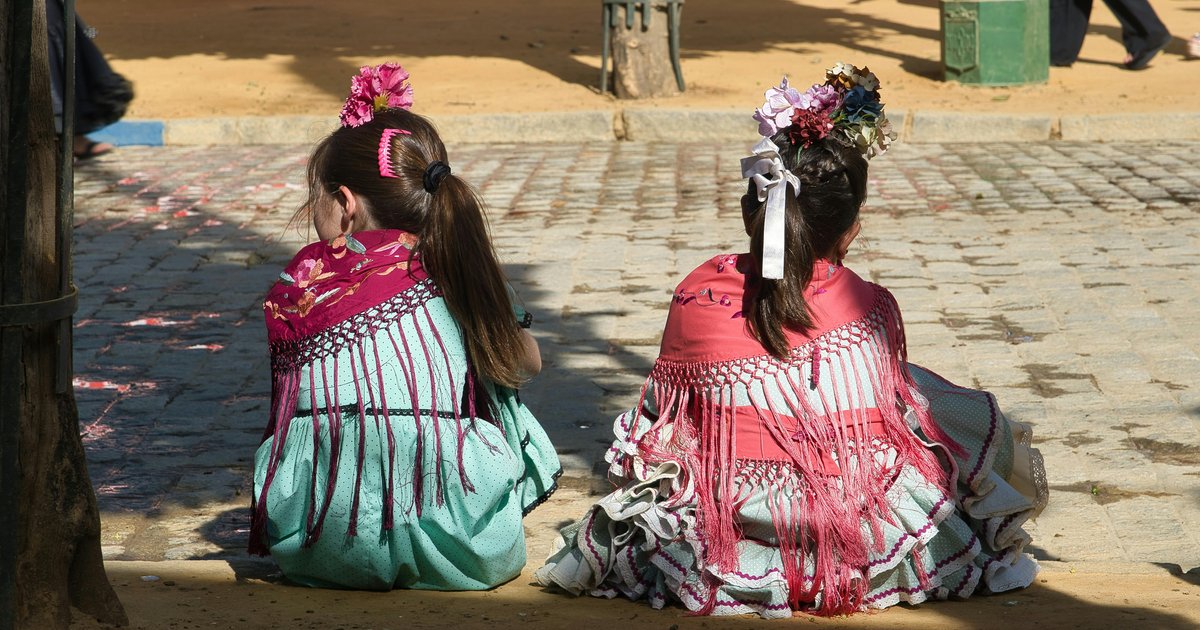
The traje de flamenca is formal dress for Seville’s Feria in the same way that formal evening wear is dress code for a black-tie event. Women plan their outfits months in advance. The dresses are made to measure by specialist tailors. They cost anywhere from €300 to several thousand euros. Accessories, the complementos (com-pleh-MEN-tos) including flowers, shawl, and shoes, are coordinated with care. The dress communicates social identity and cultural belonging. It is not a costume. It is an expression of Andalucían identity worn with serious pride.
Misconception 3: It’s About Flamenco Dancing
The dance of the Feria de Abril is not flamenco. It’s sevillanas (seh-vee-YAH-nahs). These are related but distinct art forms. Flamenco is serious, complex professional performance art. Sevillanas is a folk dance that virtually everyone in Seville learns as a child, social, joyful, participatory.
Want to go deeper? Audaz Revista Issue 1 covers topics like this with original cultural features and language insights you will not find in a textbook. Explore Issue 1
Every caseta has a small dance floor. Couples and groups dance sevillanas throughout the day and evening. It consists of four distinct sections (coplas), each with specific movements and footwork. If you want to join in, a few lessons before you go are genuinely worthwhile.
For building the Spanish vocabulary to actually communicate during the Feria, our guide to 50 Essential Spanish Expressions Native Speakers Use Daily covers the conversational phrases that make social situations flow naturally.
Misconception 4: You Can Only Go in the Evening
The Feria has two very different personalities depending on the time of day.
The daytime Feria (roughly noon to 8pm) is dominated by the horse parade, the paseo de caballos (pah-SAY-oh day kah-BAH-yos). Riders in traditional traje corto and women riding side-saddle in full flamenco dress parade along the main avenue. Carriages drawn by horses pull families and groups between casetas. The horse culture of Andalucía is genuinely beautiful and the daytime is when it’s most visible.
The evening Feria (8pm onwards, real energy from 10pm) is when the dancing intensifies and the atmosphere becomes electric. The fairground is lit by thousands of lanterns. The dancing runs until dawn. If you can only go once, go in the evening. If you have two chances, do both.
Misconception 5: The Food Is Just Tapas
The food at the Feria is specific and traditional. The official drink is manzanilla (man-thah-NEE-yah), a dry, saline sherry from Sanlúcar de Barrameda, served ice cold in small copitas (koh-PEE-tahs). Drinking manzanilla is an act of cultural participation.
Food staples include gambas al ajillo (GAM-bahs al ah-HEE-yoh, prawns in garlic), jamón ibérico (hah-MON ee-BEH-ree-koh, cured Iberian ham), espinacas con garbanzos (spinach with chickpeas), and torrijas (toh-REE-hahs, a fried bread soaked in milk and honey). These are the flavours of the Feria. Eat as many of them as you can.
The Language of the Feria
- ¿Bailes sevillanas? (BAH-ee-les seh-vee-YAH-nahs), “Do you dance sevillanas?”, the question that starts many conversations
- ¡Olé! (oh-LAY), used as an exclamation of appreciation for good dancing, beautiful dresses, anything worthy of admiration
- ¡Qué guapa/guapo! (kay GWAH-pah/GWAH-poh), “How beautiful!”, said to someone in a particularly striking outfit
- Una copita de manzanilla, por favor (OO-nah koh-PEE-tah day man-thah-NEE-yah), your most important sentence at the Feria
Our guide to 7 Spanish Words Your Textbook Never Taught You covers the kind of authentic vocabulary that makes conversations at events like the Feria feel natural rather than rehearsed.
Practical Information
The Feria takes place in late April or early May, two weeks after Semana Santa. The fairground is a 20-minute walk from Seville’s historic centre, or a short taxi ride. Entry to the fairground itself is free. Budget approximately €50–80 per evening for food and drink in public casetas.
The week traditionally begins with the alumbrado (ah-loom-BRAH-doh), the lighting of the fairground at midnight on Monday. The entire fairground illuminates simultaneously. It’s one of the great visual spectacles of Spanish cultural life. If you can only be there for one moment, be there for the alumbrado.
✅ Feria de Abril Preparation Checklist
Tick everything off before you go. The more boxes you check, the better your Feria experience will be.
🌸 Feria de Abril Preparation Checklist
Audaz Revista
Take Your Spanish Further
Audaz Revista Issue 1 is out now, a full-length bilingual magazine for serious Spanish learners. Latin American culture, grammar deep-dives, and language insights written by educators.
Conclusion
The Feria de Abril rewards preparation and punishes passivity. You can wander the fairground as an observer, watch the beautiful people in their beautiful clothes, and feel pleasantly bewildered. Or you can arrive with some sevillanas in your body, some Spanish on your tongue, and an openness to being pulled onto a dance floor by a generous Sevillano.
The second experience is entirely different from the first. The Feria is not a spectacle to watch from the outside. It’s a living tradition to participate in. The more Spanish you bring to it, the more it gives you back.
Go with an open heart. Learn the words. Try the manzanilla. Dance badly at first. This is where the magic happens. ¡Olé! 💃
Share
Topics

audazrevista
You may also like

Get the Inside Scoop