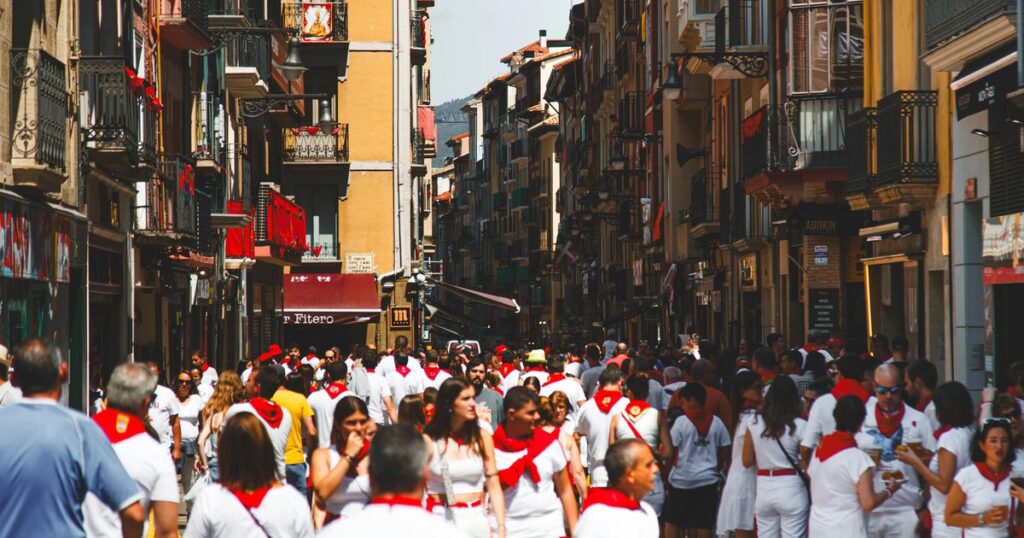
Imagine standing in a narrow Spanish street. The morning sun is already warm on your skin. Around you are thousands of people from every corner of the world. Then the cannon fires. Within seconds, the air turns red.
This is La Tomatina (lah toh-mah-TEE-nah), Spain’s most joyfully chaotic festival, held every year in the small town of Buñol (BOON-yol), about 40 kilometres west of Valencia. And yes, it is exactly as messy as it sounds.
But La Tomatina is more than a food fight. It is a piece of living history, a community celebration, and a total sensory experience you will be talking about for years. This guide covers everything you need to know, from how to get there and what to wear, to the Spanish phrases that will make your experience richer.
La Tomatina is not a tourist spectacle built for cameras. It is a real community tradition that has been running since 1945.
How La Tomatina Started
The origin of La Tomatina is the kind of story that feels almost too good to be true.
In August 1945, a group of young men were watching a procession of los gigantes (lohs hee-GAN-tays), the towering carnival figures that are a staple of Spanish fiestas. One participant accidentally fell. The nearby crowd, mostly teenagers, got rowdy. A vegetable stall was knocked over. Somehow, a spontaneous tomato fight broke out in the streets of Buñol.
The local authorities tried to ban it. They failed. Year after year, the young people of Buñol returned with tomatoes. By 1957, the festival was so beloved that the town held a mock funeral for the ban, complete with a coffin and a marching band. La Tomatina became an official festival in 1980, and the Spanish government declared it a Festival of International Tourist Interest in 2002.
✦ By the Numbers
Roughly 22,000 participants take part each year, with visitors coming from over 50 countries. What started as an accidental street brawl is now one of the most recognised festivals in the world. (Source: Valencia Tourism Board, 2024)
What Actually Happens on the Day
La Tomatina is always held on the last Wednesday of August. The tomato fight lasts exactly one hour. But the day begins long before that.
The Ham-Climbing Contest (Morning)
The festivities begin with a local tradition: climbing a greased pole, known as el palo jabonoso (el PAH-loh hah-boh-NOH-soh), to reach a ham hanging at the top. Only when someone successfully grabs the ham does the cannon fire and the tomato fight begin.
It sounds straightforward. It is not. The pole is coated in oil and soap, and watching competitors slide back down repeatedly is genuinely entertaining. The whole town gathers around it.
The Tomato Fight (11 am)
When the first cannon fires, trucks loaded with overripe tomatoes roll slowly through the crowd. People climb on, grab tomatoes by the handful, and throw them at everyone in sight — strangers and friends alike.
- Roughly 120,000 kilograms of tomatoes are used each year
- Tomatoes are slightly crushed before the fight to reduce impact
- The fight ends exactly one hour later when a second cannon fires
- Clean-up trucks and fire hoses appear almost immediately after
How to Get to Buñol
Buñol is a town of about 10,000 residents. During La Tomatina week, that number increases dramatically. Planning your travel ahead is essential.
By train from Valencia: Regular Renfe (REHN-feh) trains run from Estación del Norte. The journey takes about 45 minutes. On La Tomatina day, additional services are added, but they fill up quickly. Buy tickets the day before.
By bus: Private operators run shuttle buses from Valencia’s city centre and from various European cities. These often include festival entry.
By car: Driving to Buñol on festival day is not recommended. Roads close and parking is extremely limited. Leave the car in Valencia and take the train.
Guided tours: Many Valencia-based operators offer all-inclusive packages with transport, festival entry, and a post-fight meal. For first-timers, these simplify logistics considerably.
What to Wear and What to Leave Behind
This is possibly the most important section of this guide. Getting your preparation wrong here can ruin the experience.
✔ Wear
- Old clothes you don’t mind discarding
- Closed-toe shoes, firmly secured
- Swimming goggles
- Contact lenses (if you wear glasses)
✘ Leave Behind
- Phone, wallet, valuables
- Jewellery of any kind
- Anything you are attached to
- Glass containers
After the fight, locals open their garden hoses to help participants wash off, and the Buñol River runs through the town for a more thorough rinse. Many hostels and guesthouses near the route also offer shower access as a paid service.
The Official Rules of La Tomatina
La Tomatina is more organised than it appears. Official rules exist, and they are enforced.
- No glass containers. All drinks must be in plastic or soft packaging.
- Crush tomatoes before throwing. Whole tomatoes can cause injury. Squash them first.
- No tearing clothes. Do not grab or rip other participants’ clothing.
- Stop when the cannon fires. The second cannon signals the end. This is taken seriously.
- Keep a safe distance from the trucks. Let them pass without blocking their path.
Since 2013, tickets have been required and numbers are capped at 22,000 to ensure the event remains safe and enjoyable for everyone.
Spanish Phrases for La Tomatina
Learning a few Spanish words before you go changes the entire experience. Locals appreciate the effort, and you will feel more connected to the culture around you.
| Spanish | Pronunciation | English Meaning |
|---|---|---|
| La tomatina | lah toh-mah-TEE-nah | The tomato festival |
| Un tomate | oon toh-MAH-tay | A tomato |
| ¡Vamos! | BAH-mos | Let’s go! |
| ¡Qué divertido! | keh dee-behr-TEE-doh | How fun! |
| El palo jabonoso | el PAH-loh hah-boh-NOH-soh | The greased pole |
| La fiesta | lah fee-ES-tah | The party or festival |
| Empujando | em-poo-HAN-doh | Pushing |
“¡Qué divertido!” — those two words, shouted mid-tomato-fight, will earn you instant friends.
Beyond the Tomato Fight: The Wider Buñol Experience
La Tomatina is the headline event, but Buñol has more to offer than one hour of tomato chaos.
The town’s Castillo de Buñol dates back to the 10th century. It is Moorish in origin and offers sweeping views of the surrounding valley. Entry is free on festival day. Arrive early to explore it before the crowds build.
La Tomatina sits within a full week of festivities, known as la semana de fiestas (lah seh-MAH-nah deh fee-ES-tahs). The week includes live music, parades, and a famous paella (pie-AY-uh) competition. Valencia is the birthplace of paella, and the region takes the dish very seriously.

If you are planning a longer trip, Valencia itself is well worth two or three days. The city has outstanding architecture, a thriving food market at the Mercado Central, and a lively evening culture that connects directly to what La Tomatina celebrates: community, warmth, and the Spanish art of being present.
Are You Ready for La Tomatina?
La Tomatina is genuinely joyful, but it is not for everyone. Use this checklist to see where you stand.
La Tomatina Readiness Check
Tick each statement that applies to you:
Practical Information
| Detail | Information |
|---|---|
| Date | Last Wednesday of August (26 August 2026) |
| Location | Buñol, Valencia region, Spain |
| Tickets | Required since 2013, capped at 22,000 participants |
| Entry cost | Approximately €10–15 |
| Guided packages | €50–90 from Valencia, includes transport + entry |
| Nearest city | Valencia (40 km, 45 min by train) |
Sources: Valencia Tourism Board, La Tomatina Official Statistics 2024; Buñol Town Council, Official Festival Guidelines.
Conclusion
La Tomatina is one of those experiences that simply doesn’t translate until you are standing in it. The noise, the colour, the smell, and the absurd, infectious joy of it all combine into something you genuinely cannot replicate anywhere else.
It is also a wonderful entry point into Spanish festival culture. La Tomatina is not a tourist spectacle built for cameras. It is a real community tradition running since a group of teenagers knocked over a vegetable stall in 1945. The town of Buñol is fiercely proud of it, and that pride is evident in every aspect of how the event runs.
Whether you are a Spanish learner seeking cultural immersion, a traveller after something genuinely unique, or simply someone who wants to throw tomatoes at strangers in a legally sanctioned context: this festival delivers every time.
Your Spanish adventure starts with a single tomato. Go get messy. ¡Vamos!