Learn 20 Food Terms in 10 Minutes (The Fun Way)
Why Food Vocabulary Is Your Secret Weapon
Here’s a truth about learning Spanish that nobody tells you early enough. Food vocabulary gets you further, faster, than almost any other category of words.
Think about it. You use food words every single day in Spain. At the market. In restaurants. At the supermarket. Cooking at home. Ordering street food at 2am after a night out. Food is constant.
Research by linguist Paul Nation (2001) found that vocabulary learned in context, especially emotionally engaging contexts like eating, is retained up to 50% better than words learned in isolation. And nothing is more emotionally engaging than being hungry in a foreign country.
So let’s learn 20 essential Spanish food words in four groups of five. Each word comes with pronunciation, meaning, and a slice of cultural context that’ll make it stick in your brain permanently.
Ready? Your Spanish is about to level up.
Group 1: At the Market (En el Mercado)
Spanish markets are sensory overload in the best way. Stalls piled high with produce, vendors shouting prices, the smell of fresh bread and cured meats. Knowing these five words transforms you from confused tourist to confident shopper.
1. Aceite (ah-SAY-teh) – Oil
Specifically, aceite de oliva (olive oil). Spain is the world’s largest olive oil producer, making over 40% of the global supply. In markets, you’ll see vendors with enormous metal drums of golden-green oil. The good stuff is aceite de oliva virgen extra (extra virgin). Ask for “medio litro” (half a litre) to start.
2. Jamón (ha-MOHN) – Ham
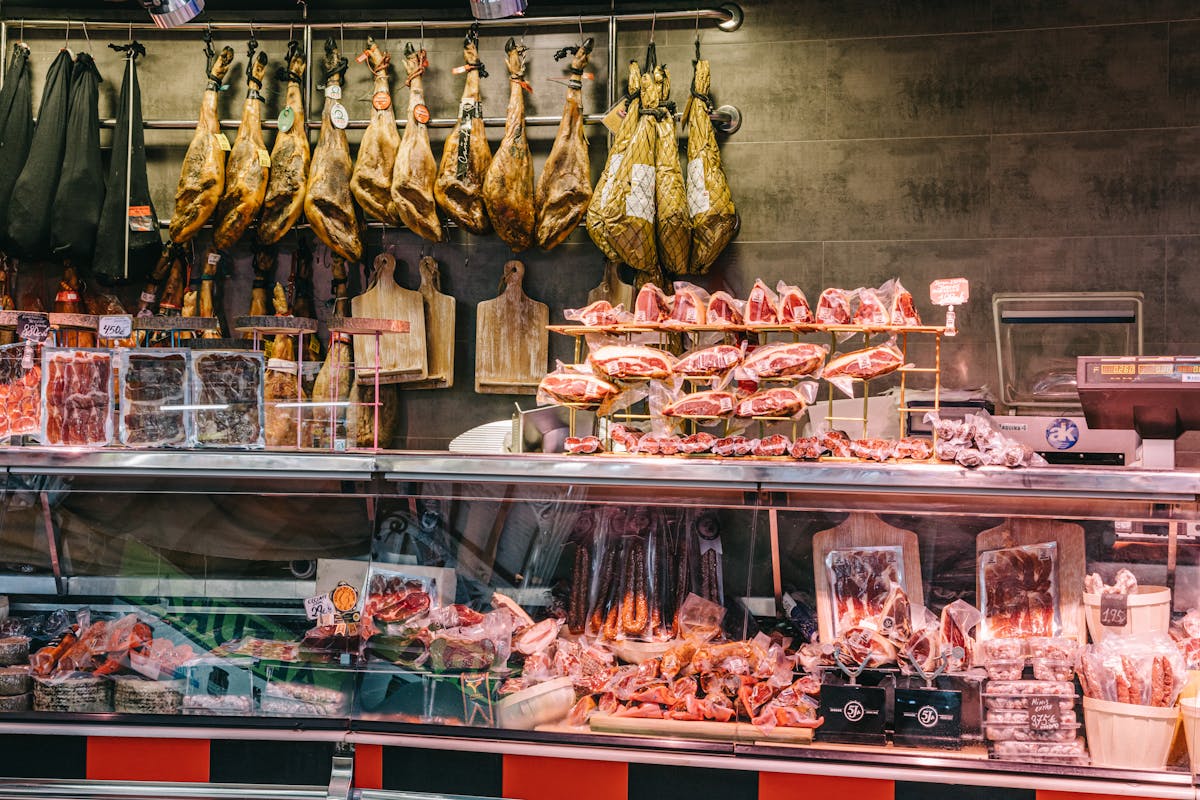
Not just any ham. Spanish jamón is a religion. You’ll see entire cured legs hanging from market ceilings. The hierarchy: jamón serrano (mountain ham, good) and jamón ibérico (from black Iberian pigs, extraordinary). At markets, ask for “cien gramos de jamón” (100 grams of ham) and watch the vendor slice it paper-thin with an enormous knife.
3. Verduras (behr-DOO-ras) – Vegetables
The collective word for vegetables. Market stalls organised by type will have signs reading “verduras y hortalizas” (vegetables and garden produce). Point at anything colourful and ask: “¿Qué es esto?” (What is this?). Vendors love explaining their produce to curious foreigners.
4. Pescado (pes-KAH-do) – Fish
Spain eats more fish per capita than almost any European country. The fish section of any Spanish market is an education. Note the difference: pescado is fish you eat (caught fish), while pez (peth) is a live fish swimming around. Once it’s on your plate, it’s pescado.
5. Queso (KEH-so) – Cheese
Spain produces over 100 varieties of cheese. At markets, you’ll find everything from mild queso fresco (fresh cheese) to the intensely flavoured Manchego (from La Mancha region, made from sheep’s milk). Ask for “un trocito para probar” (a little piece to try) and most vendors will happily give you samples.
Group 2: At the Restaurant (En el Restaurante)
These five words are your survival toolkit for eating out. Memorise them and you’ll never feel lost at a Spanish restaurant again.
6. La cuenta (la KWEN-ta) – The bill
The single most important restaurant phrase. In Spain, the waiter will NEVER bring the bill unless you ask. You could sit there for three hours and nobody would rush you. When you’re ready to leave: “La cuenta, por favor.” That’s it. Freedom.
7. Tapa (TAH-pa) – Small dish/snack
Originally, a tapa was a slice of bread placed on top of a wine glass to keep flies out (tapa means “lid” or “cover”). Now it’s a small portion of food, sometimes free with your drink (in cities like Granada and León), sometimes ordered separately. Plural: tapas (TAH-pas). “Ponme dos tapas de tortilla” gets you two portions of Spanish omelette.
8. Cuchara (koo-CHA-ra) – Spoon
Why spoon specifically? Because you’ll need to ask for one. Many traditional Spanish dishes (gazpacho, crema, lentejas) require a spoon, and sometimes they forget. Other cutlery: tenedor (teh-neh-DOR, fork), cuchillo (koo-CHEE-yo, knife). “¿Me traes una cuchara?” (Can you bring me a spoon?) solves the problem instantly.
9. Postre (POS-treh) – Dessert
When the waiter asks “¿Vais a querer postre?” (Will you want dessert?), you need to know this word. Classic Spanish postres include: flan (caramel custard), arroz con leche (rice pudding), and tarta de Santiago (almond cake from Galicia). The correct answer to “¿Postre?” is always “Sí.”
10. Vino (BEE-no) – Wine
Spain has more land planted with vineyards than any other country on Earth. At restaurants, you’ll choose between vino tinto (red), vino blanco (white), and vino rosado (rosé). House wine is “vino de la casa” and is almost always excellent and cheap (2-4 euros for a generous glass). According to the Spanish Ministry of Agriculture, Spain’s wine regions produce over 40 million hectolitres annually.
Group 3: Cooking at Home (Cocinando en Casa)
If you’re staying in Spain for any length of time, you’ll cook. These words make the kitchen less intimidating and recipe-following actually possible.
11. Ajo (AH-ho) – Garlic
The backbone of Spanish cooking. If a recipe doesn’t start with garlic, it’s suspicious. You’ll find braids of dried garlic (ristras) hanging in kitchens across the country. Essential tip: when a recipe says “un diente de ajo” (a clove of garlic), it means one single clove. Not the whole bulb. (We’ve all made that mistake.)
12. Sartén (sar-TEN) – Frying pan
Every Spanish kitchen revolves around the sartén. Tortilla española, huevos fritos, patatas bravas – they all happen in the pan. Note: in some regions, it’s feminine (la sartén) and in others masculine (el sartén). Both are correct. Don’t let anyone tell you otherwise.
13. Hervir (air-BEER) – To boil
Your first cooking verb. “Hervir el agua” (boil the water) appears in almost every recipe. The conjugation you’ll use most: “hierve” (YER-beh, it boils/you boil it). Related: cocer (ko-SEHR, to cook/simmer), freír (freh-EER, to fry), asar (ah-SAR, to roast).
14. Receta (reh-SEH-ta) – Recipe
When you want to cook something Spanish, you’ll search for “receta de paella” or “receta de gazpacho.” Pro tip: search recipes in Spanish on Spanish websites. The results are more authentic than English-language “Spanish recipes” which are often wildly inaccurate. Your language practice and your cooking improve simultaneously.
15. Sal (SAL) – Salt
Simple, essential, and the first seasoning in every Spanish dish. “Sal al gusto” (salt to taste) appears in every recipe ever written. At the table, you might need to ask: “¿Me pasas la sal?” (Can you pass me the salt?). Related: pimienta (pee-mee-EN-ta, pepper), azúcar (ah-SOO-kar, sugar).
Group 4: Street Food (Comida Callejera)
The best Spanish food often comes from the most unassuming places. Small stands, market stalls, window counters. These words unlock Spain’s incredible street food scene.
16. Churros (CHOO-ros) – Fried dough sticks
Long, ridged sticks of fried dough, sometimes straight, sometimes in loops, always served with thick hot chocolate for dipping. Churros are breakfast food, late-night food, festival food, and “I deserve this” food. A ración (portion) costs 3-5 euros and feeds two people easily. The crispy outside, soft inside combination is addictive.
17. Bocadillo (bo-ka-DEE-yo) – Sandwich (on crusty bread)
Not a soft bread sandwich. A bocadillo is made on a barra de pan (crusty baguette-style bread). The bread is crunchy outside, soft inside, and the filling is always simple. Jamón. Tortilla. Calamares (yes, fried squid in a sandwich, a Madrid specialty). “Un bocadillo de jamón” is the universal quick lunch across Spain.
18. Helado (eh-LAH-do) – Ice cream
Spanish heladerías (ice cream shops) are everywhere in summer. Flavours you won’t find elsewhere: turrón (nougat), mantecado (lard-based traditional flavour), horchata (tiger nut milk). Ordering protocol: “Una bola de…” (one scoop of…) or “dos bolas de…” (two scoops of…). Point at what looks good and ask “¿De qué sabor es?” (What flavour is that?).
19. Frutos secos (FROO-tos SEH-kos) – Nuts/dried fruits
Literally “dry fruits.” You’ll find stalls selling roasted almonds, pistachios, sunflower seeds (pipas), and dried figs everywhere. Street vendors at festivals always have bags of frutos secos. They’re the perfect portable snack. “Una bolsa de almendras” (a bag of almonds) usually costs 2-3 euros.
20. Pincho (PEEN-cho) – Small snack on a stick/bread
Similar to a tapa but specifically refers to a small portion served on a piece of bread, often held together with a toothpick. More common in northern Spain (Basque Country, where they’re called pintxos). At pincho bars, you grab what you want from the counter and they count your toothpicks at the end to calculate your bill. Genius system.
Interactive: Restaurant Role-Play
Test your new vocabulary with this scenario. You’re at a restaurant in Spain. Read the situation and choose your response:
Scenario: You sit down. The waiter approaches and says “¿Qué os pongo?” (What shall I get you?)
| Situation | What You Say | Words Used |
|---|---|---|
| You want red wine and some tapas | “Ponme un vino tinto y dos tapas del día” | vino, tapa |
| You need a spoon for your soup | “¿Me traes una cuchara, por favor?” | cuchara |
| You want to know about dessert | “¿Qué tenéis de postre?” | postre |
| You’re ready to leave | “La cuenta, por favor” | la cuenta |
| You want to compliment the food | “Estaba todo buenísimo” | (bonus phrase!) |
Quick Reference: All 20 Words at a Glance
| # | Spanish | Pronunciation | English | Context |
|---|---|---|---|---|
| 1 | Aceite | ah-SAY-teh | Oil | Market |
| 2 | Jamón | ha-MOHN | Ham | Market |
| 3 | Verduras | behr-DOO-ras | Vegetables | Market |
| 4 | Pescado | pes-KAH-do | Fish | Market |
| 5 | Queso | KEH-so | Cheese | Market |
| 6 | La cuenta | la KWEN-ta | The bill | Restaurant |
| 7 | Tapa | TAH-pa | Small dish | Restaurant |
| 8 | Cuchara | koo-CHA-ra | Spoon | Restaurant |
| 9 | Postre | POS-treh | Dessert | Restaurant |
| 10 | Vino | BEE-no | Wine | Restaurant |
| 11 | Ajo | AH-ho | Garlic | Cooking |
| 12 | Sartén | sar-TEN | Frying pan | Cooking |
| 13 | Hervir | air-BEER | To boil | Cooking |
| 14 | Receta | reh-SEH-ta | Recipe | Cooking |
| 15 | Sal | SAL | Salt | Cooking |
| 16 | Churros | CHOO-ros | Fried dough | Street |
| 17 | Bocadillo | bo-ka-DEE-yo | Sandwich | Street |
| 18 | Helado | eh-LAH-do | Ice cream | Street |
| 19 | Frutos secos | FROO-tos SEH-kos | Nuts | Street |
| 20 | Pincho | PEEN-cho | Bread snack | Street |
Your Next Steps
You’ve just learned 20 words that you’ll use every single day in Spain. That’s not an exaggeration. From your morning coffee order to your late-night churros run, these words are going to show up constantly.
The best part? You didn’t learn them from a textbook. You learned them with context, culture, and stories attached. Which means they’ll stick.
Try using three of these words today. Order something at a Spanish restaurant (even if it’s in your home city). Look up a receta in Spanish. Visit a market and identify the verduras and queso. The more you use them, the more permanent they become.
Your Spanish is growing. You’ve got this.
Sources: Nation, I.S.P. (2001). “Learning Vocabulary in Another Language.” Cambridge University Press; Spanish Ministry of Agriculture, Fisheries and Food, annual production statistics.
Related reading: Explore more Spanish language lessons on Audaz Revista.
Share
Topics

audazrevista

You may also like


Get the Inside Scoop