Avocado, Aguacate or Palta? Spanish Food Words by Country
By the Audaz Revista editorial team
Updated October 21, 2026 · Reviewed by the Audaz editorial team
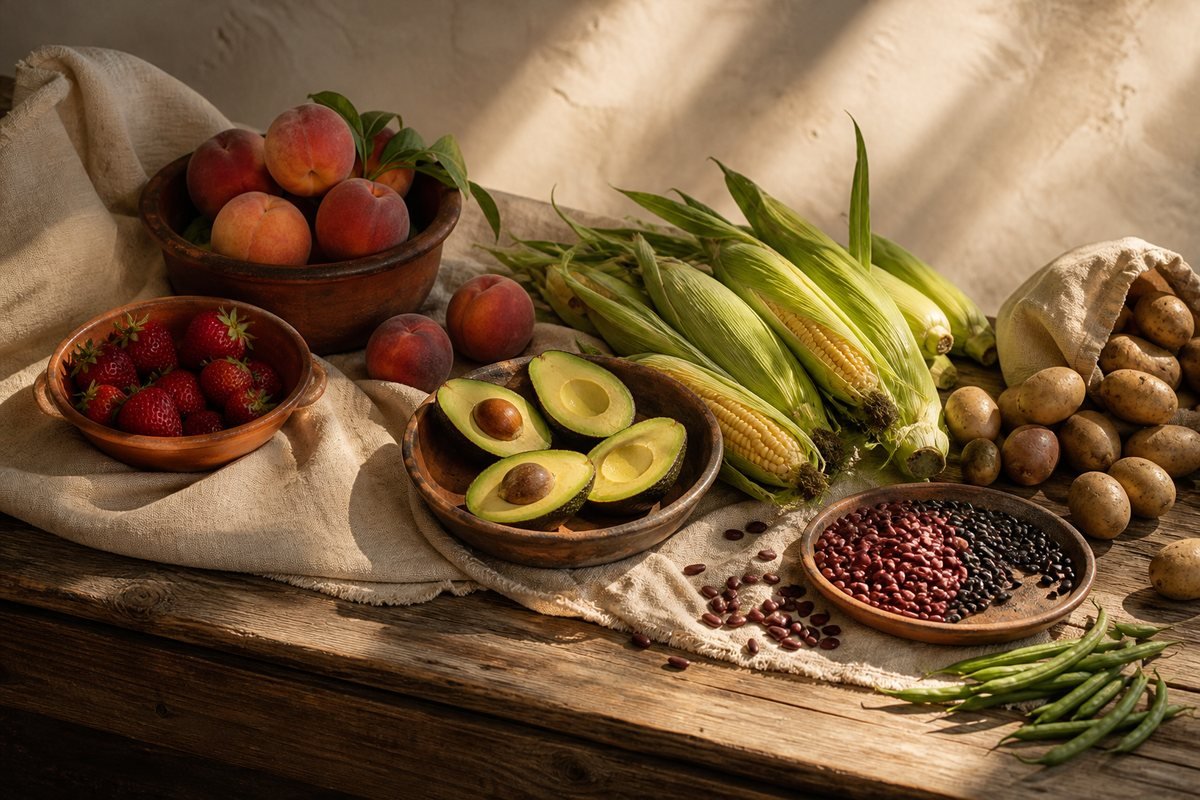
Why do Spanish food words change by country? Many foods came from the Americas, and each region kept the name its own people used. So an avocado is aguacate in Mexico, from the Nahuatl language, and palta in Argentina and Chile, from Quechua. Beans can be frijoles, porotos or caraotas. Our table shows 13 of these words across 6 countries.
- Many foods came from the Americas, so Spanish borrowed local names for them.
- Mexican words often come from Nahuatl, and Andean words from Quechua: aguacate and palta, elote and choclo.
- Green beans have a different word in all 6 countries in our table, and only Spain says patata.
- Watch torta: it’s a cake in Argentina, Chile and Venezuela, and a filled bread roll in Mexico.
Ask for an avocado in Buenos Aires and you may get a polite pause. The word there is palta. Cross into Mexico and it’s aguacate again. It’s the same fruit on the same plate, with two very different histories behind it.
Food words are where Spanish shows its map most clearly. In this piece we look at why that happens, then give you a table you can keep for your next trip. Every word in it comes from the dictionaries of the Real Academia Española and the Association of Academies of the Spanish Language.
Why does Spanish have so many words for the same food?
Many of these foods were growing in the Americas long before Spanish arrived. When Spanish speakers met them, they often borrowed the local name. In Mexico that name usually came from Nahuatl, the language of the Aztecs. In the Andes it came from Quechua, the language of the Inca world.
We think the avocado is the clearest case. The dictionary traces aguacate to the Nahuatl ahuacatl, the name of the fruit. It traces palta to the Quechua pallta. Both words entered Spanish, and each one stayed where it was born.
Corn on the cob follows the same split. Mexico says elote, from the Nahuatl élotl. Argentina and Chile say choclo, from the Quechua chuqllu, which means an ear of corn. You can see the pattern repeat across the table below.
| Spanish word | Where it’s used | Comes from |
|---|---|---|
| aguacate | Spain, Mexico, Venezuela | Nahuatl ahuacatl |
| palta | Argentina, Chile, Peru, Uruguay | Quechua pallta |
| elote | Mexico, Central America | Nahuatl élotl |
| choclo | Argentina, Chile, parts of Colombia, Peru | Quechua chuqllu |
| chile | Mexico, Central America | Nahuatl chilli |
| ají | South America, the Caribbean | Taíno, a Caribbean language |
| poroto | Argentina, Chile, Peru and nearby | Quechua purutu |
| zapallo | Argentina, Chile, Peru and nearby | Quechua sapallu |
Spain’s own word for potato hides a surprise, too. Papa comes from Quechua, and batata, the sweet potato, comes from a Caribbean language. The dictionary says patata is a blend of the two. So even the word most tied to Spain is built from two American words.
What are the Spanish food words that change by country?
Here are 13 everyday foods and the word each country uses for them. We checked every entry against the country marks in the Diccionario de la lengua española and the Diccionario de americanismos. Where a cell has two words, the dictionaries list both for that country.
| Food | Spain | Mexico | Argentina | Chile | Colombia | Venezuela |
|---|---|---|---|---|---|---|
| Avocado | aguacate | aguacate | palta | palta | aguacate* | aguacate |
| Beans | judía, alubia | frijol | poroto | poroto | frijol | caraota |
| Corn on the cob | mazorca | elote | choclo | choclo | choclo (west), jojoto (east) | jojoto |
| Peach | melocotón | durazno* | durazno | durazno | durazno | durazno |
| Strawberry | fresa | fresa* | frutilla | frutilla | fresa* | fresa* |
| Potato | patata | papa | papa | papa | papa | papa |
| Banana | plátano | plátano* | banana | plátano* | banano | cambur |
| Green beans | judía verde | ejote | chaucha | poroto verde | habichuela | vainita |
| Chili pepper | guindilla | chile | ají | ají | ají | ají |
| Sweet potato | boniato, batata | camote | batata | camote | batata | batata, camote |
| Pea | guisante | chícharo | arveja | arveja | arveja | arveja |
| Cake | tarta | pastel* | torta | torta | torta, ponqué | torta, ponqué |
| Pumpkin | calabaza | calabaza* | zapallo | zapallo | ahuyama, zapallo | auyama |
* The dictionaries give this word no country mark, so it’s the general Spanish word, or one marked for the Americas as a whole. We found no regional word marked for that country, so we list the general one.
A few rows are worth a second look. Potato is the easy one, since papa works in all 5 American countries here, and only Spain says patata. Green beans are the hard one, with a different word in all 6 countries, so it’s the row we’d learn by heart.
Small words carry history, too. Frutilla, the strawberry in Argentina and Chile, is simply a small form of fruta, fruit. Ponqué, a cake in Colombia and Venezuela, comes from the English pound cake. And Spain’s alubia reached Spanish from Arabic.
A tip for travellers. Menus often use the local word with no explanation. Before a trip, learn the potato, bean and corn words for that country. They’re everyday foods, so you’re likely to see them.
Which Spanish food words can get you into trouble?
Most mix-ups are harmless, and people will usually understand you, but we’d take care with one word: torta.
In Argentina, Chile and Venezuela, a torta is a cake. In Mexico, the dictionary describes it as a bread roll cut lengthwise and filled with food. That’s a sandwich, so if you ask for a birthday torta in Mexico City, you might get lunch instead of dessert. In Spain the word has one more meaning in casual speech: a slap in the face.
Chili is the other one to watch. A Mexican chile and an Andean ají are both hot peppers. In Chile, the country, the pepper is called ají.
We like the banana row best, because it takes the most turns. Spain says plátano, Argentina says banana, Colombia says banano and Venezuela says cambur. The dictionary traces banana itself to a language of the Congo region. If you’re ordering in a restaurant, our guide to restaurant phrases in Spanish covers the rest of the conversation.
What is popcorn called in Spanish?
Popcorn may have the most names of any snack. In Venezuela it’s cotufa, and in Chile it’s cabritas. In Argentina you’ll hear pochoclo, a word of Quechua origin, or pororó. Spain says palomitas, little doves, and the dictionary lists it beside cotufa as the same thing.
Colombia has a small puzzle. You’ll often see crispeta given as the Colombian word. Yet the Diccionario de americanismos, published in 2010, marks it as dated there. Dictionaries record speech at a moment in time, and snack words change quickly. We’d love to hear what you call it.
Which word should you learn first?
Learn the word for the place you’re going. A Mexican market will expect elote and ejote, and a Chilean one will expect choclo and poroto verde. Our guide to Mexican menu words is a good start for Mexico.
If you don’t know where you’ll be, the starred words in our table are a safe base. They’re the general Spanish words, so most people will understand them. Then pick up the local word once you hear it.
For the bigger picture, see our piece on how Latin American and Spain Spanish differ. And if you’d like to go deeper into one cuisine, our Oaxaca food vocabulary has more words from the Mexican kitchen.
Try it. Next time you talk to a Spanish speaker from another country, ask ¿Cómo le dicen al aguacate allá? What do you call an avocado there? It’s an easy question, and it often starts a long conversation.
Frequently asked questions
Is it aguacate or palta?+
Both are correct. Aguacate comes from Nahuatl and is used in Spain, Mexico and Venezuela. Palta comes from Quechua and is used in Argentina, Chile, Peru and Uruguay.
What is the Spanish word for beans?+
It depends on the country. Spain says judía or alubia, Mexico and Colombia say frijol, Argentina and Chile say poroto, and Venezuela says caraota.
Does torta mean cake in Spanish?+
In Argentina, Chile and Venezuela, yes. In Mexico a torta is a filled bread roll, a kind of sandwich. In Spain the word can also mean a slap.
Why does Spain say patata and Latin America say papa?+
Papa is the Quechua word for potato. The dictionary says Spain’s patata is a blend of papa and batata, the sweet potato.
In a hurry? We also made a short web story version of this piece.
Every Spanish word lives in a place. Our next issue, Ciudades que hablan, takes you to 18 cities across the Spanish-speaking world. Each one gets a single story, told in Spanish by someone who lives there. Join the waitlist and we’ll tell you when it opens.
Audaz Revista
Audaz Revista is the reading guide for Spanish learners. We tell you what you can read in Spanish at your level, and help you finish it.
Share
Topics

audazrevista
You may also like


Get the Inside Scoop