Pack your bags. We’re heading to the south of Spain, and trust me, your Spanish is about to level up in ways no classroom could ever match.
Andalusia (or Andalucía, an-dah-loo-THEE-ah) isn’t just a region. It’s the beating heart of everything people picture when they think of Spain: flamenco guitars echoing through cobblestone streets, the scent of orange blossoms drifting through ancient courtyards, and tapas bars so packed with locals that you’ll need your best Spanish just to get a seat.
This is where the magic happens. And this guide? It’s your ticket to experiencing all of it like a local, not a tourist clutching a phrasebook.
Why Andalusia Deserves Its Own Guide
Here’s the real talk. Most travel guides treat Andalusia like a checklist: Alhambra, tick. Seville cathedral, tick. Beach, tick. Done.
But Andalusia is eight provinces spanning over 87,000 square kilometres. It’s home to roughly 8.5 million people, according to Spain’s National Statistics Institute (INE). Each city has its own dialect quirks, food traditions, and personality. Lumping them together is like saying “just visit Australia” without mentioning whether you mean Sydney or the Outback.
What makes this region extraordinary for Spanish learners is the sheer variety. The accent in Seville sounds different from Granada. The vocabulary in Málaga has its own flavour. And the culture shifts as you move from the coast to the mountains.
If you’re serious about learning Spanish through real-world immersion, Andalusia gives you more cultural and linguistic range per square kilometre than anywhere else in Spain.
Seville: The Soul of Andalusia
Let’s start with Sevilla (seh-VEE-yah), the capital of the region and arguably the most passionate city in all of Spain.
What You’ll Experience
Seville hits different. The moment you step into the Barrio de Santa Cruz (BAH-ree-oh deh SAN-tah KROOTH), the old Jewish quarter, you’ll understand why this city has inspired poets and artists for centuries. Narrow alleyways open into hidden plazas. Jasmine climbs the walls. And somewhere, always, someone is playing guitar.
The Real Alcázar (reh-AL al-KAH-thar) is a UNESCO World Heritage Site and one of the oldest royal palaces still in use. Its Moorish architecture tells the story of Andalusia’s multicultural past, when Muslims, Christians, and Jews lived side by side for centuries. The Palacio de Carlos V inside the complex blends Renaissance and Islamic styles in ways that will stop you mid-sentence.
And then there’s the Feria de Abril (FEH-ree-ah deh ah-BREEL), Seville’s famous April Fair. If you want to understand why Andalusians are so proud of their culture, read our guide to what every first-timer gets wrong at the Feria. It’s a week-long celebration of flamenco, sherry, and community that you simply cannot replicate anywhere else.
Language Tips for Seville
Sevillanos are famous for dropping the “s” sound at the end of words. So gracias becomes something closer to “grathia.” Don’t panic. Your ears will adjust within a day or two.
Useful phrase: “¿Dónde está la mejor terraza?” (DOHN-deh es-TAH lah meh-HOR teh-RAH-thah) means “Where’s the best terrace?” You’ll need this. Seville is an outdoor city, and finding the right terraza for sunset drinks is practically a local sport.
Granada: Where History Whispers from Every Wall
If Seville is the soul of Andalusia, Granada (grah-NAH-dah) is its memory.
The Alhambra and Beyond
Yes, you need to visit the Alhambra (al-AM-brah). It’s the most visited monument in Spain for a reason, attracting over 2.7 million visitors annually according to the Patronato de la Alhambra. But here’s what the guidebooks miss: book your tickets at least two months in advance. Seriously. They sell out.
The Nasrid Palaces inside the Alhambra complex are where Islamic art reached its absolute peak in Europe. The geometric patterns, the play of light and water, the Arabic calligraphy carved into the walls, it’s mesmerising. And knowing even a few words of Arabic-origin Spanish (and there are hundreds) makes the experience richer.
But Granada isn’t just the Alhambra. The Albaicín (al-bye-THEEN) neighbourhood is a maze of whitewashed houses, tea shops, and miradores (mee-rah-DOH-rehs, viewpoints) with jaw-dropping views of the Alhambra against the Sierra Nevada mountains.
Granada’s Free Tapas Culture
Here’s the real talk. Granada is one of the last cities in Spain where you still get a free tapa with every drink. Order a caña (KAH-nyah, a small draft beer) and a plate of food appears. Order another, and a different plate arrives. Your Spanish vocabulary will expand fast when you’re motivated by free food.
Try saying: “Una caña, por favor” (OO-nah KAH-nyah, por fah-VOR). That’s all you need. The bartender handles the rest.
For more on ordering food in Spanish like a local, we’ve got you covered.
Córdoba: The Quiet Powerhouse
Córdoba doesn’t shout. It doesn’t need to. This city was once the most advanced metropolis in all of Europe.
A History That Rewrites What You Thought You Knew
During the 10th century, Córdoba (KOR-doh-bah) was the capital of the Caliphate of Córdoba and home to over 500,000 people, making it one of the largest cities in the world at the time. It had street lighting, running water, and a library containing over 400,000 manuscripts, according to historian María Rosa Menocal’s research at Yale University.
The Mezquita-Catedral (meth-KEE-tah kah-teh-DRAHL) is Córdoba’s crown jewel. It’s a mosque that was converted into a cathedral, and walking inside is genuinely disorienting in the best way. Hundreds of red-and-white striped arches stretch out in every direction. It’s unlike any building you’ve ever seen.
We’ve written a deep dive into Córdoba’s hidden spots that goes beyond the Mezquita. Check it out before you visit.
The Patios of Córdoba
Every May, Córdoba hosts the Festival de los Patios (fehs-tee-VAHL deh lohs PAH-tee-ohs). Locals throw open their private courtyards, decorated floor-to-ceiling with geraniums, jasmine, and bougainvillea, and invite strangers in. It’s been listed as UNESCO Intangible Cultural Heritage since 2012.
Useful phrase: “¡Qué bonito!” (keh boh-NEE-toh) means “How beautiful!” You’ll say it roughly forty-seven times during the festival.
Málaga: More Than Just a Beach Town
Forget what you’ve heard about Málaga being “just” the Costa del Sol airport. This city has reinvented itself as one of Spain’s most exciting cultural destinations.
Málaga’s Cultural Renaissance
Picasso was born here in 1881, and the city has leaned hard into its artistic heritage. The Museo Picasso Málaga houses over 200 works. The Centre Pompidou Málaga brought a branch of the famous Parisian museum to the port. And the Soho neighbourhood has become a street art gallery where murals cover entire buildings.
But here’s what makes Málaga special for Spanish learners: it’s big enough to have incredible culture and food, but small enough that locals actually talk to you. The malagueños (mah-lah-GAY-nyohs, people from Málaga) are famously chatty and warm.
For a deeper look at what the tourist guides skip, check out our Málaga language and travel guide.
Espetos and Chiringuitos
Málaga’s food scene revolves around the sea. Espetos (ehs-PEH-tohs) are sardines skewered on bamboo sticks and grilled over an open fire right on the beach. You eat them at a chiringuito (chee-reen-GEE-toh), a beachside restaurant that ranges from a shack with plastic chairs to something surprisingly upscale.
Order like this: “Ponme unos espetos y una cerveza bien fría” (PON-meh OO-nohs ehs-PEH-tohs ee OO-nah ther-VEH-thah bee-EN FREE-ah). Translation: “Give me some sardine skewers and a nice cold beer.” That sentence alone is worth the plane ticket.
Beyond the Big Four: Hidden Andalusia
The big cities get all the attention, but Andalusia’s smaller towns are where you’ll find the most authentic experiences.
Ronda: The Town on the Edge
Ronda (ROHN-dah) sits dramatically on top of a cliff split by the El Tajo gorge. The Puente Nuevo (PWEN-teh NWEH-voh, New Bridge), which is actually from 1793, spans the 120-metre deep canyon. It’s one of the most photographed spots in all of Spain, and for good reason.
Ronda is also the birthplace of modern bullfighting, though that’s a conversation with a lot of cultural nuance. The Plaza de Toros (PLAH-thah deh TOH-rohs), built in 1785, is one of the oldest bullrings in Spain.
The White Villages Route
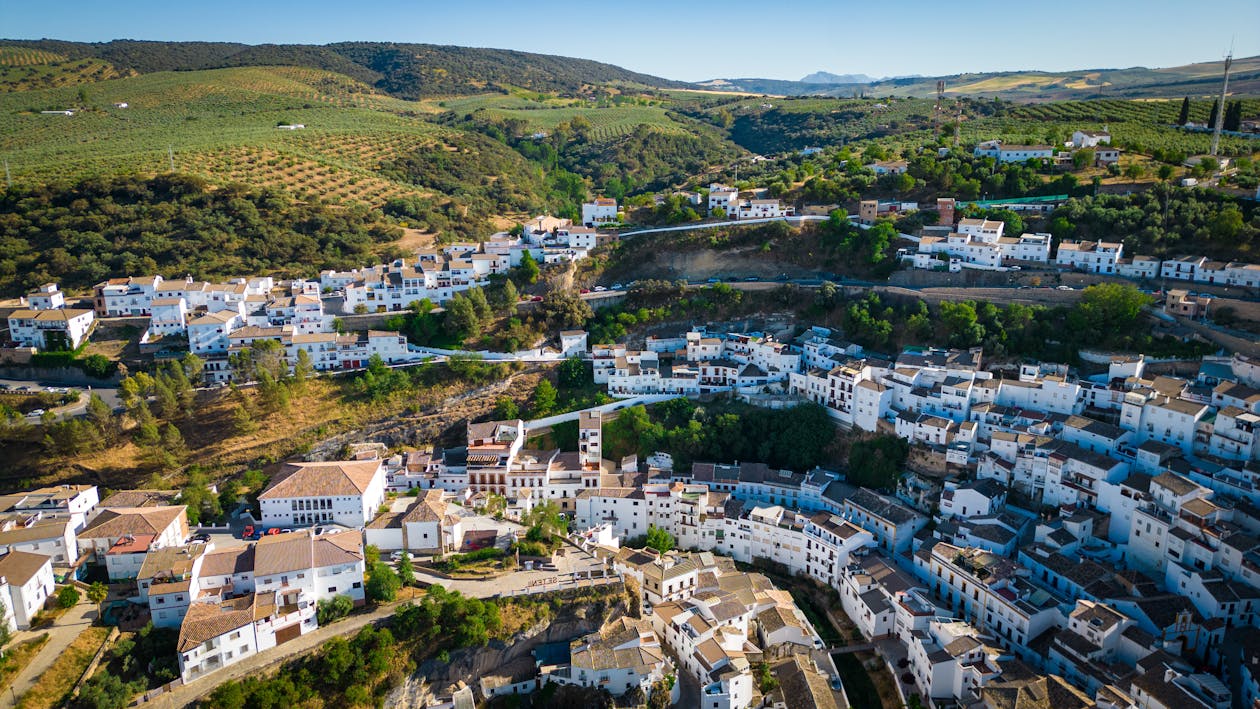
The pueblos blancos (PWEH-blohs BLAHN-kohs, white villages) are scattered across the mountains between Ronda and the coast. Towns like Zahara de la Sierra and Grazalema look like they’ve been dipped in whitewash and dropped onto mountaintops. They’re tiny, they’re stunning, and they’re where you’ll practise your Spanish with elderly locals who’ve never met a tourist before.
This is where the magic happens. No tourist crowds. No English menus. Just you, your Spanish, and some of the friendliest people in Europe.
Cádiz: Europe’s Oldest City
Founded by the Phoenicians around 1100 BCE, Cádiz (KAH-deeth) claims to be the oldest continuously inhabited city in Western Europe. It sits on a narrow peninsula jutting into the Atlantic, and its carnival, the Carnaval de Cádiz, is the third largest in the world after Rio and Trinidad.
For a complete breakdown of what to see and how to survive the local dialect, check out our Cádiz travel and language survival guide.
Essential Andalusian Spanish: What Your Textbook Forgot
Forget what your textbook told you. Andalusian Spanish sounds different from what you’ve been studying, and that’s a beautiful thing.
Key Differences You’ll Notice
- Dropped “s” sounds: Estamos becomes “ehtamoh.” Gracias becomes “grathia.”
- Seseo vs. ceceo: In parts of Andalusia, “c” before “e” or “i” sounds like “s” instead of “th.” In other parts, everything sounds like “th.” It depends on the town.
- Speed: Andalusians speak fast. Really fast. Don’t feel bad if you can’t catch everything at first.
- Unique vocabulary: Quillo (KEE-yoh) is Andalusian slang for “mate” or “buddy.” You’ll hear it constantly.
Survival Phrases for Andalusia
- “¿Me pones una tapa?” (meh POH-nehs OO-nah TAH-pah): “Can you get me a tapa?” More natural than the textbook version.
- “Illo, ¿qué pasa?” (EE-yoh, keh PAH-sah): “Hey mate, what’s up?” Very Andalusian, very informal.
- “Está to’ muerto esto” (ehs-TAH toh MWEHR-toh EHS-toh): “This place is dead.” Used when a bar or area is empty. Local slang.
- “Vamos pa’lante” (VAH-mohs pah-LAHN-teh): “Let’s keep going” or “onwards.” A contraction of para adelante. You’ll hear it everywhere.
Your Spanish is about to level up just by spending a week in Andalusia. The immersion here is unavoidable, and that’s exactly the point.
For a solid foundation before you go, check out our pronunciation guide with the 8 rules native speakers actually follow.
When to Visit Andalusia
Timing matters more here than in most parts of Spain.
Best Times
- March to May: Perfect temperatures (18-25°C), the Feria de Abril in Seville, the Patio Festival in Córdoba, and Semana Santa (seh-MAH-nah SAHN-tah, Holy Week) processions across every city. This is peak Andalusia.
- September to November: The summer crowds vanish, prices drop, and temperatures become comfortable again. The harvest season means incredible food.
When to Avoid
- July and August: Seville and Córdoba regularly hit 40-45°C. That’s not a typo. The locals escape to the coast or hide indoors until evening. Unless you enjoy feeling like you’re inside an oven, plan accordingly.
Getting Around Andalusia
Andalusia’s main cities are well connected, but the smaller towns require a bit more planning.
Trains
Spain’s RENFE network connects Seville, Córdoba, Málaga, and Granada efficiently. The AVE high-speed train gets you from Seville to Córdoba in just 45 minutes. Book through the RENFE website or app.
Buses
For smaller towns and the pueblos blancos, buses are your best option. ALSA is the main bus company. Schedules can be infrequent, so check times carefully and learn this phrase: “¿A qué hora sale el próximo autobús?” (ah keh OH-rah SAH-leh el PROHK-see-moh ow-toh-BOOS), meaning “What time does the next bus leave?”
Renting a Car
For maximum freedom, especially in the countryside, rent a car. The roads are good, petrol is cheaper than northern Europe, and having your own wheels lets you stumble upon villages and viewpoints that no bus route reaches.
Your Andalusia Itinerary: 10 Days, No Regrets
Here’s a suggested route that balances the big highlights with authentic, off-the-beaten-path moments:
- Days 1-3: Seville. The Alcázar, the cathedral, the Triana neighbourhood for flamenco, and at least one night eating tapas in the Alameda de Hércules.
- Days 4-5: Córdoba. The Mezquita, the Jewish quarter, and the patios. Eat salmorejo (sal-moh-REH-hoh), the cold tomato soup that’s thicker and richer than gazpacho.
- Day 6: Ronda. The bridge, the old town, and wine from the local vineyards. Ronda is small enough to explore in a day.
- Days 7-8: Granada. The Alhambra (remember, book early), the Albaicín, and the free tapas bars around Plaza Nueva.
- Days 9-10: Málaga. Museums, the beach, espetos, and a farewell dinner in one of the rooftop restaurants overlooking the port.
The Bottom Line
Andalusia isn’t just a travel destination. It’s a language immersion programme, a cultural education, and an unforgettable adventure wrapped into one sun-drenched region.
The Spanish you’ll learn here is raw, real, and alive. It’s not textbook Spanish. It’s the Spanish of people who sing while they cook, who turn a simple coffee into a two-hour conversation, and who believe that life should be celebrated loudly and often.
Your Spanish is about to get a serious upgrade. And Andalusia? It’s ready for you.
Now you’re ready to explore. Go use these phrases and have an incredible experience.
]]>Share
You may also like


Get the Inside Scoop