Día de los Muertos Is Not Mexican Halloween
By the Audaz Revista editorial team
Updated August 4, 2026 · Reviewed by the Audaz editorial team
Día de los Muertos is the Mexican festival on 1 and 2 November that welcomes the dead home for a night. Families build an ofrenda (an offering table), lay a path of cempasúchil petals, and sit with the food the person liked. UNESCO inscribed it in 2008 under the name Indigenous festivity dedicated to the dead. It shares a week with Halloween and almost nothing else.
- UNESCO inscribed it in 2008, after proclaiming it in 2003. Reference number 00054.
- Mexico’s own national institute of anthropology says the 1 and 2 November dates are Catholic, not pre-Hispanic. The Mexica festivals for the dead fell in other months.
- Cempasúchil is the marigold. Mexico’s dictionary also calls it flor de muerto.
- Calavera has eight senses in that dictionary. One is a sugar skull. One is a joke poem about a living person. One is money children ask for on 2 November.
- La Catrina started as political satire by an engraver, not as a goddess of death.
- Mexico City’s huge parade is newer than most learners. It was built after a James Bond film invented it.
What is Día de los Muertos, exactly?
It is the two days when the dead are expected home. The word to hold on to is expected. They are treated like guests with an arrival time, and the house is got ready for them.
UNESCO lists it on the Representative List of the Intangible Cultural Heritage of Humanity under the official name Indigenous festivity dedicated to the dead, reference 00054. It was proclaimed in 2003 and inscribed in 2008. The UNESCO description says the festivity “commemorates the transitory return to Earth of deceased relatives and loved ones”.
Read that phrase slowly, because it is the whole holiday. Transitory return. The dead come back, they eat, and they go. The family’s job is to make the trip easy.
UNESCO describes how: families “facilitate the return of the souls to Earth by laying flower petals, candles and offerings along the path”. The favourite dishes of the person who died are cooked and set out at the home shrine and at the grave.
Halloween is about keeping the dead away. Día de los Muertos is about giving them directions home. Same season, opposite instruction.
Is Día de los Muertos the same as Halloween?
No, and the difference is easier to feel than to define. National Geographic puts it plainly: “While Halloween embraces terror and mischief on the last night of October, Day of the Dead festivities unfold over the first two days of November in an explosion of color and life-affirming joy.”
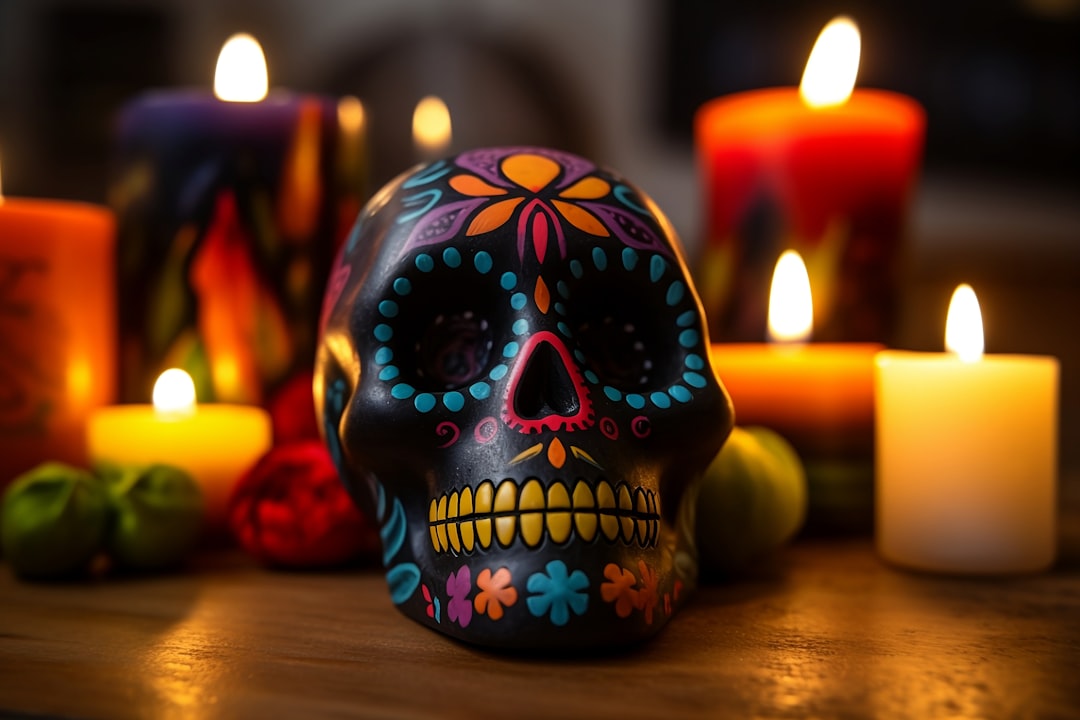
The tone is the tell. A Halloween skeleton is meant to unsettle you. A calavera has your aunt’s name iced across its forehead and you are supposed to eat it.
| Halloween | Día de los Muertos | |
|---|---|---|
| When | Night of 31 October | 1 and 2 November |
| The dead are | Something to scare or be scared by | Guests you cooked for |
| Central object | A carved pumpkin at the door | An ofrenda inside the house |
| Where it happens | Streets and doorsteps | Homes and the panteón (the cemetery) |
| The flower | None | Cempasúchil, laid as a path |
| Who it is for | Anyone | Named people, with their photographs on the table |
There is one honest overlap, and Mexico’s dictionary records it. Sense 7 of calavera in the Diccionario del español de México is “money or a gift that children ask for on the second of November”. Children going door to door on the day of the dead is a real Mexican thing with a real Mexican name. It is called pedir calaverita.
Is Día de los Muertos an ancient Aztec festival?
This is where almost every guide, including a lot of Mexican ones, gets it wrong. The answer from Mexico’s own national institute of anthropology and history is no.
The INAH article El origen del Día de Muertos opens with the correction: “Contrario a la idea popular extendida y aceptada en México, el Día de Muertos no es de origen prehispánico.” Contrary to the popular idea, widespread and accepted in Mexico, Día de Muertos is not of pre-Hispanic origin.
The dates are the giveaway. 1 November is All Saints, instituted by Pope Boniface IV and moved to November by Pope Gregory IV. 2 November is All Souls, set by Abbot Odilo of Cluny. Both were on the Catholic calendar for centuries before anyone crossed the Atlantic, and Franciscans brought them to Mexico in the sixteenth century.
The Mexica did hold long festivals for the dead. INAH names them. Miccailhuitontli, the small feast of the dead, and Huey Miccailhuitl, the great one. They sat in the eighth and ninth months of the Mexica calendar, roughly August into September, and they were nowhere near the start of November.
INAH cites the historian Elsa Malvido, who traced how the festival was reworked during the Cardenismo period, 1934 to 1940, into a secular national symbol. So the version sold to tourists as timeless and indigenous is, in its current shape, younger than the aeroplane.
None of that makes it fake. A tradition is not less real for having a birthday. It makes it a mestizo tradition, which is what Mexico actually is: a Catholic calendar, an indigenous relationship with the dead, and a twentieth-century state that decided this was the image it wanted to send abroad.
For the wider set of customs this one sits inside, our complete guide to Mexican traditions covers the full calendar.
What goes on an ofrenda, and what is each thing called?
The ofrenda is the altar. The word is not special or ceremonial in Spanish, which is worth knowing. Mexico’s dictionary defines ofrenda as simply an object offered, particularly to a divinity or in someone’s memory. Its own example sentence is “El día de muertos llevan sus ofrendas al panteón”, on the day of the dead they take their offerings to the cemetery.
Learn these eight words and you can read any photograph of an altar.
| Word | What it is | Worth knowing |
|---|---|---|
| ofrenda | The altar itself, and anything placed on it | Built at home, at the grave, or both |
| cempasúchil | The marigold, Tagetes erecta | The dictionary’s own note: used to dress graves, above all on the day of the dead |
| flor de muerto | The same flower, second name | Listed by the dictionary alongside cempoal and clavel de las Indias |
| calavera | The sugar skull with a name on the forehead | Dictionary sense 4. It should not frighten anyone |
| pan de muerto | Sweet bread, decorated with dough bones | The one food nobody skips |
| copal | Aromatic tree resin, burned as incense | From the Bursera genus. Mexico has about forty species |
| papel picado | Cut tissue paper strung in rows | The movement is the point. It shows the air the souls travel through |
| panteón | The cemetery | The ordinary Mexican word. Cementerio sounds formal by comparison |
Two of those entries carry more than a translation. The dictionary defines cempasúchil botanically, then adds the use: “Es muy usada para adornar las tumbas, sobre todo el Día de muertos”. The flower’s job is written into its dictionary entry. And copal is defined by what it does to a room, a resin burned to scent temples with an intense aroma.
National Geographic describes the altar’s logic the same way a Mexican grandmother would: water first, to settle the thirst of a long journey, then food, then photographs, then a candle.
The marigold path is a set of directions. UNESCO’s description has families laying petals and candles along the route from the cemetery to the house. National Geographic says the golden petals guide wandering souls back. The altar is the destination; the path is the signage.
What does calavera actually mean in Mexico?
Ten things, and the range is the best Spanish lesson in this whole holiday. The Diccionario del español de México lists them all in one entry, split into two groups.
Sense 5 is the one worth stealing. A calaverita literaria is a short rhyme that kills off a living person, usually a politician, a boss or a friend, in a funny way. Newspapers run them every November. Writing one about your Spanish teacher is a more honest test of your Spanish than any exam.
Sense 8 is a warning. Call a Mexican man un calavera and you are not calling him a skeleton. You are calling him a rake.
The last two have nothing to do with the holiday at all, and that is the point. A mechanic saying calavera means the red tail light on the back of your car. Someone pointing at your foot means the hole worn through the heel of your sock. Context does all the work in this word.
One word, ten meanings, and only three of them are about bones.
Who is La Catrina, and where did she come from?
She is the tall skeleton in the enormous feathered hat. She is on every poster, every mug and every face painted for the parade. She is also little more than a century old, and she started as an insult.
National Geographic gives the sequence. In the early twentieth century the political cartoonist and lithographer José Guadalupe Posada made an etching to go with a literary calavera. He dressed his figure of death in fancy French clothes and called it Calavera Garbancera. The target was Mexicans who hid indigenous roots behind European fashion. Later, Diego Rivera put Posada’s skeleton in his own work and named her Catrina.
So the most recognisable Day of the Dead image in the world is a piece of class satire that outlived its argument and became a costume.
Look up catrina in the Diccionario del español de México and there is no skeleton at all. The entry reads: a glass jug with a handle and a spout, about a litre, used to serve pulque in cantinas. The lady in the hat is La Catrina, with the article. A catrina on its own is a drinks jug.
Why does Mexico City have a parade that did not exist ten years ago?
Because of James Bond. This is not a joke and it is not an internet rumour.
The 2015 film Spectre opens with an enormous Day of the Dead parade through the centre of Mexico City: giant skulls, floats, thousands of painted faces. No such parade existed. It was invented for the camera.
Then the city built it for real. El Financiero, reporting on 2 November 2024, says the Mega desfile de Día de Muertos began in Mexico City in 2016 because of the spy film, and that the first one was staged by 1,028 volunteers. It now draws crowds that fill the Paseo de la Reforma.
Hold both facts at once. The ofrenda in a house in Oaxaca is the tradition. The parade on Reforma is a film set that became a public holiday. If you go to Mexico for one and photograph the other, you have not seen the thing you came for.
The oldest-looking part of the celebration is the newest part of it.
What should you say about it, and what should you avoid?
The phrases below are the ones that make you sound like you have read something. Say the date rather than the season, and say what you actually mean.
| Instead of | Say | Why |
|---|---|---|
| “Mexican Halloween” | Día de Muertos | Mexicans usually drop the los. Both forms are correct |
| “Happy Day of the Dead” | ¿Ya pusiste tu ofrenda? | Have you put up your altar yet. The normal opening line |
| “It is like a festival for death” | Es para recordar a los que se fueron | It is to remember the ones who have gone |
| “The Aztec holiday” | Es una tradición mestiza | It is a mixed tradition. This is what INAH’s own article argues |
| “Cemetery” in Spanish as cementerio | panteón | The everyday Mexican word, and the one on the dictionary’s example sentence |
One more, and it is the one that changes a conversation. If a Mexican friend shows you their ofrenda, ask ¿Quién es? Who is it. Every photograph on that table is a specific person, and the altar exists so that somebody will ask.
If the vocabulary of Mexican Spanish is what you are after next, our guide to the menu words nobody teaches you covers the food side, and Spain versus Mexico covers the accent and the grammar. For the other big Mexican family festival, there is Las Posadas.
Frequently asked questions
Is Día de los Muertos the same as Halloween?+
No. Halloween falls on the night of 31 October and works on fright and mischief. Día de Muertos falls on 1 and 2 November and works on welcome. Families build an ofrenda, cook the food the dead person liked, and visit the panteón. National Geographic describes the difference as terror and mischief on one side, and an explosion of colour and life-affirming joy on the other. The one genuine overlap is that Mexican children ask for a calaverita, money or a small gift, on 2 November.
Is Día de los Muertos pre-Hispanic?+
Not in its current form. Mexico’s Instituto Nacional de Antropología e Historia states directly that Día de Muertos is not of pre-Hispanic origin. The 1 and 2 November dates come from the Catholic feasts of All Saints and All Souls, brought to Mexico by Franciscans in the sixteenth century. The Mexica did hold festivals for the dead, Miccailhuitontli and Huey Miccailhuitl, but those fell in the eighth and ninth months of their calendar, roughly August into September.
What is an ofrenda?+
The altar. Mexico’s dictionary defines ofrenda as an object offered, particularly to a divinity or in someone’s memory. In practice it holds water, the food the person liked, their photograph, candles, cempasúchil petals, copal incense and papel picado. It is built at home, at the grave, or both.
What does calavera mean?+
Ten things. The Diccionario del español de México lists a skull, a skeleton, the figure of Death, a sugar skull with a name on its forehead, a comic verse that pretends to be the epitaph of a living person, a printed drawing of living people as skeletons, the money children ask for on 2 November, a man who chases women and stays out late, the red tail light on a vehicle, and the hole that wears through the heel of a sock.
Why is Mexico City’s Day of the Dead parade so new?+
Because it was copied from a film. The 2015 James Bond film Spectre opens with a Day of the Dead parade through Mexico City that had never existed. El Financiero reports that the Mega desfile de Día de Muertos began in 2016 because of that film, and that 1,028 volunteers staged the first one.
When exactly is Día de Muertos?+
1 and 2 November every year. In much of Mexico, 1 November is for children who have died, and 2 November is for adults. The preparation, the cooking and the cleaning of graves start days earlier.
Want Spanish taught through the culture it actually lives in? Subscribe to Audaz and we will send you the free Spanish Reading Starter Pack.
Sources: UNESCO Intangible Cultural Heritage, Indigenous festivity dedicated to the dead, ref. 00054, proclaimed 2003 and inscribed 2008. Instituto Nacional de Antropología e Historia, El origen del Día de Muertos, citing the historian Elsa Malvido. Diccionario del español de México, El Colegio de México, entries for ofrenda, cempasúchil, calavera, catrina, copal and panteón. National Geographic, “Top 10 things to know about the Day of the Dead”, Logan Ward, last updated 27 October 2025. El Financiero, 2 November 2024, on the first Mega desfile de Día de Muertos.
Audaz Revista
Audaz Revista is the reading guide for Spanish learners. We tell you what you can read in Spanish at your level, and help you finish it.
Share
Topics

audazrevista
You may also like
Get the Inside Scoop