Understanding Hispanic culture is the secret ingredient that transforms textbook Spanish into authentic communication. Language and culture are inseparable—the words you learn carry centuries of history, values, and traditions that shape how native speakers think and express themselves.
At Audaz Revista, we believe cultural fluency is just as important as linguistic fluency. This comprehensive guide explores the rich tapestry of Hispanic traditions, celebrations, values, and customs that span over 20 countries and 500+ million people. Whether you’re preparing for Day of the Dead festivities, understanding why family gatherings extend for hours, or navigating business relationships in Latin America, this guide provides the cultural context you need.
From the colorful calaveras of Día de los Muertos to the passionate rhythms of flamenco, from quinceañera celebrations to the sacred traditions of Semana Santa—discover the heart and soul of Hispanic culture.
Table of Contents
- What Is Hispanic Culture? Defining a Diverse Identity
- Why Cultural Understanding Matters for Language Learners
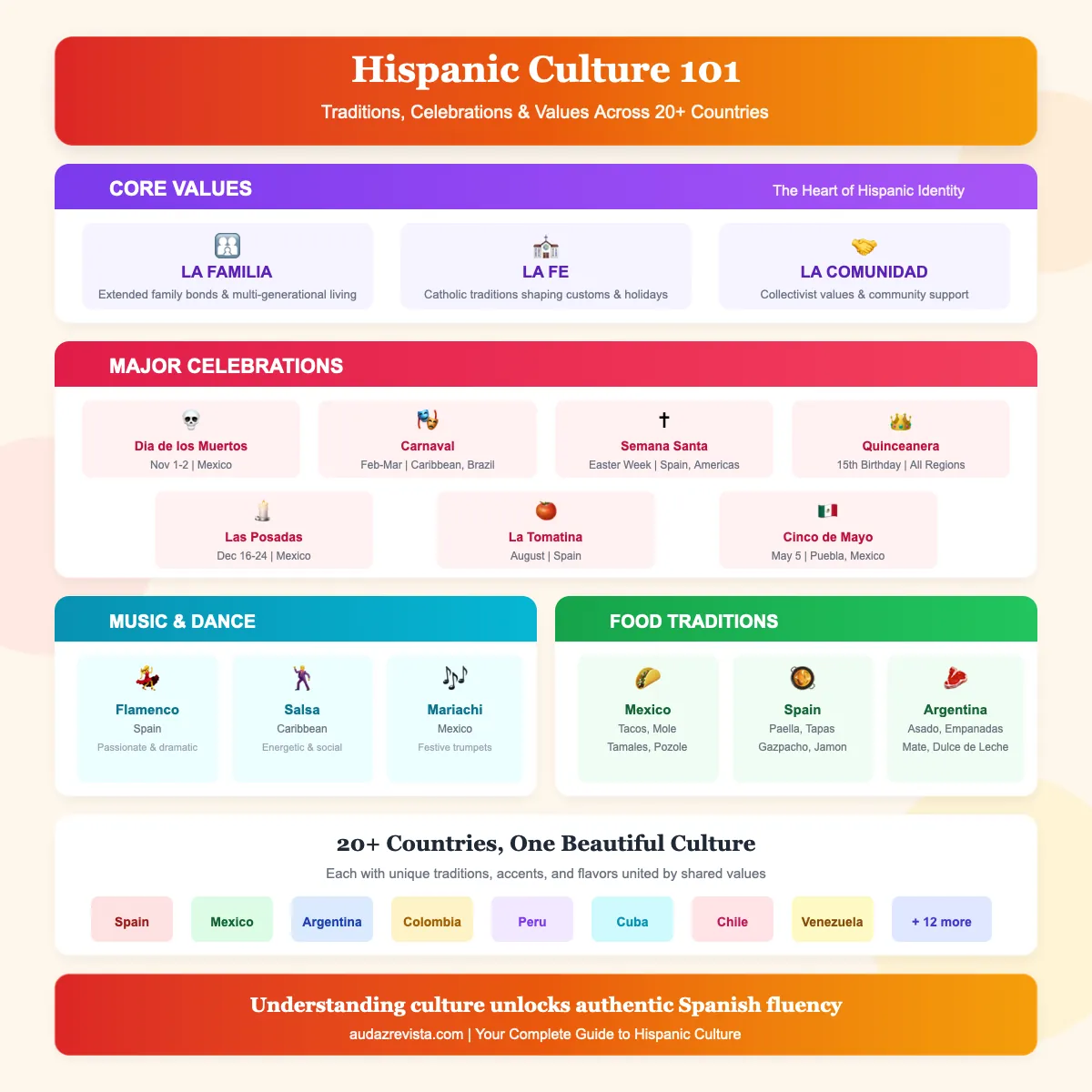
- Core Values: Family, Faith & Community
- Major Celebrations & Holidays
- Regional Differences: Spain vs Latin America
- Food Traditions & Culinary Heritage
- Music & Dance: The Soul of Hispanic Culture
- Cultural Mistakes to Avoid
- Expert Tips for Cultural Immersion
- Frequently Asked Questions
- Conclusion & Next Steps
What Is Hispanic Culture? Defining a Diverse Identity
Hispanic culture refers to the traditions, customs, beliefs, and practices of Spanish-speaking peoples worldwide. This encompasses Spain (the origin of the Spanish language) and the 19 Latin American countries where Spanish is the primary language, plus significant communities in the United States and beyond.
Hispanic vs Latino: Understanding the Distinction
These terms are often used interchangeably, but they have different meanings:
- Hispanic refers to people from Spanish-speaking countries (linguistic/cultural)
- Latino/Latina refers to people from Latin America (geographic)
A person from Spain is Hispanic but not Latino. A Brazilian is Latino but not Hispanic (they speak Portuguese). A Mexican-American might identify as both. These identities are personal, and many people have strong preferences about which term applies to them.
The Diversity Within Unity
While Hispanic cultures share language and certain foundational values, the diversity is immense:
- Spain — Mediterranean European culture with distinct regional identities (Catalonia, Basque Country, Andalucía)
- Mexico — Rich indigenous heritage blended with Spanish colonial influence
- Caribbean (Cuba, Puerto Rico, Dominican Republic) — African, Spanish, and indigenous Taíno influences
- Central America — Maya heritage, coffee culture, and distinct national identities
- South America — From Andean cultures in Peru and Bolivia to the European-influenced Argentina and Uruguay
Why Cultural Understanding Matters for Language Learners
Learning Spanish without understanding Hispanic culture is like learning music theory without ever hearing a song. Culture provides:
1. Contextual Understanding
Why does Spanish have formal (usted) and informal (tú) forms? Because respect for elders and hierarchy is deeply embedded in the culture. Understanding this helps you use them appropriately.
2. Idiomatic Fluency
Expressions like “estar en la luna” (to be on the moon = daydreaming) or “no hay mal que por bien no venga” (every cloud has a silver lining) only make sense with cultural context.
3. Social Navigation
Knowing that punctuality standards differ, that declining food might offend hosts, or that business relationships require personal rapport—this knowledge prevents social missteps.
4. Authentic Connection
Native speakers open up when you demonstrate cultural awareness. Mentioning Día de los Muertos or asking about someone’s quinceañera shows genuine interest beyond superficial language learning.
Core Values: Family, Faith & Community (Familia, Fe y Comunidad)
La Familia — The Central Pillar
Family is the foundation of Hispanic culture. This manifests in ways that may surprise those from more individualistic cultures:
- Extended family is immediate family — Grandparents, aunts, uncles, and cousins are central, not peripheral
- Multi-generational living — Adult children often live with parents until marriage, and elderly parents typically live with their children rather than in nursing homes
- Family gatherings are frequent and lengthy — Sunday lunches can last 4-5 hours with multiple generations
- Family approval matters — Major decisions (career, relationships) often involve family input
Key vocabulary:
- Sobremesa — The time spent talking at the table after a meal (a cherished tradition). Learn more about the tradition of sobremesa and why it’s central to Spanish social life.
- Compadrazgo — The relationship between a child’s parents and godparents (extremely important)
- Respeto — Respect, especially toward elders
La Fe — Faith and Spirituality
Catholicism has profoundly shaped Hispanic culture, though religious practice varies from deeply devout to culturally Catholic. Even secular Hispanics often celebrate religious holidays and use religious expressions:
- Religious holidays are cultural events—Semana Santa, Día de los Santos, Christmas traditions
- Common expressions — “Si Dios quiere” (God willing), “Gracias a Dios” (Thank God), “Vaya con Dios” (Go with God)
- Saints’ days — Many people celebrate their “santo” (the feast day of their namesake saint) in addition to birthdays
- Shrines and religious imagery — Common in homes and businesses
La Comunidad — Community and Social Bonds
Hispanic cultures tend toward collectivism over individualism:
- Physical closeness — Personal space is smaller; physical touch in conversation is normal
- Social warmth — Greetings involve kisses on cheeks (number varies by country)
- Group orientation — Decisions consider group harmony; direct confrontation is often avoided
- Hospitality — Guests are treated generously; offering food and drink is automatic
Major Celebrations & Holidays
Día de los Muertos (Day of the Dead) — October 31 – November 2
Perhaps the most internationally recognized Hispanic tradition, Día de los Muertos originated in Mexico but has spread throughout Latin America and beyond.
What it is: A celebration honoring deceased loved ones, blending pre-Columbian indigenous beliefs with Catholic All Saints’ and All Souls’ Days.
Key elements:
- Ofrendas — Altars decorated with photos, marigolds, candles, and favorite items of the deceased
- Calaveras — Decorative skulls, often made of sugar
- Pan de muerto — Sweet bread baked for the occasion
- Cempasúchil — Marigold flowers believed to guide spirits home
- Cemetery visits — Families gather at graves for all-night vigils with food, music, and memories
Cultural significance: Unlike morbid associations with death in some cultures, Día de los Muertos celebrates death as a natural part of life. The mood is festive, not somber. Families believe deceased relatives return briefly to the world of the living. For a deeper exploration of this beautiful celebration, read our complete guide to Día de los Muertos traditions.
Cinco de Mayo — May 5
What it actually commemorates: Mexico’s victory over French forces at the Battle of Puebla in 1862—NOT Mexican Independence Day (which is September 16).
In Mexico: A relatively minor holiday, mainly celebrated in Puebla state with parades and battle reenactments.
In the United States: Evolved into a celebration of Mexican-American culture with festivals, music, and food. While some criticize its commercialization, many Mexican-Americans embrace it as a day of cultural pride.
Semana Santa (Holy Week)
The week leading to Easter is arguably the most important religious observance in the Hispanic world.
In Spain: Famous processions with pasos (elaborate floats with religious statues) and penitentes (hooded participants). Seville’s celebrations are world-renowned.
In Latin America: Dramatic reenactments of the Passion, street processions, and elaborate church services. In Guatemala, streets are carpeted with intricate designs made from colored sawdust and flowers.
Las Posadas — December 16-24
A nine-day celebration reenacting Mary and Joseph’s search for lodging before Jesus’s birth.
The tradition: Groups go house to house singing, asking for “posada” (lodging). They’re turned away until reaching the designated host home, where a party awaits with food, piñatas, and ponche (hot fruit punch).
Quinceañera — 15th Birthday Celebration
The quinceañera marks a girl’s transition from childhood to womanhood at age 15.
Elements:
- Religious ceremony (typically a Catholic mass of thanksgiving)
- Elaborate party with formal dress, court of honor (chambelanes and damas)
- Special traditions: changing from flat shoes to heels, receiving the last doll, the waltz
- Can be as elaborate as a wedding, with significant family investment
Other Notable Celebrations
- La Tomatina (Spain) — World’s largest tomato fight in Buñol, Valencia
- Carnaval — Pre-Lenten celebrations, especially spectacular in Rio, Barranquilla (Colombia), and Trinidad
- Feria de Abril (Spain) — Seville’s April fair with flamenco, horses, and revelry
- Día de los Reyes (January 6) — Three Kings Day, often more important than Christmas for gift-giving
Regional Differences: Spain vs Latin America
Linguistic Differences
- Vosotros — Spain uses this plural “you” form; Latin America uses “ustedes” for both formal and informal
- Pronunciation — Spain has the “th” sound (distinción) for “c” and “z”; Latin America uses “s” (seseo)
- Vocabulary — Computer is “ordenador” in Spain, “computadora” in Latin America; many other differences exist
For a detailed comparison of how the language differs across regions, explore our guide on differences between Spain and Mexico.
Cultural Differences
- Meal times — Spain eats dinner around 9-10 PM; Latin America generally earlier. Explore more Spanish daily customs that shape everyday life.
- Siesta tradition — More prevalent in Spain (though declining in cities)
- Indigenous influence — Strong in Mexico, Central America, and Andean regions; less so in Spain and Southern Cone
- African influence — Prominent in Caribbean nations, Colombia’s coast, and Brazil’s neighbors
Food Traditions & Culinary Heritage
Food is central to Hispanic culture—it’s how love is expressed, community is built, and traditions are passed down.
Spain
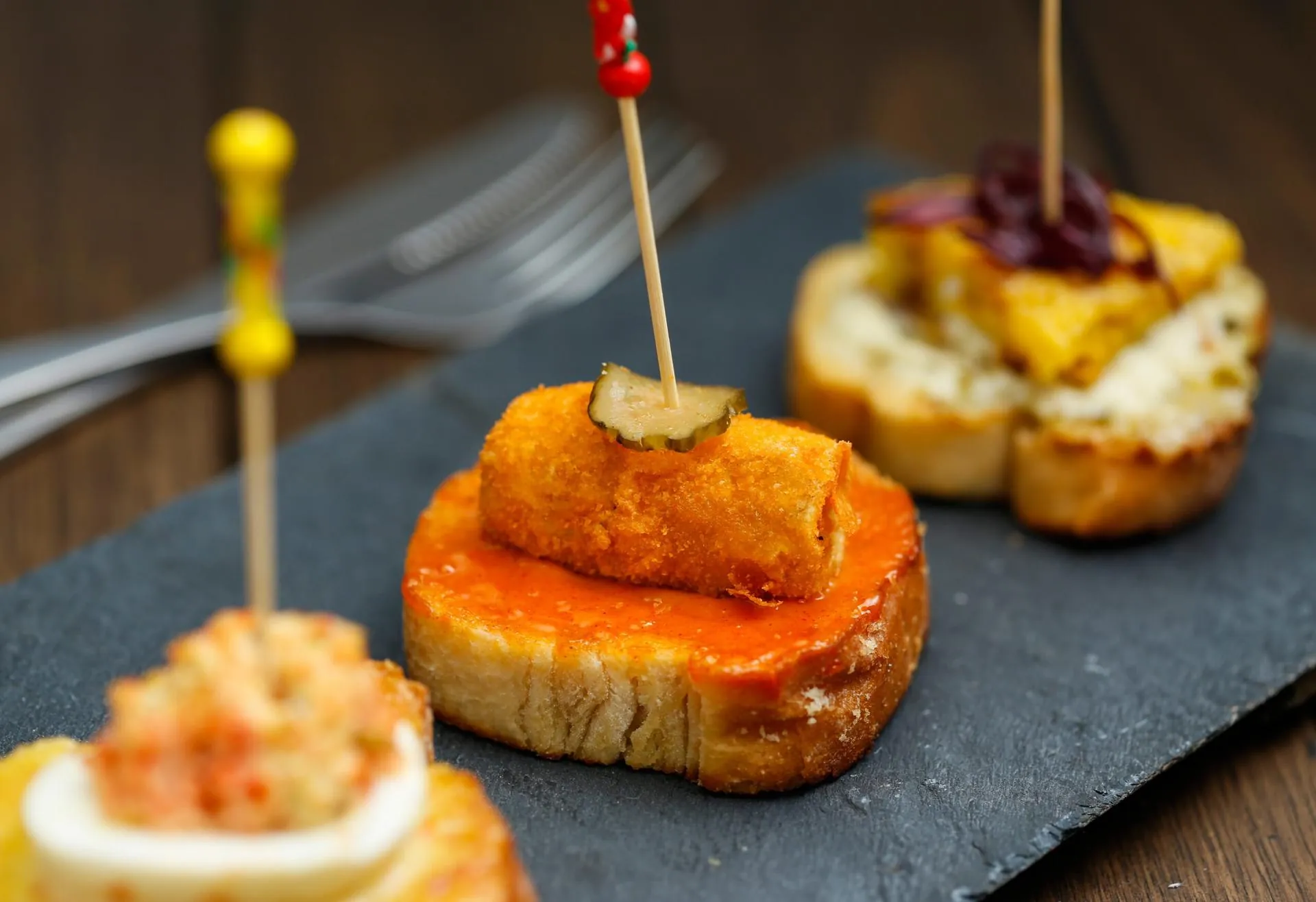
- Tapas culture — Small dishes meant for sharing and socializing
- Paella — Valencia’s rice dish, traditionally made outdoors for gatherings
- Jamón ibérico — Cured ham, almost sacred in Spanish cuisine
- La sobremesa — Extended conversation after meals
Mexico
- Corn-based cuisine — Tortillas, tamales, pozole, atole
- Mole — Complex sauces with dozens of ingredients
- Street food culture — Tacos, elotes, churros
- Day of the Dead foods — Pan de muerto, sugar skulls
Peru
- Ceviche — Fresh fish “cooked” in citrus
- Fusion cuisine — Japanese-Peruvian (Nikkei) and Chinese-Peruvian (Chifa) traditions
- Potato diversity — Over 3,000 varieties native to Peru
Argentina
- Asado — Barbecue as social institution
- Mate — Shared herbal tea, a daily ritual
- Italian influence — Pizza, pasta, and pastries
Music & Dance: The Soul of Hispanic Culture
Flamenco (Spain)
More than entertainment, flamenco expresses the duende—deep emotional truth. Originating in Andalucía from Romani, Moorish, and Jewish influences, it combines guitar, singing (cante), dance, and rhythmic clapping (palmas).
Salsa (Caribbean/New York)
Born from Cuban son music mixed with jazz in 1960s New York, salsa is now global. Its name means “sauce”—a blend of flavors from multiple cultures.
Mariachi (Mexico)
String-based ensemble music essential to Mexican celebrations. A mariachi serenade is a classic romantic gesture. UNESCO recognizes mariachi as Intangible Cultural Heritage.
Tango (Argentina/Uruguay)
Born in the working-class neighborhoods of Buenos Aires and Montevideo, tango is both music and dance expressing passion, loss, and urban life. Also UNESCO-protected.
Reggaeton (Puerto Rico)
Modern urban genre combining Caribbean rhythms with hip-hop. Artists like Bad Bunny and Daddy Yankee have made it globally dominant.
Cultural Mistakes to Avoid
1. Being Too Direct
Hispanic cultures generally value indirectness in sensitive situations. Blunt feedback can seem rude. Learn to soften messages and read between the lines.
2. Rushing Meals
Asking for the check immediately after finishing food is jarring. Sobremesa is expected—enjoy the conversation.
3. Declining Food Insistently
When a host offers food, a polite acceptance (even if just a little) honors their hospitality. Repeated refusal can offend.
4. Punctuality Expectations
Social events often start later than stated. Arriving “on time” to a party might mean arriving before the host is ready. Business contexts are generally more punctual.
5. Misusing Cinco de Mayo
Treating it as “Mexican Day” or Mexican Independence Day shows cultural ignorance. Know what you’re celebrating.
6. Generalizing “Hispanic” Culture
Argentina is not Mexico is not Spain. Each country and region has distinct traditions, foods, and identities. Avoid treating Hispanic culture as monolithic.
Expert Tips for Cultural Immersion
1. Embrace Physical Affection
Greet with a cheek kiss (one in most of Latin America, two in Spain). Accept hugs. Stand close during conversation. This isn’t invasive—it’s warm.
2. Learn About Your Target Region
If you’ll be in Colombia, study Colombian culture specifically. Watch Colombian films, listen to Colombian music, learn Colombian slang.
3. Participate in Celebrations
If invited to a quinceañera, posada, or family gathering—go! Participation shows respect and creates authentic learning experiences.
4. Ask Questions Respectfully
Showing curiosity about traditions flatters most people. “I don’t know much about [tradition]—could you tell me about it?” opens wonderful conversations.
5. Learn Religious Context
Even if you’re not Catholic, understanding Catholic traditions helps you understand Hispanic culture. Many cultural practices have religious roots.
Frequently Asked Questions
Is “Hispanic” offensive to some people?
Some prefer “Latino/a” or specific nationalities (Mexican, Colombian, etc.). The term “Latinx” is used in some U.S. contexts but is controversial in Spanish-speaking countries. When possible, ask individuals their preference.
How do I show respect to elders in Hispanic culture?
Use “usted” (formal “you”), greet them first, offer your seat, use titles like “Don” or “Doña.” Listen attentively and don’t interrupt. Physical affection (hugs, cheek kisses) is appropriate and expected.
Are all Hispanic countries very religious?
Religious practice varies widely by country, generation, and individual. Uruguay is highly secular; Guatemala has a strong evangelical presence; Mexico ranges from deeply devout to agnostic. Cultural Catholicism (celebrating traditions without regular practice) is common.
How important is knowing about culture if I’m just learning Spanish for business?
Essential. Business in Hispanic cultures often depends on personal relationships (personalismo). Building rapport, sharing meals, and understanding cultural context significantly affects professional success.
Can I participate in Día de los Muertos celebrations if I’m not Hispanic?
Yes, if you do so respectfully. Many communities welcome participation. Learn the meaning behind traditions, avoid costumes that mock or sexualize the imagery, and approach with sincere interest rather than tourism.
Conclusion & Next Steps
Cultural fluency is a journey, not a destination. The more you learn about Hispanic traditions, values, and history, the more your language skills will flourish—and the more meaningful your connections will become.
Your next steps:
- Explore our guides to specific celebrations like Día de los Muertos and Semana Santa
- Learn the language basics with our Essential Spanish Phrases guide
- Immerse yourself through our Spanish Media & Entertainment guide for films, music, and podcasts
- Plan cultural experiences with our Spanish for Travel guide
Remember: every cultural misunderstanding is a learning opportunity. Approach Hispanic culture with humility, curiosity, and genuine respect, and doors will open that remain closed to those who only learn vocabulary.
¡Bienvenido al mundo hispano! — Welcome to the Hispanic world!
🌎 Explore Hispanic Culture
Dive deeper into Spanish and Latin American traditions: