What if the fastest way to learn Spanish was also the most enjoyable? While textbooks have their place, research consistently shows that immersive entertainment—movies, TV shows, music, and podcasts—accelerates language acquisition dramatically. You’re not just memorizing vocabulary; you’re absorbing how native speakers actually talk, including slang, humor, emotional expression, and cultural references.
At Audaz Revista, we’ve curated the ultimate guide to learning Spanish through entertainment. Whether you’re a complete beginner looking for accessible content or an advanced learner ready for fast-paced dialogue, you’ll find recommendations tailored to your level—plus proven strategies for turning passive watching into active learning.
Grab your popcorn, queue up your playlist, and discover why “studying” Spanish has never been more fun.
Table of Contents
- Why Learning Through Media Works
- Best Spanish Shows on Netflix by Level
- Essential Spanish-Language Movies
- Spanish Music: Artists & Playlists for Learning
- Spanish Podcasts for Every Level
- YouTube Channels for Spanish Learners
- Books & Audiobooks
- How to Watch Effectively: Active Learning Techniques
- Common Mistakes When Learning Through Media
- Expert Tips for Media-Based Learning
- Frequently Asked Questions
- Conclusion & Your Immersion Plan
Why Learning Through Media Works
Traditional language learning often fails because it lacks context, emotion, and repetition in natural patterns. Media-based learning solves all three:
The Science Behind Entertainment-Based Learning
- Comprehensible input — Linguist Stephen Krashen’s research shows we acquire language best through input we mostly understand but that challenges us slightly. Visual context (seeing what’s happening) makes TV and movies ideal
- Emotional engagement — When content moves you emotionally, your brain forms stronger memory connections. You’ll remember vocabulary from an intense scene better than from a flashcard
- Natural speech patterns — Native speakers don’t talk like textbooks. Media exposes you to contractions, filler words, regional accents, and real conversational rhythm
- Cultural context — Understanding jokes, references, and social dynamics teaches you how language functions in real life
- Repetition without boredom — You can rewatch favorite scenes without the tedium of drilling vocabulary lists
What Research Says
A study published in the Journal of Educational Psychology found that students who supplemented their language courses with foreign-language television showed significantly greater improvements in listening comprehension and vocabulary acquisition compared to those who only used traditional methods.
Best Spanish Shows on Netflix by Level
Beginner (A1-A2): Shows with Clear Speech and Visual Context
Destinos: An Introduction to Spanish
An educational telenovela specifically designed for Spanish learners. While dated, it’s excellent for true beginners—dialogue is deliberately clear and slow.
Extra en Español
Think “Friends” but designed for language learners. Exaggerated situations, simple vocabulary, and slow speech make it perfect for beginners.
Pocoyo (children’s animation)
Don’t underestimate children’s content. Simple vocabulary, clear pronunciation, and repetition make animated shows surprisingly effective.
Intermediate (B1-B2): Engaging Stories with Manageable Complexity
La Casa de Papel (Money Heist)
Spain’s global phenomenon about an elaborate heist. European Spanish with clear diction, gripping plot. Ideal for intermediate learners ready for authentic content.
Élite
Teen drama set in an exclusive Spanish private school. Contemporary slang, relationship drama, and mystery elements. Spain Spanish.
Club de Cuervos
Mexican comedy about a dysfunctional family inheriting a soccer team. Mexican Spanish, humor, and business vocabulary. Excellent cultural insights.
Narcos
While partly in English, the Spanish portions feature Colombian and Mexican Spanish. Good for learning to distinguish accents. Mature content.
Gran Hotel
Period drama set in early 1900s Spain. Clearer speech than modern shows, romance and mystery. Great for those who enjoy “Downton Abbey” style drama.
Advanced (C1-C2): Fast-Paced Native Content
Vis a Vis (Locked Up)
Gritty Spanish prison drama. Fast dialogue, slang, and intense emotional scenes. Not for the faint of heart.
Las Chicas del Cable (Cable Girls)
1920s Madrid drama following telephone operators. Period vocabulary plus modern storytelling.
El Marginal
Argentine prison drama with heavy Argentine Spanish (voseo, distinct accent). Challenging but rewarding for advanced learners wanting exposure to River Plate Spanish.
La Casa de las Flores
Mexican dark comedy about a wealthy family’s secrets. Witty dialogue, Mexican slang, and cultural commentary. Requires strong comprehension.
Documentary Options
- Rotten (Spanish episodes) — Food industry exposés
- Maradona in Mexico — Sports documentary
- Street Food: Latin America — Cultural and culinary exploration
Essential Spanish-Language Movies
Classics Every Learner Should Watch
El Laberinto del Fauno (Pan’s Labyrinth) — Guillermo del Toro, Spain
Dark fantasy set in post-Civil War Spain. Accessible Spanish, visually stunning, culturally significant.
Y Tu Mamá También — Alfonso Cuarón, Mexico
Coming-of-age road trip. Mexican Spanish, mature themes, considered one of the best films of the 2000s.
El Secreto de Sus Ojos (The Secret in Their Eyes) — Argentina
Oscar-winning thriller. Argentine Spanish with clear dialogue despite the accent.
Amores Perros — Alejandro González Iñárritu, Mexico
Interlocking stories in Mexico City. Raw, intense, and linguistically challenging.
Todo Sobre Mi Madre (All About My Mother) — Pedro Almodóvar, Spain
Almodóvar’s masterpiece about motherhood and identity. Clear Spanish, emotional depth.
Recent Hits
- Roma (2018) — Alfonso Cuarón’s Oscar winner set in 1970s Mexico City
- El Hoyo (The Platform) (2019) — Spanish sci-fi thriller
- Relatos Salvajes (Wild Tales) (2014) — Argentine anthology of revenge stories
- No (2012) — Chilean political drama about the Pinochet referendum
Feel-Good Films for Beginners
- Coco — Pixar film with Mexican cultural themes (watch in Spanish dub)
- Instructions Not Included — Mexican comedy-drama, accessible dialogue
- La Misma Luna (Under the Same Moon) — Immigration drama, clear speech
Spanish Music: Artists & Playlists for Learning
Why Music Is Powerful for Language Learning
- Repetition — You’ll replay songs you love dozens of times
- Pronunciation — Singing along improves accent and rhythm
- Vocabulary — Lyrics stick in memory through melody
- Cultural insight — Music reflects society’s emotions and concerns
Artists by Genre
Pop/Ballads (Clear lyrics, great for beginners)
- Juanes (Colombia) — Clear singing, meaningful lyrics
- Shakira (Colombia) — Global star with accessible Spanish songs
- Pablo Alborán (Spain) — Beautiful ballads, clear pronunciation
- Luis Miguel (Mexico) — Classic romantic songs
- Natalia Lafourcade (Mexico) — Folk-influenced, poetic lyrics
Reggaeton/Urban (Contemporary vocabulary and slang)
- Bad Bunny (Puerto Rico) — Dominant force in modern Latin music
- J Balvin (Colombia) — Catchy hooks, Colombian expressions
- Daddy Yankee (Puerto Rico) — Reggaeton pioneer
- Rosalía (Spain) — Flamenco-influenced modern sound
- Karol G (Colombia) — Popular female reggaeton artist
Rock/Alternative
- Maná (Mexico) — Latin rock legends
- Café Tacvba (Mexico) — Creative, varied styles
- Soda Stereo (Argentina) — Foundational rock en español
- Los Bunkers (Chile) — Chilean rock
Traditional/Folk
- Buena Vista Social Club (Cuba) — Cuban classics
- Mercedes Sosa (Argentina) — Folk legend
- Chavela Vargas (Mexico) — Ranchera and bolero
- Paco de Lucía (Spain) — Flamenco guitar virtuoso
Songs Perfect for Learners
- El Daily (New York Times en Español) — News analysis
- CNN en Español — International news
- NotiCast (Mexico) — Mexican news
YouTube Channels for Spanish Learners
Learning Channels
- Dreaming Spanish — Comprehensible input method with content at all levels
- SpanishPod101 — Structured video lessons
- Butterfly Spanish — Mexican teacher explains grammar clearly
- Why Not Spanish — Colombian couple’s lessons and vlogs
- Spanish with Vicente — Spain Spanish with grammar focus
Native Content Channels
- Luisito Comunica — Mexican travel vlogger (clear speech, interesting topics)
- HolaSoyGerman — Chilean comedy (fast but popular)
- Enchufe.tv — Ecuadorian comedy sketches
- Juanpa Zurita — Mexican content creator
- Jaime Altozano — Spanish musician explains music theory (educational)
Books & Audiobooks
Graded Readers (by level)
- TPRS Books — “Brandon Brown” series (A1-A2)
- Olly Richards — “Short Stories in Spanish” (A2-B1)
- Paco y su Familia — (A1 beginner stories)
Classic Literature (Advanced)
For a curated list of the best reading material at every level, check out our guide to Spanish books for learners.
- Cien Años de Soledad — Gabriel García Márquez (magical realism masterpiece)
- La Sombra del Viento — Carlos Ruiz Zafón (accessible literary fiction)
- Como Agua para Chocolate — Laura Esquivel (Mexican culture, food, romance)
- Don Quijote — Miguel de Cervantes (the original, challenging but rewarding)
Audiobooks for Commutes
- Audible Spanish — Large selection of Spanish audiobooks
- Spotify audiobooks — Growing Spanish catalog
- LibriVox — Free public domain audiobooks in Spanish
How to Watch Effectively: Active Learning Techniques
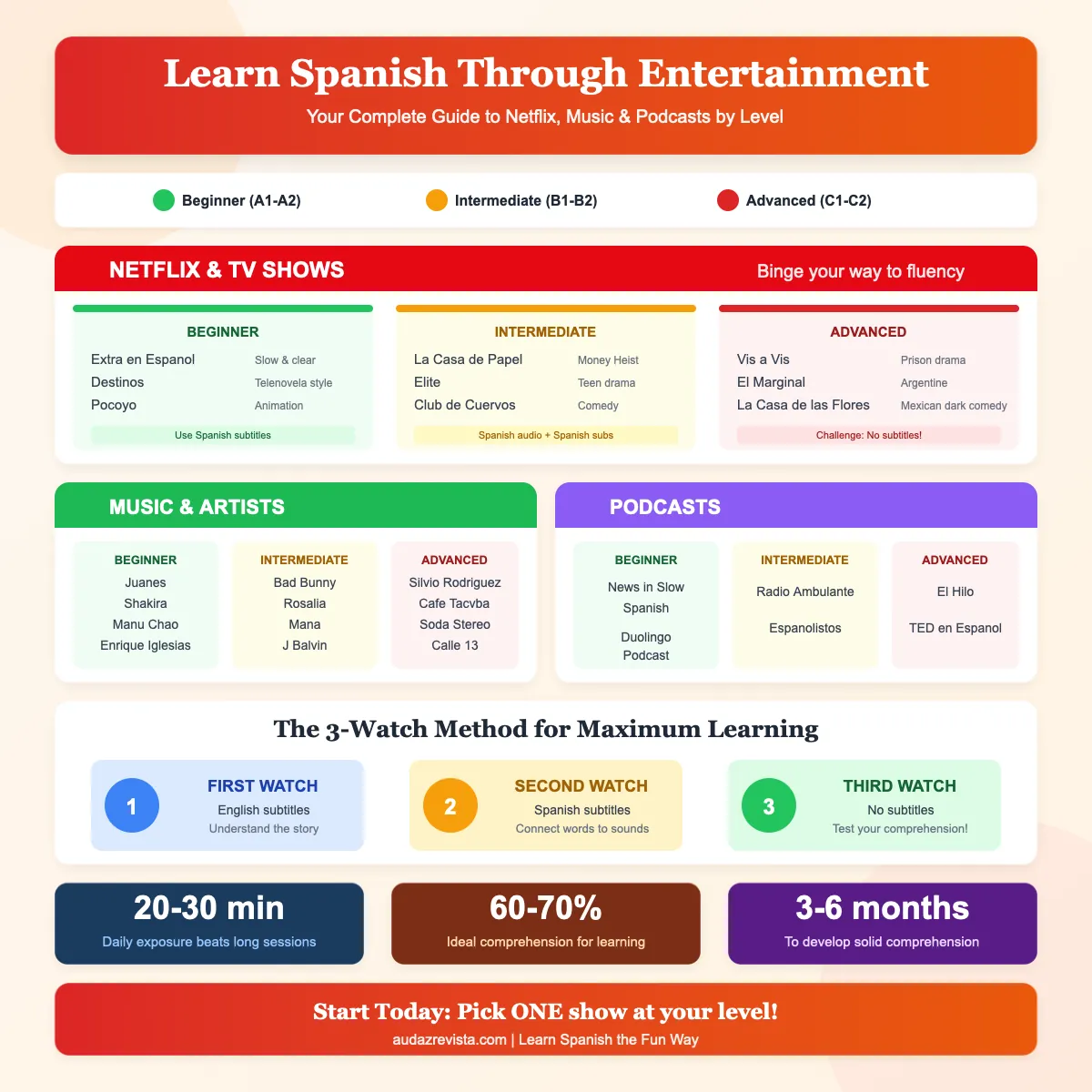
The Three-Watch Method
- Keep a notebook nearby
- Write down new phrases (not individual words)
- Note expressions that sound natural
- Look up unfamiliar words after the episode, not during
Shadowing Technique
- Pause after sentences
- Repeat exactly what was said, mimicking tone and rhythm
- Improves pronunciation and trains your ear
Discussion and Output
- Summarize episodes in Spanish (writing or speaking)
- Find Spanish-speaking friends to discuss shows with
- Write reviews of content in Spanish
Common Mistakes When Learning Through Media
1. Passive Watching
Watching without any active engagement teaches little. Use the techniques above to make viewing productive.
2. Content Too Far Above Your Level
If you understand less than 60-70%, you’ll learn slowly and feel frustrated. Choose content appropriate to your level.
3. Relying Only on English Subtitles
English subtitles help at first, but transition to Spanish subtitles, then no subtitles, as soon as possible.
4. Not Repeating
Rewatching familiar content is incredibly valuable. You’ll catch new words each time.
5. Ignoring Music
Songs are underrated for language learning. The repetition and emotional connection make vocabulary stick.
Expert Tips for Media-Based Learning
1. Create a Spanish Media Environment
Change your phone language to Spanish. Set Netflix profiles to default to Spanish content. Make Spanish your first option, not a “study” activity.
2. Use Language Reactor Extension
This Chrome extension for Netflix lets you see dual subtitles, hover over words for definitions, and save vocabulary. Game-changer for learners.
3. Follow Spanish Social Media
Follow Spanish-speaking influencers, meme accounts, and news sources. Quick, daily exposure adds up.
4. Join Online Communities
Reddit’s r/Spanish, language exchange apps, and Discord servers connect you with other learners and native speakers.
5. Set Achievable Goals
One episode per day. One album per week. Small consistent exposure beats occasional marathons.
Frequently Asked Questions
Should I watch with subtitles?
Yes, but progress from English subtitles → Spanish subtitles → no subtitles as your level improves. Spanish subtitles are particularly valuable for intermediate learners.
How much time should I spend watching Spanish content?
Even 20-30 minutes daily makes a significant difference over time. Consistency matters more than duration.
What if I don’t understand anything?
Start with content designed for learners (like “Destinos” or “Extra en Español”) or children’s shows. Build up gradually.
Does Spanish from Spain or Latin America matter?
Expose yourself to both. The core language is the same, and hearing different accents improves your overall comprehension. Focus on whichever region you’ll interact with most.
Can I really learn Spanish just by watching TV?
Media is powerful but works best alongside other study. Combine watching with grammar review, vocabulary practice, speaking practice, and reading for optimal results.
Conclusion & Your Immersion Plan
The secret to language learning that feels effortless? Make it enjoyable. When you’re genuinely entertained, you forget you’re studying—and that’s when real acquisition happens. Explore more fun ways to learn Spanish that keep you motivated.
Your 30-day immersion challenge:
- Week 1: Watch one Spanish show episode daily with Spanish subtitles
- Week 2: Add a Spanish podcast to your commute or workout
- Week 3: Create a Spanish music playlist and listen daily
- Week 4: Try watching without subtitles and start a Spanish-language book
Ready to build the grammar foundations that will help you understand media better? Check out our Ser vs Estar guide and Essential Spanish Phrases. If you want to learn Spanish fast, combining media immersion with structured study is the proven path.
Want to understand the cultural references in Spanish media? Our Hispanic Culture guide provides the context you need.
¡A disfrutar! — Enjoy!