Nine Days, One City, and a Vocabulary You Won’t Find in Any Textbook
Forget what your textbook told you about Spanish festivals. San Fermin isn’t just the Running of the Bulls. It’s nine days of non-stop culture, music, tradition, and a crash course in Spanish expressions you’ll never learn in a classroom.
Every July, the city of Pamplona transforms. Around a million visitors pour into a city of just 200,000 people. The streets turn white and red. The energy is electric. And the Spanish you’ll hear is fast, loud, and absolutely magnificent.
Your Spanish is about to level up. Let’s unpack the culture, history, and essential vocabulary of Spain’s most famous festival.
The Origins: More Than Just Bulls
San Fermin has roots going back to the medieval period, long before anyone thought to run alongside bulls. The festival honours San Fermin (san fehr-MEEN), the patron saint of Navarra, who according to tradition was martyred in the third century.
The religious celebrations originally took place in October. According to the Ayuntamiento de Pamplona (Pamplona’s city council), the festival was moved to July in 1591 because, well, the weather is better. That’s a very Spanish reason to change a centuries-old tradition.
The encierro (en-see-EH-rroh, the running of the bulls) was added later. Herders needed to move bulls from corrals outside the city to the bullring. Young men started running alongside them, partly for practical reasons, partly because it was thrilling. Over centuries, this practical necessity became the world-famous spectacle you see today.
But here’s the real talk. The encierro is just one event in a packed nine-day programme that includes parades, concerts, religious ceremonies, fireworks, and some of the best street food in Spain.
The Chupinazo: Where It All Begins
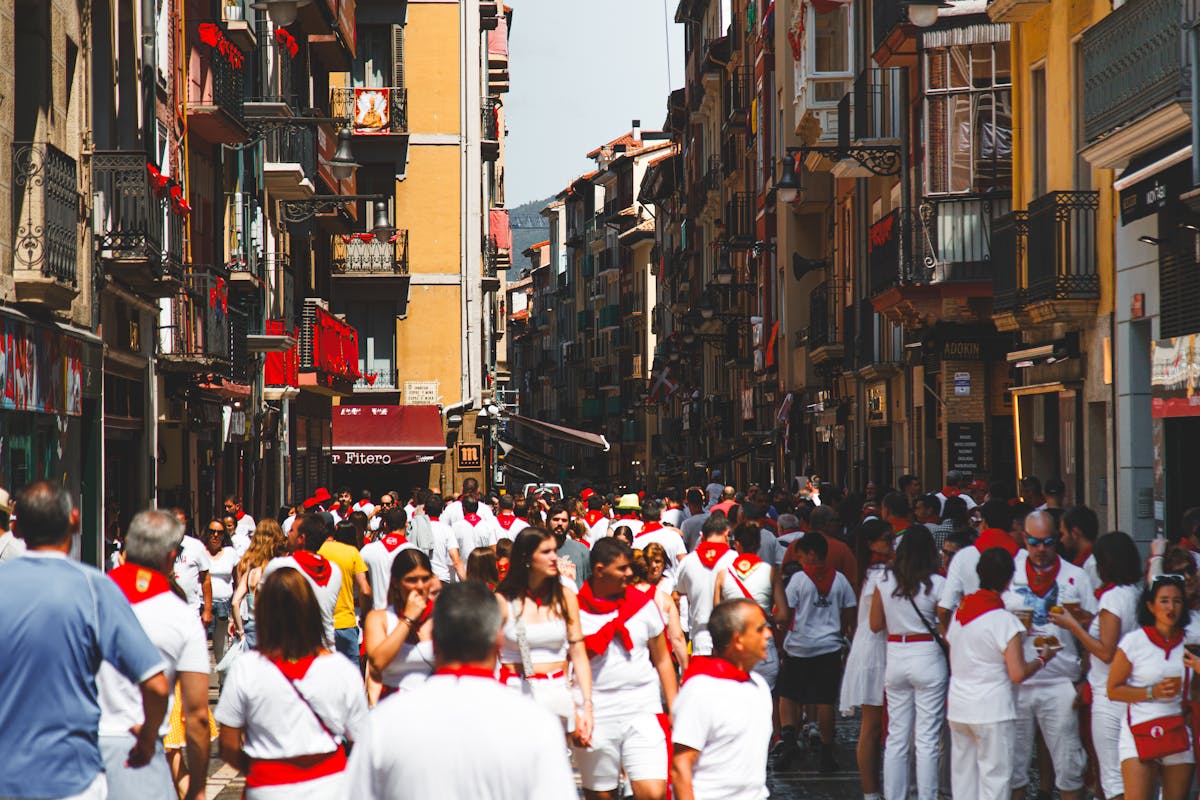
Every year on July 6th at noon, the festival begins with the chupinazo (choo-pee-NAH-so, the opening rocket). Thousands of people pack into the Plaza del Ayuntamiento, all wearing white clothes with red panuelos (pah-nyoo-EH-los, scarves) around their necks.
The mayor or a local dignitary fires a rocket from the balcony of the city hall. The crowd erupts. People spray each other with wine and champagne. The panuelos go on. And for the next nine days, Pamplona doesn’t sleep.
The phrase you’ll hear everyone shouting is “Pamploneses, Pamplonesas, Viva San Fermin!” (pam-ploh-NEH-ses, pam-ploh-NEH-sas, VEE-vah san fehr-MEEN). It means “People of Pamplona, long live San Fermin!” Learn it. You’ll be shouting it too.
The Nine-Day Programme: What Actually Happens
Most outsiders think San Fermin is just the bull run. That’s like saying Christmas is just the tree. Here’s what the full festival actually includes.
The Encierro (Bull Run)
Every morning at 8:00 AM from July 7th to 14th, six bulls and six steers run an 875-metre course through the old town streets to the Plaza de Toros (the bullring). The run takes about three minutes. Runners, called mozos (MOH-sos, young men), wear white with red sashes and try to run as close to the bulls as possible.
Before the run starts, participants sing to a small statue of San Fermin set into the wall on Cuesta de Santo Domingo street. The prayer goes: “A San Fermin pedimos, por ser nuestro patron, nos guie en el encierro, danandonos su bendicion” (ah san fehr-MEEN peh-DEE-mos, por sehr NWES-troh pah-TRON, nos GEE-eh en el en-see-EH-rroh, DAN-doh-nos soo ben-dee-see-ON). Translation: “We ask San Fermin, as our patron, to guide us in the bull run, giving us his blessing.”
Los Gigantes y Cabezudos (Giants and Big-Heads)
This is where San Fermin gets wonderfully bizarre. Every morning, enormous figures called gigantes (hee-GAN-tes, giants) parade through the streets. These are four-metre-tall papier-mache figures representing kings and queens from different continents. They dance. They spin. Kids go absolutely wild for them.
The cabezudos (kah-beh-SOO-dos, big-heads) are smaller figures with oversized heads who chase children through the streets with foam batons. It sounds strange. It’s pure magic.
Procesion de San Fermin
On July 7th, the religious procession carries a wooden statue of San Fermin through the old quarter. This is the heart of the festival’s spiritual tradition, and it draws both devout Catholics and curious visitors. The atmosphere is solemn, respectful, and deeply moving, a complete contrast to the rowdy celebrations happening everywhere else.
Music and Partying
Every evening, penas (PEH-nyas, social clubs or groups of friends) march through the streets playing music, singing, and dancing. The Riau-Riau is a traditional musical event where brass bands fill the streets. Free concerts happen in parks and plazas every night.
The festival’s unofficial anthem, played endlessly by penas, includes lyrics that everyone in Pamplona knows by heart. You’ll pick them up after your second day.
Fireworks and Closing
Every evening at 11:00 PM, fireworks light up the Ciudadela park. Different pyrotechnic companies compete each night, so the displays get increasingly spectacular.
On July 14th at midnight, the festival ends with the “Pobre de Mi” (POH-bray deh mee, “Poor Me”) ceremony. Everyone gathers in the Plaza del Ayuntamiento, holds lit candles, and sings “Pobre de mi, pobre de mi, que se han acabado las fiestas de San Fermin” (POH-bray deh mee, keh seh an ah-kah-BAH-doh las fee-ES-tas deh san fehr-MEEN). It means “Poor me, the San Fermin festivities are over.” People literally cry. It’s beautiful and heartbreaking.
Essential San Fermin Vocabulary
This is where the magic happens for language learners. San Fermin has its own vocabulary that you won’t find in standard Spanish courses. Here are the expressions you need to know.
- Txupinazo (choo-pee-NAH-so): The opening rocket. In Basque-influenced Navarrese Spanish, “tx” makes a “ch” sound.
- Encierro (en-see-EH-rroh): The bull run. From encerrar, meaning to enclose or pen in.
- Mozo (MOH-so): A runner in the encierro. Also means “young man” in general Spanish.
- Pena (PEH-nyah): A social club or group that organises activities during the festival.
- Panuelo (pah-nyoo-EH-loh): The red scarf worn around the neck. Don’t put it on until the chupinazo.
- Faja (FAH-hah): The red sash worn around the waist.
- Corrida (koh-RREE-dah): The bullfight that takes place in the evening after the morning run.
- Txistorra (chees-TOH-rah): A thin, spiced Navarrese sausage. The best street food at San Fermin.
Try using these words in context. They’ll make you sound like someone who’s actually been there, not someone who just watched a documentary.
What Locals Actually Think About San Fermin
Here’s something most travel guides won’t tell you. Pamplona’s locals, known as pamploneses (pam-ploh-NEH-ses), have a complicated relationship with their own festival.
Many adore it. The penas plan all year for it. Families have traditions that go back generations. Grandparents bring grandchildren to see the gigantes for the first time. It’s deeply personal.
But some locals leave town during San Fermin. The noise, the crowds, the mess, it’s overwhelming when it’s your home being overrun. According to a 2023 survey by the Universidad Publica de Navarra, approximately 60% of residents view the festival positively, while around 25% have mixed feelings, particularly about tourist behaviour and noise levels.
If you go, respect this tension. Learn the polite expressions that show you’re a thoughtful visitor. Say “disculpe las molestias” (dees-KOOL-peh las moh-LES-tee-as, “sorry for the inconvenience”) to residents. They’ll appreciate it enormously.
The Ethical Debate: Bulls, Tradition, and Modern Spain
You can’t write about San Fermin without addressing this. The festival’s relationship with bullfighting is one of the most debated topics in modern Spanish culture.
Anti-bullfighting sentiment has grown significantly across Spain. In 2010, Catalonia banned bullfighting entirely (though the Constitutional Court overturned the ban in 2016 on cultural grounds). According to a 2023 Gallup poll conducted in Spain, roughly 58% of Spaniards oppose bullfighting, though support remains stronger in regions with deep taurine traditions like Navarra and Andalusia.
In Pamplona, the debate is passionate on both sides. Supporters argue that tauromaquia (tow-roh-MAH-kee-ah, the art of bullfighting) is an irreplaceable cultural heritage. Critics call it animal cruelty that doesn’t belong in the twenty-first century.
As a visitor, you’ll encounter both perspectives. The vocabulary of this debate is genuinely useful for understanding modern Spain. Words like animalismo (ah-nee-mah-LEES-moh, animal rights activism), tradicion (trah-dee-see-ON, tradition), and patrimonio cultural (pah-tree-MOH-nee-oh kool-too-RAHL, cultural heritage) come up constantly in Spanish media and conversations about festivals across the country.
How to Experience San Fermin Like a Local
If you’re planning to go, here’s the insider playbook.
What to Wear
White shirt, white trousers, red panuelo, red faja. This isn’t optional. Without the uniform, you’ll feel completely out of place. You can buy everything at shops in Pamplona’s old town for around 20-30 euros.
Where to Stay
Book months in advance. Hotels triple their prices. Many locals rent their apartments, and camping options exist on the outskirts. Some experienced festival-goers don’t book accommodation at all, because sleeping is not really part of the programme.
What to Eat
Beyond txistorra, try pimientos del piquillo (pee-mee-EN-tos del pee-KEE-yoh, Navarra’s famous red peppers), chistorra con huevos (chees-TOH-rah kon WHEH-vos, sausage with eggs) for a morning refuel, and cuajada (kwah-HAH-dah, a sheep’s milk dessert). Navarra’s food vocabulary is distinct from the rest of Spain.
Essential Survival Phrases
- “Donde estan los banos?” (DON-deh ehs-TAN los BAH-nyos): “Where are the toilets?” You’ll need this one.
- “Una cerveza, por favor” (OO-nah sehr-VEH-sah, por fah-VOR): “A beer, please.” The most spoken sentence during San Fermin.
- “Vamos a la pena” (VAH-mos ah lah PEH-nyah): “Let’s go to the social club.” This is how you join the real party.
San Fermin and the Spanish Language: Why This Festival Matters for Learners
Festivals are where language comes alive. In a classroom, Spanish is controlled and careful. At San Fermin, it’s raw, emotional, and real. You’ll hear pronunciations you’ve never encountered in textbooks. You’ll learn expressions that only exist in context.
The Navarrese accent is distinctive. It’s clearer and more deliberate than Andalusian Spanish, but with Basque influences that add unique sounds. Listening to pamploneses speak during the festival is like getting a masterclass in regional variation.
And the emotional vocabulary of San Fermin, the joy, the fear, the sadness at the closing ceremony, gives you access to a range of intermediate and advanced expressions that textbooks simply can’t replicate.
Now you understand this culture better. Use this knowledge to connect authentically. Whether you visit Pamplona or simply use these expressions in conversation, your Spanish now carries the weight of one of Spain’s most powerful cultural traditions. Viva San Fermin.
Share

audazrevista
You may also like

Get the Inside Scoop