In This Article
- Myth #1: Those Pointed Hoods Are NOT What You Think
- Myth #2: It’s Not Just Seville
- The Pasos. A Full Year of Preparation
- The Costaleros. Hidden Heroes Under the Floats
- Saetas. When the Whole Street Falls Silent
- Hermandades. The Fierce Competition Nobody Talks About
- Sacred and Street Party. Both at the Same Time
- The Massive Economic Engine Behind the Processions
- Spanish Vocabulary. Talk Like a Local During Semana Santa
- Conclusion
Let’s get something straight. If you think you understand Semana Santa Spain traditions from one photo online, this article is for you. Semana Santa (seh-MAH-nah SAHN-tah, Holy Week) is one of Spain’s most spectacular cultural events. And almost everything outsiders think they know about it is wrong.
We already have a great overview of Semana Santa traditions across Spanish-speaking countries. This time, we’re going deeper. We’re busting myths and fixing the big misconceptions.
By the end, you’ll have insider knowledge. The kind that turns you from a confused tourist into a genuine aficionado. So forget what your textbook told you. Here’s the real Semana Santa.
Myth #1: Those Pointed Hoods Are NOT What You Think
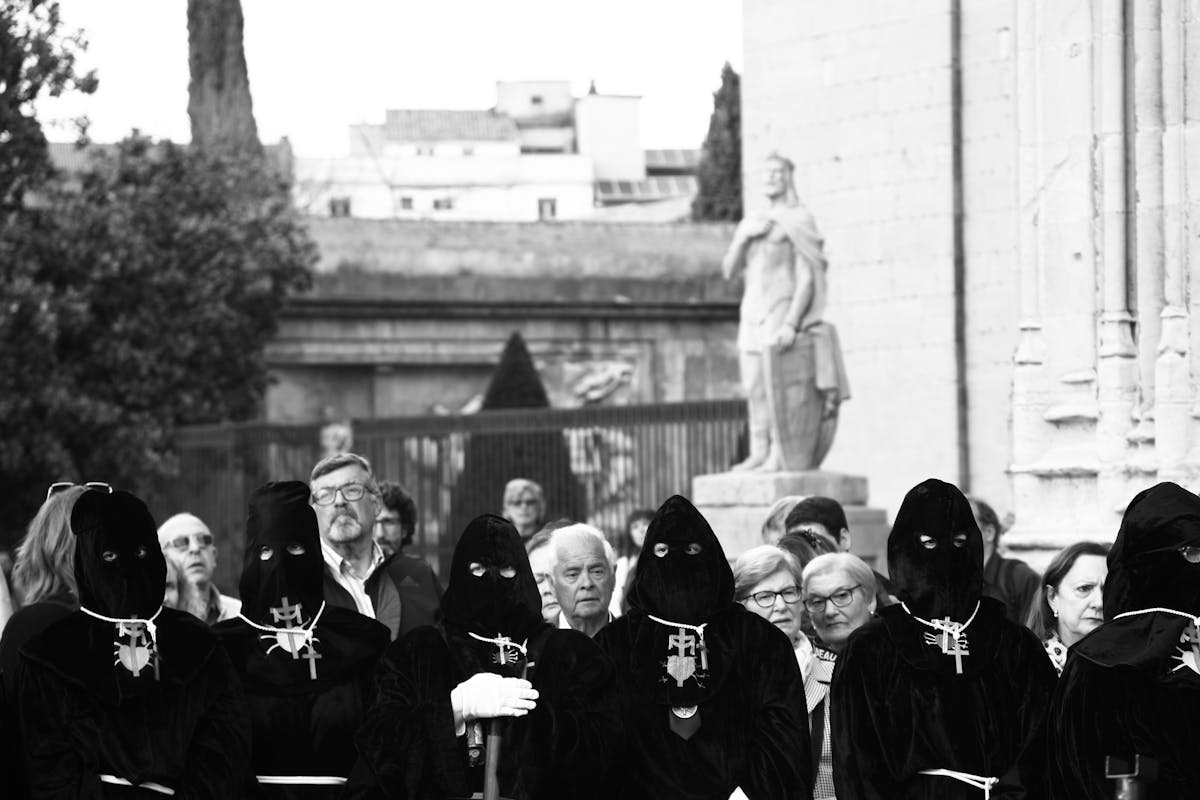
Let’s address the elephant in the room. Every year, photos of Semana Santa processions go viral. People see tall pointed hoods and long robes. Faces are completely hidden. It looks alarming to outsiders, especially those from North America.
But here’s the truth. The capirote (kah-pee-ROH-teh, pointed hood) has been part of Spanish Catholic tradition since medieval times. It existed centuries before any hate group. In fact, the Inquisition used the capirote as public punishment in the 15th century. Condemned people had to wear one in shame.
Over time, the meaning flipped. Wearing the capirote during Semana Santa became a willing act of penitencia (peh-nee-TEN-thee-ah, penance). The hood covers the face because penance should be private. You’re not doing this for social media. You’re doing it between yourself and God. That’s the whole point.
Historian Juan Carrero Rodriguez wrote about this in “Anales de las Cofradias Sevillanas.” He traces the capirote in its current Semana Santa form back to the 16th century. The look-alike to certain American hate symbols is pure coincidence. Spain’s Semana Santa traditions came first, by hundreds of years.
The nazarenos (nah-thah-REH-nohs, penitents) who wear these hoods include men, women, and children. Whole families walk together. It’s a deep honor to take part in the procession.
Myth #2: It’s Not Just Seville
Ask any tourist about Semana Santa Spain traditions and they’ll say “Seville.” Sure, Seville is world-famous for it. But saying Semana Santa only happens in Seville is like saying Christmas only happens in New York.
Every region in Spain has its own distinct flavor,
| City | Known For | Unique Element | Vibe |
|---|---|---|---|
| Seville | Massive processions, dramatic pasos | La Madruga (the Great Dawn), when the most prestigious brotherhoods process from midnight to midday | Emotional, theatrical, loud |
| Malaga | Freed prisoners marching | Prisoners are traditionally released to carry a float. Spectators shout “guapo!” and throw flowers. | Passionate, intense |
| Valladolid | Artistic processional sculptures | Renaissance-era pasos carved by masters like Gregorio Fernandez. Processions are quiet and solemn. | Austere, reverent, silent |
| Zamora | Spain’s oldest Semana Santa | Declared of International Tourist Interest. Medieval atmosphere with candlelight processions. | Dark, ancient, mystical |
| Cartagena | Roman military aesthetics | Participants dress as Roman soldiers. Biblical drama meets military pageantry. | Theatrical, unique |
The Spanish National Tourism Office says over 20 cities have Semana Santa events declared of “International Tourist Interest.” Seville gets the headlines. But exploring beyond the obvious tourist spots will reward you with totally different Semana Santa traditions in Spain.
The Pasos. A Full Year of Preparation
The pasos (PAH-sohs, processional floats) are jaw-dropping. Think massive wooden platforms with life-size religious sculptures on top. They’re lit by hundreds of candles, draped in velvet, and covered in thousands of fresh flowers.
Here’s what most outsiders don’t know. These pasos take a full year to prepare. The moment one Semana Santa ends, work on the next one starts. This is how seriously Spain takes Semana Santa traditions.
What goes into a single paso,
- The sculptures, Many are centuries old. Some were carved by Baroque masters like Juan de Mesa or Pedro Roldan. A single Cristo figure can be worth millions of euros. Each one gets museum-level care.
- The flowers, Thousands of fresh carnations, roses, and irises go on in the hours before each procession. Flower arranging for pasos is a special skill passed down through families.
- The candles, Hundreds of beeswax candles are set by hand. The dripping wax pattern on the paso is part of its beauty.
- The clothing, Virgin Mary figures wear real embroidered robes. Some are studded with actual jewels. Dedicated seamstresses care for these all year long.
- The silver and gold, Many pasos have ornate silver candelabras and gold-leaf details. These need regular polishing and restoration.
Some pasos weigh over 5, 000 kilograms. That’s about as heavy as a large SUV. And human beings carry them. Which brings us to the next big reveal.
The Costaleros. Hidden Heroes Under the Floats
Under every paso, hidden from view, are the costaleros (kohs-tah-LEH-rohs, float carriers). These teams of 24 to 48 people carry the huge floats on their necks. They use a wooden beam called a trabajadera (trah-bah-hah-DEH-rah).
Let that sink in. They carry a 5, 000-kilogram float on their necks. For hours. Through narrow streets. Sometimes uphill. This is one of the most intense Semana Santa Spain traditions you’ll ever see.
Being a costalero is a tough physical test and a deep honor. Teams train for months. They walk in perfect sync, guided by a capataz (kah-pah-TAHTH, foreman). The capataz uses a bell or knocker to give directions. The costaleros can’t see where they’re going. They trust the capataz completely.
The Consejo General de Hermandades y Cofradias de Sevilla says over 15, 000 costaleros take part in Seville’s Semana Santa alone. Many families pass the role from parent to child. Spots on top brotherhoods’ costalero teams have waiting lists that last for years.
The most dramatic moment is the levanta (leh-VAHN-tah, the lift). The capataz gives the signal. The costaleros raise the paso from the ground in one powerful move. The crowd erupts. It gives you chills every single time.
Saetas. When the Whole Street Falls Silent
Picture this. A massive procession moves through a narrow street. Thousands of people watch. Then, from a balcony above, a single voice rings out. The whole procession stops. Everyone goes silent.
That’s a saeta (sah-EH-tah, literally “arrow”). It’s a raw, unplanned flamenco-style song aimed at the religious figure on the paso. The word “arrow” fits perfectly. A good saeta pierces right through you.
Saetas have deep ties to Spain’s flamenco tradition. They use the same emotional vocal style. But unlike a flamenco show in a tablao, a saeta happens in the moment. The singer picks when to sing, which paso to address, and what words to use. These spontaneous songs are a key part of Semana Santa traditions in Spain.
Not just anyone sings a saeta. It takes real vocal skill and cultural knowledge. The best saeta singers are famous in their cities. When word gets out that a top singer is on a certain balcony, crowds rush to that spot just to hear them.
Here are phrases you’ll hear locals use during Semana Santa. Try saying them out loud,
“Que bonita va la Virgen!” (keh boh-NEE-tah bah lah BEER-hen) = “How beautiful the Virgin looks!” Say this when a stunning paso passes by.
“Guapo! Guapa!” (GWAH-poh / GWAH-pah) = “Handsome! Beautiful!” People shout this at the pasos, especially in Malaga.
“Esa es! Esa es!” (EH-sah ehs) = “That’s the one! That’s the one!” Use it when your favorite hermandad passes by.
Now try this, “La Madruga es lo mejor de la Semana Santa.” (The Great Dawn is the best part of Holy Week.) You’ll sound like a local. Try this phrase today. You’ve got this.
Hermandades. The Fierce Competition Nobody Talks About
Behind every procession is a hermandad (er-mahn-DAHD, brotherhood) or cofradia (koh-frah-DEE-ah, confraternity). These groups have kept Semana Santa Spain traditions alive for centuries. Some hermandades date back to the 1300s.
Here’s what nobody tells tourists, the hermandades compete with each other. And they compete hard.
The contest isn’t formal, but it’s very real. Each hermandad wants,
- The most beautiful paso
- The best costalero team (smoothest, most in sync)
- The most stunning flower displays
- The largest number of nazarenos in the procession
- The best saeta singers stopping for their paso
Seville alone has over 60 hermandades. Membership is a big deal. You pay yearly dues. You go to meetings. You help with prep work. Many people in Seville belong to the same hermandad their great-grandparents joined. Switching hermandades is rare. It can even cause family drama.
The Archdiocese of Seville says total hermandad membership across the city tops 250, 000 people. Seville has about 700, 000 residents. That means roughly one in three people belongs to a Semana Santa brotherhood. This isn’t something locals just watch. They take part in it. That’s what makes Spain’s Semana Santa traditions so special.
The rivalry heats up most during La Madruga (lah mah-DROO-gah, the Great Dawn). This is the night from Holy Thursday to Good Friday. The most elite hermandades process during these hours. You need to arrive hours early to get a spot on the route.
Sacred and Street Party. Both at the Same Time
One big myth about Semana Santa? That it’s only a somber religious event. The flip side is also wrong, that it’s just a big party with a religious theme.
The truth is, it’s both at the same time. And that’s what makes it so special.
During a single evening of Semana Santa in Spain, you might see,
- A deeply moving procession that brings people to tears
- Families eating torrijas (toh-REE-hahs, Spanish Easter French toast) at a street stall five meters away
- Teenagers meeting up with friends along the route
- Elderly women praying the rosary as a paso passes
- Kids picking up candle wax drippings from the ground (a beloved tradition)
- Bars and restaurants packed with people eating, drinking, and having a great time
This mix is very Spanish. Sacred and playful exist side by side. You can cry during a saeta and laugh with friends over tapas ten minutes later. Life, faith, and fun all share the same streets at the same time.
It’s a lot like another great Spanish tradition, the siesta and what it reveals about Spanish culture. Spain has a gift for making daily life feel special and big events feel like daily life. These Spanish traditions during Semana Santa show that beautifully.
The Massive Economic Engine Behind the Processions
Here’s something that shocks most people. Semana Santa Spain traditions drive huge economic activity. This isn’t just a cultural event. It’s an economic powerhouse.
A 2024 study by the Universidad de Sevilla found that Semana Santa in Seville alone brings in about 350 million euros. Add the rest of Andalusia, and it tops 600 million euros.
Where does all that money go?
- Hotels, Rooms fill up to 95-100% during Semana Santa. Prices triple or even quadruple compared to normal weeks.
- Restaurants and bars, The food and drink sector has its biggest week of the year. It often beats Christmas.
- Artisan workshops, Embroiderers, woodcarvers, goldsmiths, and candlemakers work all year to supply the hermandades.
- Fashion, Women buy new mantillas (mahn-TEE-yahs, lace veils). Men buy new suits for key processions, especially Jueves Santo (Holy Thursday).
- Transportation, Airlines, trains, and buses add extra trips to handle the demand.
Whole careers exist because of Semana Santa Spain traditions. The imagineros (ee-mah-hee-NEH-rohs, religious sculptors) carve and restore sacred figures. The bordadores (bor-dah-DOH-rehs, embroiderers) create gold-thread designs on the pasos’ mantles. These artisans keep alive crafts that date back to the Renaissance.
Spanish Vocabulary. Talk Like a Local During Semana Santa
Want to learn spanish idioms that’ll make you sound like a Seville local? Here’s your cheat sheet. You won’t find these in any textbook.
- Paso de palio (PAH-soh deh PAH-lee-oh). A float with a canopy (palio) over it. It usually carries a Virgin Mary figure.
- Paso de Cristo (PAH-soh deh KREES-toh). A float carrying a Christ figure, usually without a canopy.
- Cirial (thee-ree-AHL). The tall candlestick that nazarenos carry in the procession.
- Chicota (chee-KOH-tah). A short, thick candle. Also the wax ball that kids roll from street drippings.
- Capataz (kah-pah-TAHTH). The foreman who guides costaleros with a bell or hammer.
- Recogida (reh-koh-HEE-dah). The emotional moment when a paso returns to its church. This is often the most moving part of Semana Santa traditions in Spain.
- Estacion de penitencia (ehs-tah-thee-OHN deh peh-nee-TEN-thee-ah). The official route. It means “station of penance.”
Here’s a bonus phrase that locals love, “La recogida me puso la piel de gallina.” (lah reh-koh-HEE-dah meh POO-soh lah pee-EHL deh gah-YEE-nah) = “The return to the church gave me goosebumps.” This is how native speakers really talk about Spain’s Semana Santa.
For more words that textbooks skip, check out 7 Spanish words your textbook never taught you.
Conclusion
Here’s the real talk. Semana Santa Spain traditions are so much more than what photos and headlines show. The capirotes have a noble, centuries-old history. Every city celebrates in its own way. The pasos are stunning works of art, carried by devoted costaleros. The saetas will stop you in your tracks. And the hermandades keep it all alive through pride and friendly rivalry.
The biggest myth of all? That Semana Santa is something you just watch. It’s not. It’s something you feel. The incense. The candlelight. The drumbeats bouncing off narrow stone walls. The sudden hush before a saeta. You have to be there to get it.
So here’s your plan. Pick a city. Check the hermandad schedules. Show up early for La Madruga. Bring tissues for the saetas. And let Spain’s Semana Santa traditions show you a side of this country that no guidebook can capture.
Pack your bags. Spain during Holy Week is calling. Now you know what you’re really walking into.
Share

audazrevista
You may also like

Get the Inside Scoop