Traveling to a Spanish-speaking country without knowing Spanish is like eating a gourmet meal with a cold—you miss half the flavor. The difference between a tourist experience and an authentic adventure often comes down to your ability to communicate with locals, navigate off the beaten path, and connect with the culture on a deeper level.
This comprehensive guide gives you everything you need: essential Spanish phrases organized by situation, cultural etiquette for different countries, practical tips for navigating transportation, accommodation, and emergencies, and insider knowledge that transforms your trip from ordinary to extraordinary.
Whether you’re heading to the beaches of Mexico, the streets of Barcelona, the mountains of Peru, or the vineyards of Argentina, these phrases and insights will be your passport to authentic experiences.
Table of Contents
- Why Learning Spanish Transforms Your Travel Experience
- Airport & Transportation Phrases
- Hotel & Accommodation Phrases
- Dining Out: Restaurant & Food Phrases
- Shopping & Bargaining
- Directions & Navigation
- Emergency Situations
- Country-Specific Tips
- Common Travel Mistakes to Avoid
- Expert Travel Tips
- Frequently Asked Questions
- Conclusion & Packing Your Phrase List
Why Learning Spanish Transforms Your Travel Experience
Over 500 million people speak Spanish worldwide, making it the fourth most spoken language on Earth. Spanish is the official language in 20 countries and widely spoken in the United States. Learning even basic Spanish unlocks:
Authentic Experiences
- Local recommendations — Taxi drivers, shopkeepers, and locals share their favorite hidden gems when you speak their language
- Better prices — In markets and tourist areas, Spanish speakers often get better deals
- Real connections — Conversations with locals create the memories that define great trips
Practical Benefits
- Navigation — Signs, menus, and announcements become comprehensible
- Safety — Understanding warnings and instructions protects you
- Problem-solving — When things go wrong, communication is essential
The Effort Is Appreciated
Spanish speakers are generally delighted when visitors try to speak Spanish. Even imperfect attempts show respect for the culture. You’ll encounter more patience, friendliness, and helpfulness than travelers who expect everyone to speak English.
Airport & Transportation Phrases
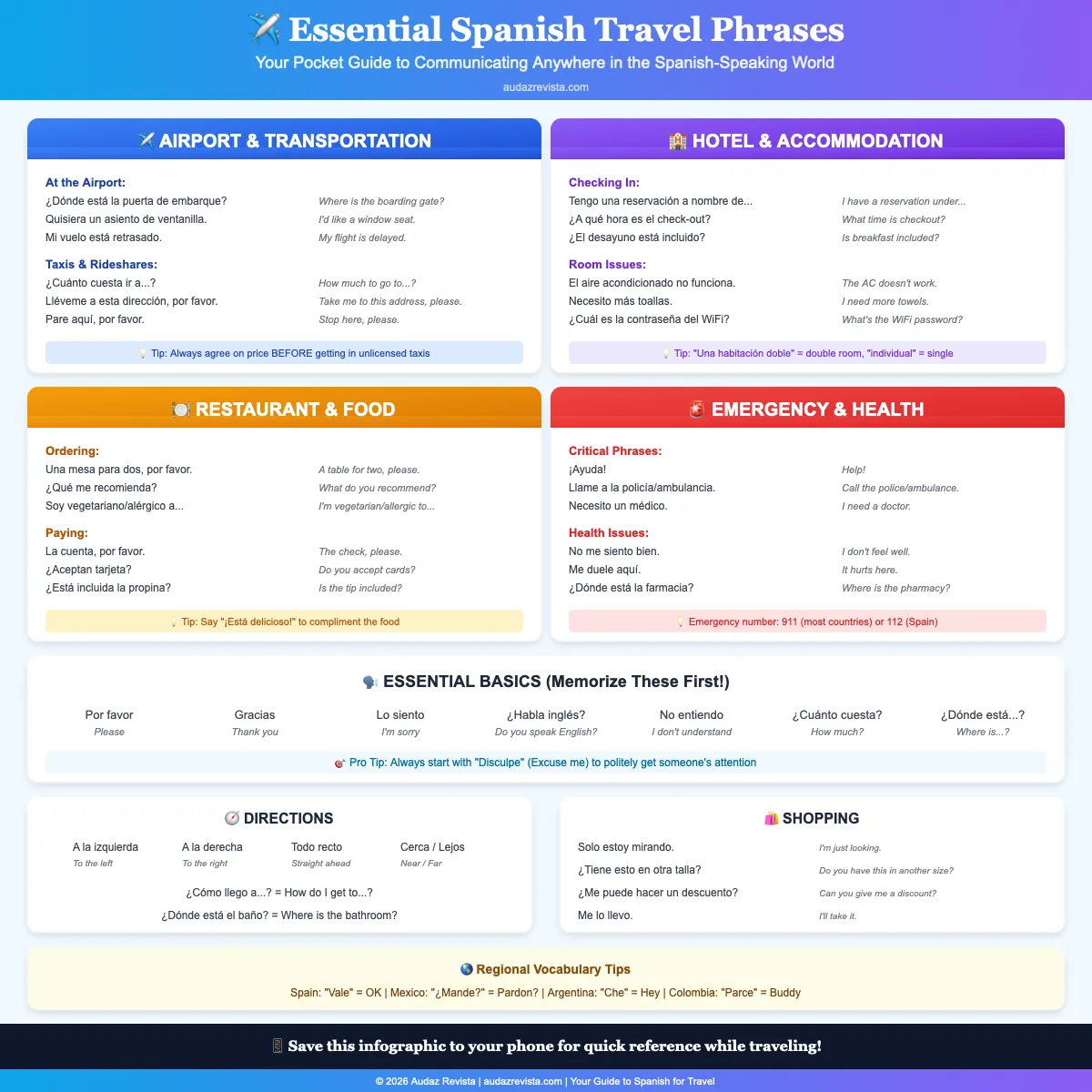
At the Airport (En el Aeropuerto)
Checking In:
- ¿Dónde está el mostrador de [aerolínea]? — Where is the [airline] counter?
- Quisiera un asiento de ventanilla/pasillo. — I’d like a window/aisle seat.
- ¿A qué hora sale el vuelo? — What time does the flight depart?
- ¿Cuál es la puerta de embarque? — Which is the boarding gate?
- Mi vuelo está retrasado/cancelado. — My flight is delayed/cancelled.
At Immigration:
- Estoy aquí de vacaciones/por negocios. — I’m here on vacation/for business.
- Me quedo [número] días. — I’m staying [number] days.
- Aquí tiene mi pasaporte. — Here’s my passport.
Baggage:
- ¿Dónde puedo recoger mi equipaje? — Where can I pick up my luggage?
- He perdido mi maleta. — I’ve lost my suitcase.
- Mi equipaje está dañado. — My luggage is damaged.
Taxis & Rideshares
- ¿Cuánto cuesta ir a…? — How much to go to…?
- Lléveme a esta dirección, por favor. — Take me to this address, please.
- ¿Puede usar el taxímetro? — Can you use the meter?
- Pare aquí, por favor. — Stop here, please.
- ¿Acepta tarjeta? — Do you accept card?
- Quédese con el cambio. — Keep the change.
Public Transportation
- ¿Dónde está la estación de metro/autobús? — Where is the metro/bus station?
- Un boleto/billete a [destino], por favor. — One ticket to [destination], please.
- ¿Este autobús va a…? — Does this bus go to…?
- ¿Cuál es la próxima parada? — What’s the next stop?
- ¿A qué hora sale el último tren? — What time does the last train leave?
Renting a Car
- Quisiera alquilar un coche. — I’d like to rent a car.
- ¿Tiene seguro incluido? — Is insurance included?
- ¿Dónde puedo dejar el coche? — Where can I return the car?
- El tanque está lleno/vacío. — The tank is full/empty.
- ¿Dónde hay una gasolinera? — Where is a gas station?
Hotel & Accommodation Phrases
Making Reservations
- Quisiera reservar una habitación. — I’d like to book a room.
- ¿Tienen habitaciones disponibles? — Do you have rooms available?
- Una habitación doble/individual. — A double/single room.
- Para dos noches. — For two nights.
- ¿Cuánto cuesta por noche? — How much per night?
- ¿El desayuno está incluido? — Is breakfast included?
Check-In & Check-Out
- Tengo una reservación a nombre de… — I have a reservation under the name…
- ¿A qué hora es el check-out? — What time is checkout?
- ¿Puedo dejar mis maletas aquí? — Can I leave my bags here?
- ¿Hay caja fuerte en la habitación? — Is there a safe in the room?
- La llave no funciona. — The key doesn’t work.
Room Issues
- El aire acondicionado no funciona. — The air conditioning doesn’t work.
- No hay agua caliente. — There’s no hot water.
- Necesito más toallas/almohadas. — I need more towels/pillows.
- La habitación es muy ruidosa. — The room is too noisy.
- ¿Pueden limpiar la habitación? — Can you clean the room?
Hotel Amenities
- ¿Tienen WiFi? ¿Cuál es la contraseña? — Do you have WiFi? What’s the password?
- ¿Dónde está la piscina/el gimnasio? — Where is the pool/gym?
- ¿A qué hora sirven el desayuno? — What time do you serve breakfast?
- ¿Pueden llamarme un taxi? — Can you call me a taxi?
Dining Out: Restaurant & Food Phrases
Getting a Table
- Una mesa para dos, por favor. — A table for two, please.
- ¿Tienen mesa afuera/adentro? — Do you have a table outside/inside?
- ¿Hay que esperar mucho? — Is there a long wait?
- Tengo una reservación. — I have a reservation.
Ordering
- El menú/la carta, por favor. — The menu, please.
- ¿Qué me recomienda? — What do you recommend?
- ¿Cuál es el plato del día? — What’s the dish of the day?
- Para mí, el/la… — For me, the…
- Sin [ingrediente], por favor. — Without [ingredient], please.
- Soy vegetariano/vegano. — I’m vegetarian/vegan.
- Soy alérgico/a a… — I’m allergic to…
During the Meal
- ¿Me puede traer más agua/pan? — Can you bring me more water/bread?
- Esto no es lo que pedí. — This isn’t what I ordered.
- Está delicioso. — It’s delicious.
- Está un poco frío/salado. — It’s a bit cold/salty.
Paying
- La cuenta, por favor. — The check, please.
- ¿Aceptan tarjeta? — Do you accept cards?
- ¿Está incluida la propina? — Is the tip included?
- ¿Pueden separar la cuenta? — Can you split the check?
- Quédese con el cambio. — Keep the change.
Dietary Terms
- Sin gluten — Gluten-free
- Sin lácteos — Dairy-free
- Sin mariscos — No shellfish
- Sin nueces — No nuts
- Picante — Spicy
- Poco hecho/muy hecho — Rare/well done (for meat)
Shopping & Bargaining
Basic Shopping
- ¿Cuánto cuesta esto? — How much is this?
- Solo estoy mirando. — I’m just looking.
- ¿Tienen esto en otro color/talla? — Do you have this in another color/size?
- Me lo llevo. — I’ll take it.
- ¿Puedo probármelo? — Can I try it on?
- ¿Dónde están los probadores? — Where are the fitting rooms?
Bargaining (in markets)
- ¿Es su mejor precio? — Is that your best price?
- Es muy caro. — It’s too expensive.
- ¿Me puede hacer un descuento? — Can you give me a discount?
- Si compro dos, ¿me hace precio? — If I buy two, will you lower the price?
- Le doy [cantidad]. — I’ll give you [amount].
Payment
- ¿Aceptan dólares/euros? — Do you accept dollars/euros?
- ¿Dónde hay un cajero automático? — Where is an ATM?
- ¿Me puede dar un recibo? — Can you give me a receipt?
Directions & Navigation
Asking for Directions
- Perdone, ¿dónde está…? — Excuse me, where is…?
- ¿Cómo llego a…? — How do I get to…?
- ¿Está lejos/cerca de aquí? — Is it far/near from here?
- ¿Se puede ir a pie? — Can you walk there?
- ¿Me puede mostrar en el mapa? — Can you show me on the map?
Understanding Directions
- A la izquierda/derecha — To the left/right
- Todo recto/derecho — Straight ahead
- En la esquina — On the corner
- Al lado de — Next to
- Enfrente de — In front of
- Detrás de — Behind
- A dos cuadras — Two blocks away
- Cruce la calle — Cross the street
Key Locations
- El centro — Downtown/city center
- La playa — The beach
- La iglesia/catedral — The church/cathedral
- El mercado — The market
- La farmacia — The pharmacy
- El hospital — The hospital
- La embajada — The embassy
Emergency Situations
Critical Phrases
- ¡Ayuda! — Help!
- ¡Emergencia! — Emergency!
- Llame a la policía/una ambulancia. — Call the police/an ambulance.
- Necesito un médico. — I need a doctor.
- ¿Dónde está el hospital más cercano? — Where is the nearest hospital?
Medical
- No me siento bien. — I don’t feel well.
- Me duele aquí. — It hurts here.
- Tengo fiebre/dolor de cabeza. — I have a fever/headache.
- Soy alérgico/a a [medicamento]. — I’m allergic to [medication].
- Necesito mi medicamento. — I need my medication.
- ¿Tiene algo para el dolor? — Do you have something for pain?
Safety Issues
- Me robaron. — I was robbed.
- He perdido mi pasaporte/cartera. — I’ve lost my passport/wallet.
- Necesito contactar a mi embajada. — I need to contact my embassy.
- ¿Dónde está la comisaría? — Where is the police station?
Country-Specific Tips
Spain
- Lunch is 2-4 PM, dinner after 9 PM
- “Vale” means “okay” (extremely common)
- “Mola” means “cool”
- Tipping: Round up or 5-10% for excellent service
Mexico
- “¿Mande?” is common for “What?” or “Pardon?”
- “Ahorita” means “right now” but could be anytime
- Tipping: 15-20% in restaurants
- Address people as “Señor/Señora” with the title
When traveling, you’ll quickly notice that vocabulary and expressions vary significantly by region. Understanding regional Spanish differences will help you communicate more effectively wherever you go.
Argentina
- “Vos” replaces “tú” (different conjugations)
- “Che” is a common interjection
- Dinner starts at 10 PM
- Mate tea is a cultural institution—accept if offered
Colombia
- “Parce” or “parcero” means “buddy”
- Very formal—use “usted” more than other countries
- Tipping: 10% often included as “propina voluntaria”
Peru
- “Chévere” means “cool”
- Altitude sickness is real—drink coca tea
- Bargaining expected in markets
Want to sound more like a local? Learning some Spanish slang words that native speakers actually use will help you connect more naturally with people during your travels.
Common Travel Mistakes to Avoid
1. Expecting Everyone to Speak English
Outside tourist zones, English is limited. Even basic Spanish dramatically improves your experience.
2. Not Carrying Cash
Many smaller businesses, taxis, and markets are cash-only. Always have local currency on hand.
3. Being Too Loud
Americans in particular are known for speaking loudly. Modulate your volume in restaurants and public spaces.
4. Ignoring Safety Basics
Tourist scams exist everywhere. Don’t flash expensive items, be aware of your surroundings, and use official taxis or apps.
5. Rushing Through Meals
Meals are social events. Enjoy the sobremesa (post-meal conversation). Asking for the check immediately seems rude.
6. Not Greeting Properly
Always say “buenos días/tardes/noches” when entering shops or starting interactions. Not greeting is considered rude.
Expert Travel Tips
1. Download Offline Maps and Translation
Google Maps and Google Translate work offline when you download language packs. Essential when you don’t have data.
2. Learn Numbers Well
Prices, times, addresses—numbers come up constantly. Master 1-100 and you’ll navigate much more easily.
3. Practice Before You Go
Use language apps, watch Spanish TV, or find conversation partners. The more comfortable you are before arrival, the more you’ll enjoy your trip.
4. Carry a Small Phrasebook
When your phone dies or you’re in a remote area, a pocket phrasebook is invaluable.
5. Embrace Mistakes
You will make language mistakes. Most locals appreciate your effort and will help you learn. Don’t let fear of errors stop you from trying.
Frequently Asked Questions
What if I only have time to learn a few phrases?
Prioritize greetings (hola, buenos días), please/thank you (por favor/gracias), basic questions (¿dónde está…?, ¿cuánto cuesta?), and help/emergency phrases. These cover most situations.
Is Spanish very different between countries?
Core grammar and vocabulary are consistent. Accents, slang, and some expressions differ. You’ll be understood everywhere with standard Spanish.
How much Spanish do I need for a one-week trip?
The phrases in this guide are more than enough for a typical vacation. Focus on practical situations you’ll encounter.
Should I learn Spain Spanish or Latin American Spanish?
If you’re traveling to Latin America, Latin American Spanish is more practical (no “vosotros,” different vocabulary for some items). But either works everywhere.
What about using translation apps?
Translation apps are helpful backups, but conversation flows better when you speak directly. Use apps for complex communication; rely on memorized phrases for daily interactions.
Conclusion & Packing Your Phrase List
Speaking Spanish while traveling isn’t about perfection—it’s about connection. Every phrase you learn opens doors to experiences, relationships, and memories that non-Spanish-speaking travelers miss entirely.
Before you go:
- Download our printable travel phrase card to carry in your pocket
- Practice the top 20 phrases until they flow naturally
- Learn about your destination’s culture with our Hispanic Culture Guide
- Master basic grammar with our Ser vs Estar guide
Safe travels—and remember: the best way to learn is to use what you know, make mistakes, and keep trying.
¡Buen viaje! — Have a good trip!