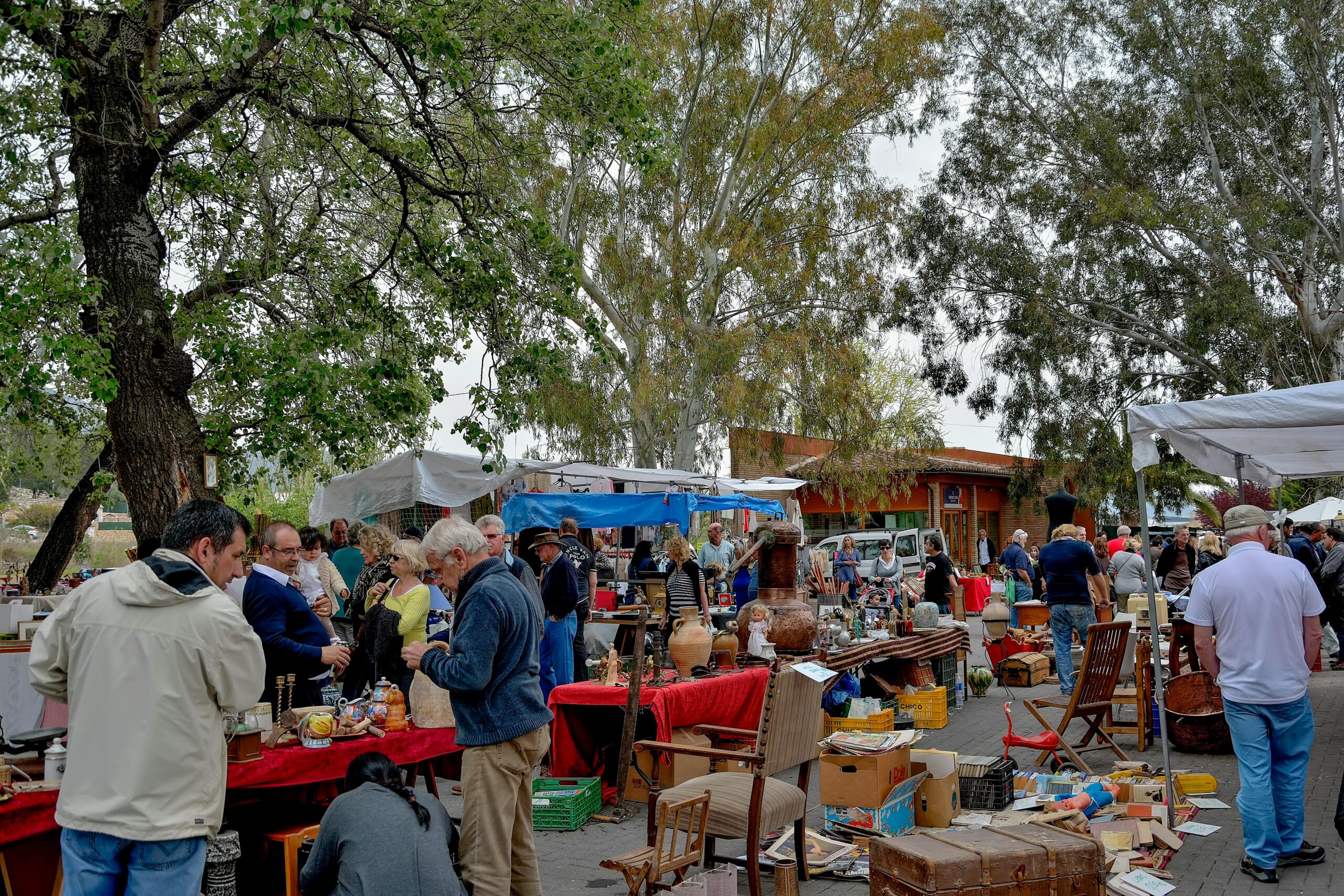
The Spanish Sunday market is a weekly social ritual disguised as shopping. Markets like Madrid’s El Rastro (el RAS-troh) and Barcelona’s Els Encants (els en-CAHNTS) are where entire neighbourhoods gather to meet, talk, haggle, and belong. People come for the company as much as the antiques. Some of Europe’s oldest markets, El Rastro traces back to the 15th century and Els Encants to the 14th, and both still pull crowds every week.
Every Sunday morning across Spain, something extraordinary happens. Entire neighbourhoods wake up and pour into the streets, not because they need to buy anything, but because the mercadillo (mer-cah-DEE-yo, flea market) is calling. It’s language immersion, social bonding, and cultural preservation all wrapped in the smell of churros and the sound of vendors shouting ¡venga, venga! (come on, come on). Once you understand what’s really going on, you’ll see why this tradition has survived for over 500 years.
What exactly is a mercadillo?
A mercadillo is Spain’s version of a flea market or open-air market. But calling it a “flea market” doesn’t do it justice. That’s like calling flamenco “some dancing.”
The word comes from mercado (mer-CAH-doh, market) with the diminutive -illo suffix, making it a “little market.” But many mercadillos are anything but little. Madrid’s El Rastro alone stretches across 30+ streets and draws over 100,000 visitors every Sunday, according to Madrid’s official tourism board.
Spanish mercadillos typically happen on Sundays and public holidays. Some towns have them on specific weekdays too. You’ll find everything from vintage clothing and antique furniture to handmade jewellery, fresh produce, and things you didn’t know existed. The variety is genuinely wild.
This is where the magic happens. Unlike sterile shopping centres, mercadillos are alive. Vendors call out to you. Neighbours stop to chat for twenty minutes. Kids run between stalls. Someone’s always playing guitar nearby. It’s controlled chaos, and it’s beautiful.
Which are Spain’s most famous Sunday markets?
El Rastro, Madrid
This is the one. El Rastro (el RAS-troh) is Spain’s most iconic market and one of Europe’s oldest, with roots stretching back to the 15th century. Every Sunday from 9am to 3pm, the streets around Ribera de Curtidores in the La Latina neighbourhood transform into a sprawling treasure hunt.
The name has a brilliantly grim origin. Rastro means “trail” or “trace.” It refers to the trail of blood that used to run down these streets from the area’s historic slaughterhouses and tanneries. Dark? Yes. Fascinating? Absolutely.
Today, over 1,000 vendors set up stalls selling antiques, vintage records, handmade crafts, second-hand books, and everything in between. But the real draw is the post-market ritual: ir de cañas (eer day CAH-nyas, going for small beers) at the bars lining the surrounding streets. Most Madrileños will tell you the cañas matter more than the shopping.
Els Encants, Barcelona
Els Encants Vells (els en-CAHNTS vels) has an even older pedigree, dating back to the 14th century, making it one of Europe’s oldest markets. In 2013, it moved into a stunning modern structure near Plaça de les Glòries, featuring a massive mirrored canopy that reflects the kaleidoscope of goods and people below.
What makes Els Encants unique is its subasta (soo-BAS-tah, auction) tradition. Every Monday, Wednesday, and Friday at 7am, professional buyers and collectors gather for open auctions. It’s the only market in Europe that still operates this way. If you love digging into the words and traditions your textbook never covered, this is the place to do it.
What about the markets beyond the big two?
Nearly every Spanish town has its own mercadillo. Some highlights worth seeking out:
- Mercadillo de San Fernando, Cádiz: The heart of Andalusian market culture, overflowing with flamenco records and local ceramics.
- El Jueves, Sevilla: Running every Thursday (jueves means Thursday) since the 13th century.
- Mercado de Motores, Madrid: A monthly market inside a historic railway museum, blending gastronomy with vintage finds.
- Mercat de Sant Antoni, Barcelona: Famous for its Sunday book and coin market since the 1880s.
What makes the Spanish Sunday market more than shopping?
Here’s what most travel guides miss. The Spanish Sunday market isn’t primarily about buying things. It’s about being together.
In Spain, Sunday is sacred, and not in a religious way. It’s the day families reconnect. Friends catch up. Neighbours bump into each other “accidentally” at the same stall they’ve visited for thirty years. The mercadillo provides the excuse to get everyone out of the house and into shared public space.
Watch closely and you’ll see it. A vendor doesn’t just sell you a lamp. They tell you its history, where it came from, who owned it before. A buyer doesn’t just browse. They greet the same vendors by name, ask about their families, negotiate prices they both know are already fair. This isn’t commerce. It’s social etiquette in action, and it reveals everything about how Spain values human connection over efficiency.
Why is a mercadillo the best place to practise Spanish?
Forget what your textbook told you about immersion needing a classroom. A single Sunday at a mercadillo teaches you more practical Spanish than a week of textbook exercises.
Here’s why. Markets force you to use Spanish, not just understand it. You need to ask prices, negotiate, describe what you’re looking for, understand rapid-fire responses from vendors, and navigate small talk. It’s a pressure cooker for conversational skills.
The Spanish you’ll hear at a market is the real thing. Vendors drop consonants. They use slang native speakers actually use. They speak fast. That’s exactly what you need if you want your Spanish to move beyond classroom level. It also helps to arrive with a handful of food terms that make your Spanish sound native, since produce and snack stalls are everywhere.
Plus, vendors are incredibly patient with learners. They deal with tourists constantly. They’ll slow down, repeat things, even teach you the right word for something. It’s free tutoring with every purchase.
What vocabulary do you need at a Spanish market?
Your Spanish is about to level up. Here are the words you’ll actually need at a mercadillo.
How do you ask about prices?
| Spanish | Pronunciation | English |
|---|---|---|
| ¿Cuánto cuesta? | CWAN-toh CWES-tah | How much is it? |
| ¿Cuánto vale? | CWAN-toh VAH-lay | How much is it worth? |
| ¿Me lo puedo llevar? | may lo PWAY-doh yay-VAR | Can I take it? |
| Solo estoy mirando | SOH-loh es-TOY mee-RAN-doh | I’m just looking |
| ¿Tiene algo más barato? | tee-AY-nay AL-go mahs bah-RAH-toh | Do you have something cheaper? |
How do you describe what you want?
| Spanish | Pronunciation | English |
|---|---|---|
| Busco algo de segunda mano | BOOS-koh AL-go day say-GOON-dah MAH-noh | I’m looking for something second-hand |
| ¿Es antiguo? | es an-TEE-gwoh | Is it antique? |
| ¿De qué material es? | day KAY mah-teh-ree-AL es | What material is it? |
| Me encanta | may en-CAN-tah | I love it |
How do you haggle like a Spaniard?
Here’s the real talk. Regatear (reh-gah-tay-AR, to haggle) at a Spanish mercadillo is an art form, not a fight. Done right, both sides enjoy it. Done wrong, you’ll offend the vendor and walk away empty-handed.
Rule 1: Always greet first. Never start with a price question. Say Buenos días (boo-AY-nos DEE-as, good morning) or Buenas tardes (boo-AY-nas TAR-des, good afternoon). Getting your greetings right is non-negotiable in Spain.
Rule 2: Show genuine interest. Pick up the item. Ask about it. Comment on its quality. This isn’t just politeness. It’s part of the ritual. Spaniards read your body language before they negotiate.
Rule 3: Start your counter-offer at about 70-80% of the asking price. Spanish markets aren’t like some tourist bazaars where you start at 50%. Vendors at mercadillos generally price fairly. A modest negotiation shows respect.
Rule 4: Use the magic phrase. ¿Me lo puede dejar en…? (may lo PWAY-day day-HAR en, can you leave it at…?). This is the classic negotiation opener. It’s polite, non-aggressive, and shows you know the game.
Rule 5: Be willing to walk away. But do it gracefully with a smile and an Otra vez será (OH-trah veth seh-RAH, maybe next time). Often the vendor will call you back with a better price.
What do these markets reveal about Spanish values?
Spend enough Sundays at mercadillos and you’ll start to understand Spain on a deeper level. These markets are mirrors reflecting core Spanish values that you won’t find in any guidebook.
Sobremesa culture extends everywhere. Sobremesa (soh-bray-MAY-sah, lingering at the table after a meal just to talk) shapes the whole market too. Nobody’s in a rush. Browsing for three hours and buying nothing is perfectly normal. The experience matters more than the transaction.
Personal relationships beat efficiency. A Spaniard will happily wait ten minutes while a vendor chats with another customer. That’s not bad service. That’s respect for human connection. Compare it to the self-checkout anxiety of modern retail. This connects deeply to the Spanish lifestyle habits that prioritise people over productivity.
Sustainability isn’t a trend, it’s tradition. Long before “reduce, reuse, recycle” became a slogan, Spanish mercadillos were giving objects second lives. Vintage clothing, restored furniture, repaired electronics. The circular economy has been alive in Spanish markets for centuries.
Intergenerational bonding happens naturally. At a mercadillo, you’ll see grandparents teaching grandchildren how to spot good leather. Teenagers helping parents carry antique books. Families spanning four generations sharing churros between stalls.
How do you visit your first mercadillo?
Planning your first Spanish Sunday market experience? Here’s everything you need to know.
When to arrive: Get there early, between 9am and 10am. The best finds disappear fast, and by noon the crowds can be overwhelming. Vendors typically start packing up around 2-3pm.
What to bring: Cash. Many vendors don’t accept cards. Small bills and coins work best, especially for haggling. Also bring a reusable bag, water, and comfortable shoes. You’ll walk more than you expect.
What to buy: Leather goods, vintage records, ceramic tiles (azulejos), olive wood kitchen tools, second-hand books, and antique postcards are all classic mercadillo finds. For food markets, look for local honey, cured meats, and handmade cheeses.
What not to do: Don’t touch everything without asking. Don’t photograph vendors without permission. Don’t block narrow aisles. And never complain about the pace. Spanish markets run on their own clock. Embrace it.
The post-market ritual: This is critical. After browsing, find a nearby bar and order cañas y tapas (CAH-nyas ee TAH-pahs, small beers and snacks). This is where the real socialising happens. The market is the warm-up act. The bar is the main event.
How do you bring the Spanish festivals at home spain spirit to your own town?
Can’t get to Spain this weekend? You can still channel the mercadillo spirit close to home. Here’s your challenge.
- Visit your local flea market or farmer’s market this Sunday. Go with the Spanish mindset. Talk to vendors. Ask about their products. Spend twice as long as you normally would.
- Practise your market vocabulary. Rehearse five phrases from the tables above before you go. Even at an English-speaking market, say them to yourself while browsing.
- Add the post-market ritual. After shopping, sit down at a café with a friend. No phones, just conversation. That’s sobremesa, and it changes everything.
- Learn one new market word from a vendor video online. Search “mercadillo vlog” on YouTube and you’ll hear real market Spanish in action.
Why the genius is the simplicity
The Spanish Sunday market is genius because it solves problems modern society is desperate to fix, and it does it without apps, algorithms, or membership fees. Community connection? Show up at the stall. Language practice? Talk to the vendor. Sustainability? Buy something that already exists. Family time? Walk together.
Spain figured this out centuries ago. The rest of the world is slowly catching up. For more deep dives into the language and rituals behind everyday Spain, keep reading Audaz Revista.
Your move: Pick five phrases from the tables above, find your nearest Sunday market, and try them out this weekend. You’ve got this.
Frequently Asked Questions
What is the Spanish Sunday market really for?
It’s a social ritual first and a shopping trip second. The mercadillo gives families, friends, and neighbours a reason to gather in shared public space every week. Buying something is optional; the company, the chat, and the post-market beers are the real point.
What are the most famous Spanish Sunday markets?
Madrid’s El Rastro and Barcelona’s Els Encants are the two icons. Both are among Europe’s oldest markets, with El Rastro dating to the 15th century and Els Encants to the 14th. Other standouts include Cádiz’s San Fernando market, Sevilla’s El Jueves, and Barcelona’s Mercat de Sant Antoni.
Is it okay to haggle at a Spanish mercadillo?
Yes, but politely. Greet the vendor first, show real interest in the item, then counter at about 70-80% of the asking price. Use the phrase ¿Me lo puede dejar en…? (can you leave it at…?). Aggressive lowballing is considered rude, since most mercadillo prices are already fair.
What vocabulary should I learn before visiting a market?
Start with the essentials: ¿Cuánto cuesta? (how much is it?), Solo estoy mirando (I’m just looking), ¿Tiene algo más barato? (do you have something cheaper?), and Me encanta (I love it). The vocabulary tables above cover everything you’ll need to ask prices and describe what you want.
What should I bring to a Spanish Sunday market?
Cash in small bills and coins, since many vendors don’t take cards and coins help with haggling. Add a reusable bag, water, and comfortable shoes. Arrive between 9am and 10am for the best finds before the midday crowds.
Sources: Madrid Tourism Board, Official Guide to El Rastro | Barcelona Tourism, Encants Market Guide
Share

audazrevista
Get the Inside Scoop