7 Spanish Food Terms That Make You Sound Like a Native at Any Restaurant
In This Article
- The Food Language Gap
- 1. Pincho vs. Tapa: The Distinction That Matters
- 2. Ración vs. Media Ración: Ordering Like a Pro
- 3. A la Plancha: The Cooking Method That Changes Everything
- 4. Casero: The Word That Finds You the Best Food
- 5. Sobremesa: When the Meal Becomes a Marathon
- 6. Caña vs. Cerveza: Beer Ordering Made Simple
- 7. La Cuenta: The Art of Asking for the Bill
- Your Complete Restaurant Ordering Flowchart
- Conclusion
Forget what your textbook told you about ordering food in Spanish. Yes, you know pollo (POH-yoh, chicken) and agua (AH-gwah, water). Congratulations. You can survive. But surviving isn’t the same as dining.
The difference between a tourist and a local in a Spanish restaurant isn’t the food they order. It’s how they order it. The words they use. The phrases they choose. The confidence that comes from knowing exactly how Spanish dining culture works.
According to the Spain Tourism Board, Spain has over 350,000 bars and restaurants, giving it the highest density of dining establishments per capita in Europe. The Spanish spend an average of two hours per meal. Food isn’t fuel here. It’s culture, identity, and social bonding.
These seven food terms will transform your restaurant experience from awkward tourist to confident local. Each one unlocks a different layer of how Spaniards actually eat.
The Food Language Gap That Textbooks Never Close
Your Spanish textbook probably has a chapter called “At the Restaurant” with phrases like “me gustaría pedir…” (I would like to order). Native speakers never say this. It’s grammatically correct, culturally tone-deaf, and immediately marks you as a beginner.
Real restaurant Spanish is faster, more casual, and full of specific terms that communicate exactly what you want with minimum words. A Spaniard doesn’t say “I would like to order a small portion of the grilled prawns.” They say “¿Me pones una media de gambas a la plancha?” (meh POH-nehs OO-nah MEH-dee-ah deh GAHM-bahs ah lah PLAHN-chah). Six words instead of fifteen. And every bartender in Spain knows exactly what that means.
If you’ve been working through common Spanish phrases for beginners, these food terms are the upgrade your vocabulary needs.
1. Pincho vs. Tapa: The Distinction That Matters
Most foreigners use tapa (TAH-pah) for everything. Locals distinguish between tapas and pinchos (PEEN-chohs), and the difference matters.
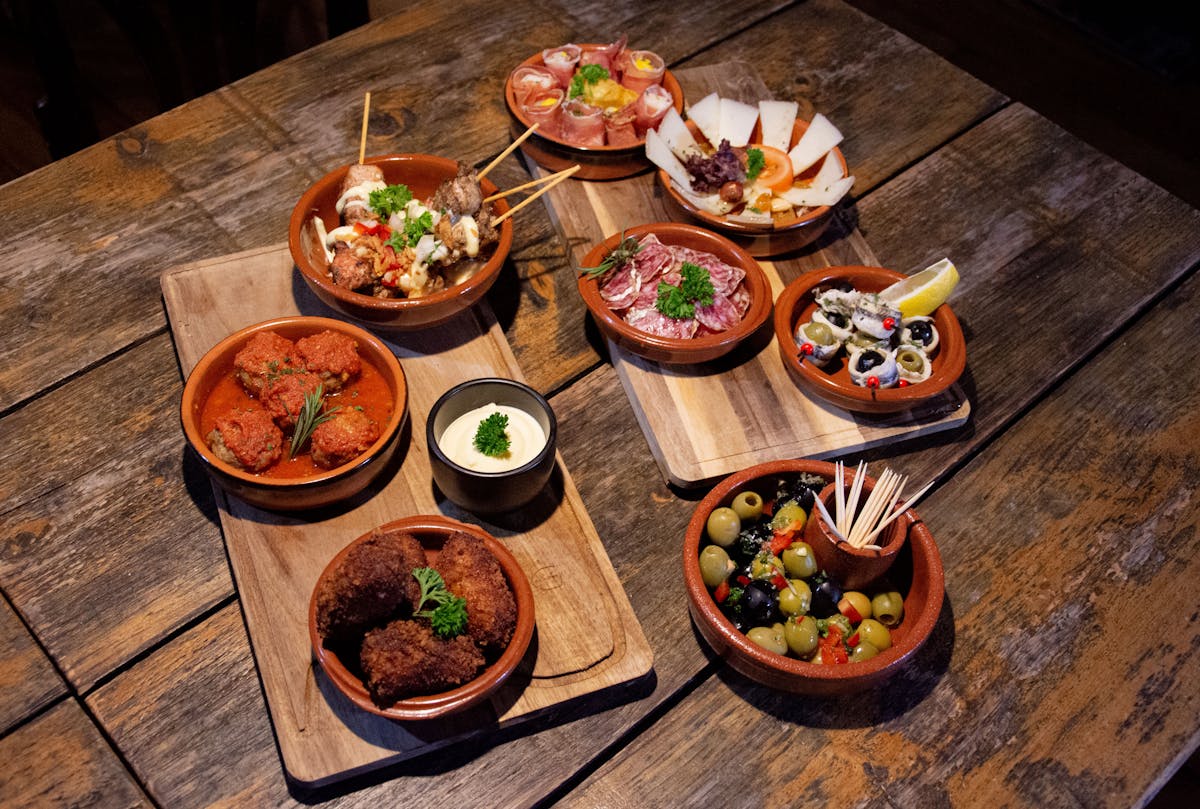
Tapa (TAH-pah): A small plate of food, usually served alongside a drink. In many parts of Spain, tapas come free with your beverage. The tradition started (according to legend) when bartenders placed a slice of bread on top of wine glasses to keep flies out. Tapa literally means “lid” or “cover.”
Pincho / Pintxo (PEEN-choh): A small snack served on bread, typically held together with a toothpick (pincho means “spike”). This is the standard in the Basque Country and Navarra. In San Sebastián, you’ll see bars with elaborate displays of pintxos on the counter. You take what you want, and they count the toothpicks to calculate your bill.
Regional breakdown:
- Andalucía: Free tapas with every drink. Order a caña, get a tapa. This is the dream.
- Madrid: Some free tapas, some paid. Ask “¿La tapa es gratis?” (Is the tapa free?)
- Basque Country: Pintxos are paid, elaborate, and extraordinary.
- Catalonia: Tapas culture exists but is less dominant than in the south.
2. Ración vs. Media Ración: Ordering Like a Pro
This is the term that separates tourists from regulars. When you see a menu in a Spanish bar, most items come in two sizes:
Ración (rah-see-OHN): A full portion. Enough for two to three people to share. This is how Spaniards eat: they order several raciones for the table and everyone shares.
Media ración (MEH-dee-ah rah-see-OHN): A half portion. Perfect for one person, or for ordering more variety for the table.
How to order:
- “¿Me pones una ración de patatas bravas?” (Can you give me a full portion of patatas bravas?)
- “Una media de jamón, por favor.” (A half portion of ham, please.)
- “Para compartir, ponme dos raciones y una media.” (To share, give me two full portions and a half.)
Pro tip: The verb poner (poh-NER, to put/give) is how locals order. “¿Me pones…?” is far more natural than “quiero” (I want) or “me gustaría” (I would like). It’s casual, friendly, and efficient. This is how native speakers actually talk.
3. A la Plancha: The Cooking Method That Changes Everything
A la plancha (ah lah PLAHN-chah) means “on the flat grill.” It’s the most common cooking method in Spanish bars and restaurants, and knowing it opens up a world of menu options.
Why it matters: When you see a la plancha on a menu, you’re getting food cooked on a flat iron griddle with minimal oil. It’s fast, clean, and lets the quality of the ingredient shine. Spaniards consider a la plancha the purest way to cook fish, seafood, and meat.
Essential cooking terms beyond a la plancha:
- Frito (FREE-toh) – Fried
- Al horno (ahl OR-noh) – Baked/roasted
- A la brasa (ah lah BRAH-sah) – Charcoal-grilled
- Guisado (gee-SAH-doh) – Stewed
- Crudo (KROO-doh) – Raw
- En su punto (en soo POON-toh) – Medium (for meat)
- Poco hecho (POH-koh EH-choh) – Rare
- Muy hecho (mooy EH-choh) – Well done
Ordering example: “¿Las gambas son a la plancha o fritas?” (Are the prawns grilled or fried?) This single question makes you sound like you know what you’re doing.
4. Casero: The Word That Finds You the Best Food
Casero (kah-SEH-roh) means “homemade” or “home-style.” When you see this word on a menu, your interest should spike immediately.
Why it matters: Casero signals that the dish was made from scratch, on the premises, using real ingredients. In a country where food quality is a point of national pride, casero is a badge of honour.
What to look for:
- Croquetas caseras (kroh-KEH-tahs kah-SEH-rahs) – Homemade croquettes. The difference between homemade and frozen croquettes is enormous.
- Postre casero (POHS-treh kah-SEH-roh) – Homemade dessert. Usually flan (flahn), arroz con leche (ah-RROHS kon LEH-cheh, rice pudding), or tarta de queso (TAR-tah deh KEH-soh, cheesecake).
- Pan casero (pahn kah-SEH-roh) – Homemade bread. A sign of a restaurant that cares.
The question to ask: “¿Las croquetas son caseras?” (Are the croquettes homemade?) If the waiter says yes with pride, you’re in the right place. If they hesitate, consider ordering something else.
5. Sobremesa: When the Meal Becomes a Marathon
There’s a word in Spanish for the time spent at the table after the meal has ended. English doesn’t have it. Sobremesa (soh-breh-MEH-sah) is the post-meal conversation, the lingering, the second coffee, the slow descent into afternoon contentment.
Sobremesa is not optional in Spanish culture. It’s the reason meals take two hours. The food might take forty-five minutes. The sobremesa takes the rest. The UNESCO Intangible Cultural Heritage listing for the Mediterranean diet specifically highlights communal eating and extended mealtimes as defining elements of the tradition.
What happens during sobremesa:
- Coffee is ordered (café solo for espresso, cortado for espresso with a splash of milk, café con leche for coffee with milk)
- Perhaps a copa (KOH-pah) of digestif, like orujo (oh-ROO-hoh, grape brandy) or pacharán (pah-chah-RAHN, sloe berry liqueur)
- Conversation deepens. This is when the real talk happens.
- Nobody asks for the bill. The table is yours for as long as you want it.
If you’ve read about Spanish lifestyle habits, you’ll recognise sobremesa as one of the pillars of Spanish daily life.
6. Caña vs. Cerveza: Beer Ordering Made Simple
Ordering beer in Spain is more specific than just saying cerveza (ther-BEH-thah). Size matters, and each size has its own name.
The beer size guide:
- Una caña (OO-nah KAH-nyah) – A small draft beer (200ml). The standard order. Always draft, always cold.
- Un doble (oon DOH-bleh) – A double caña (400ml). When one isn’t enough.
- Una jarra (OO-nah HAH-rrah) – A large mug (500ml). For serious thirsts.
- Un tercio (oon TER-thee-oh) – A 330ml bottle. When draft isn’t available.
- Un quinto (oon KEEN-toh) – A 200ml bottle. The bottled equivalent of a caña.
The native order: “Ponme una caña.” (PON-meh OO-nah KAH-nyah.) Three words. That’s it. No “por favor” needed (though it’s always polite). No “I would like.” Just “give me a caña.”
Non-beer alternatives:
- Un tinto de verano (oon TEEN-toh deh beh-RAH-noh) – Red wine mixed with lemon soda. Spain’s summer drink. Refreshing and low alcohol.
- Un vermut (oon ber-MOOT) – Vermouth on ice with an olive. The pre-lunch tradition.
- Una clara (OO-nah KLAH-rah) – Beer mixed with lemon soda. Light and perfect for hot days.
7. La Cuenta: The Art of Asking for the Bill
In Spain, the waiter will never bring you the bill unless you ask. This isn’t bad service. It’s good manners. Bringing the bill unasked implies “please leave,” which is the opposite of Spanish hospitality.
How to ask:
- “La cuenta, por favor.” (lah KWEN-tah, por fah-BOR) – The bill, please. Standard and polite.
- “¿Me cobras?” (meh KOH-brahs) – Can you charge me? More casual. Used in bars.
- “¿Cuánto es?” (KWAHN-toh ehs) – How much is it? For quick transactions at a bar counter.
Tipping culture: Tipping in Spain is appreciated but not expected. Rounding up (leaving the change) is common. Leaving 5-10% is generous. Leaving 20% would be unusual and might confuse the waiter.
For more expressions that make you sound natural in everyday situations, explore our guide to 50 Spanish idioms and expressions.
Your Complete Restaurant Ordering Flowchart
From Entering to Leaving: The Native Sequence
Step 1: Arriving
Walk in. Say “¡Buenas!” (BWEH-nahs, casual hello). Don’t wait to be seated (unless it’s a formal restaurant). Find a table or stand at the bar.
Step 2: Getting Attention
Make eye contact with the waiter. A small hand raise. Say “Perdona” (per-DOH-nah, excuse me). Don’t snap fingers. Don’t wave wildly.
Step 3: Drinks First
“Ponme una caña y un tinto de verano.” (Give me a beer and a tinto de verano.) Drinks always come before food decisions.
Step 4: Food Order
“¿Qué nos recomiendas?” (What do you recommend?) Then: “Ponme una media de croquetas caseras y una ración de patatas bravas.”
Step 5: More Rounds
“¿Nos pones otra ronda?” (Can you get us another round?) Spaniards order in rounds, not individual drinks.
Step 6: Sobremesa
“¿Ponme un café solo?” (Give me an espresso?) Take your time. There’s no rush.
Step 7: The Bill
“La cuenta, por favor.” Leave a few coins or round up. Say “¡Gracias, estaba todo riquísimo!” (Thanks, everything was delicious!)
Step 8: Leaving
“¡Hasta luego!” (See you later!) Even if you’ll never return, this is standard.
Conclusion
Seven terms. That’s all it takes to transform your Spanish dining experience. Pincho and tapa for knowing what you’re eating. Ración and media ración for ordering the right amount. A la plancha for understanding how it’s cooked. Casero for finding the best quality. Sobremesa for understanding why meals take two hours. Caña for ordering beer properly. And la cuenta for ending the meal with confidence.
Spanish dining is one of the great pleasures of the language learning journey. Every meal is a vocabulary lesson. Every bar is a pronunciation classroom. Every sobremesa is a conversation practice session that doesn’t feel like studying.
Use these terms at your next opportunity. Watch what happens when you order a media de croquetas caseras instead of “some croquettes.” The waiter’s face will change. The experience will shift. And your Spanish will sound like it belongs.
Now go use these words. Your Spanish is ready.
]]>Share
Topics

audazrevista
You may also like

Get the Inside Scoop