8 Spanish Lifestyle Habits That Will Transform Your Daily Routine
Table of Contents
- Why Spanish Lifestyle Habits Change Everything
- 1. The Siesta: Napping Is a National Skill
- 2. Sobremesa: The Art of Staying at the Table
- 3. The Paseo: Evening Walks That Recharge Your Soul
- 4. Late Dining: Why Dinner at 10pm Makes Sense
- 5. Cafe Culture: Coffee Is a Ritual, Not a Rush
- 6. Living Tranquilo: The “No Rush” Philosophy
- 7. Family and Friend Time: Your People Come First
- 8. Seasonal Festivals: Life Organised Around Celebration
- Practice Box: Build Your Spanish Lifestyle Vocabulary
- Conclusion: Start Living the Spanish Way Today
Why Spanish Lifestyle Habits Change Everything
Forget what your textbook told you about learning Spanish. The best way to understand a language? Live like the people who speak it.
Spanish lifestyle habits aren’t just charming cultural quirks. They’re a completely different approach to daily life. One that prioritises connection, pleasure, and actually enjoying the hours between waking up and falling asleep.
And here’s the real talk: adopting even a few of these habits will transform your spanish daily routine. You’ll slow down. You’ll connect more. And your Spanish will improve because you’ll finally understand why the language works the way it does.
According to a 2024 study by the Organisation for Economic Co-operation and Development (OECD), Spain consistently ranks among the top five countries in Europe for social connection and leisure time satisfaction (source: OECD How’s Life? 2024 Report). That’s not an accident. It’s the result of habits baked into Spanish culture for centuries.
Ready? Your Spanish is about to level up. Pack your bags.
1. The Siesta: Napping Is a National Skill
Let’s start with the most famous spanish lifestyle habit in the world. The siesta (see-EHS-tah, afternoon nap).
But forget the stereotype of an entire country asleep at 2pm. The modern siesta is more nuanced than that. Most working Spaniards don’t actually take a full nap every day. What they do is take a longer midday break, typically from around 2pm to 5pm.
Some nap. Some eat a leisurely lunch. Some just rest. The point isn’t the sleeping. The point is the pausa (POW-sah, pause). The deliberate break in the middle of the day.
Why It Works
Spain’s climate plays a role. Midday heat in summer can hit 40 degrees. But it goes deeper than weather. The siesta reflects a belief that productivity isn’t about grinding nonstop. It’s about working in focused bursts with real recovery in between.
Research from the Universidad Autónoma de Madrid confirms that short afternoon naps of twenty to thirty minutes improve cognitive performance and emotional regulation (source: Universidad Autónoma de Madrid, Sleep Research Division).
Try it: Say “Me voy a echar una siesta” (meh voy ah eh-CHAR oo-nah see-EHS-tah). It means “I’m going to take a nap.” Use it. Own it.
2. Sobremesa: The Art of Staying at the Table
This is where the magic happens.
Sobremesa (so-breh-MEH-sah, post-meal conversation time) is the time you spend at the table after eating. Not because you’re still hungry. Because the conversation is too good to leave.
In most English-speaking cultures, you eat, you get the bill, you leave. In Spain? The meal is just the opening act. Sobremesa is the main event. It can last thirty minutes. It can last three hours. Nobody checks the time.
How to Practise This Habit
Next time you eat with friends or family, resist the urge to clear the plates immediately. Pour another coffee. Tell another story. Let the conversation breathe.
This is how native speakers actually talk, by the way. The best Spanish conversations happen during sobremesa. If you want to understand common Spanish phrases in their natural habitat, this is it.
Key phrase: “¿Tomamos un cafecito?” (toh-MAH-mohs oon kah-feh-SEE-toh). It means “Shall we have a little coffee?” It’s the universal signal that sobremesa is happening.
3. The Paseo: Evening Walks That Recharge Your Soul
Every evening across Spain, something beautiful happens. People leave their houses and walk. That’s it. They just… walk.
The paseo (pah-SEH-oh, evening stroll) is the daily ritual of taking an evening walk through your neighbourhood. You greet neighbours. You stop for a chat. Kids run around in the plaza. Grandparents sit on benches watching the world go by.
It’s not exercise. It’s not a power walk with a fitness tracker. It’s a gentle, social, deeply human tradition that happens between sunset and dinner.
Why You Should Adopt This Spanish Lifestyle Habit
The paseo is free. It requires zero equipment. And it delivers something most of us desperately need: unstructured social time without screens.
If you’re looking for engaging techniques to learn Spanish, walking through a Spanish-speaking neighbourhood while listening to conversations around you is one of the best. Immersion doesn’t require a plane ticket. It requires a willingness to slow down.
Try this: “¿Damos un paseo?” (DAH-mohs oon pah-SEH-oh). It means “Shall we go for a walk?” Simple. Beautiful. Very Spanish.
4. Late Dining: Why Dinner at 10pm Makes Sense
Here’s the real talk about the Spanish daily routine. Dinner rarely happens before 9pm. Often it’s 10pm. Sometimes later.
Sounds crazy if you’re used to eating at 6 or 7pm. But it makes perfect sense when you understand the full rhythm of a Spanish day.
Lunch (the main meal) happens around 2pm. Then comes siesta or rest time. Then the paseo. Then maybe tapas around 8pm. Then dinner. The Spanish day is structured around meals and social time, not work schedules.
The Vocabulary You Need
- Cenar (seh-NAR): To have dinner
- La cena (lah SEH-nah): Dinner
- Picar algo (pee-KAR AL-goh): To snack on something, to nibble
Example: “No cenamos hasta las diez” (no seh-NAH-mohs AHS-tah lahs dee-ETH). It means “We don’t eat dinner until ten.” Say this to your friends back home. Watch their faces.
Understanding these spanish habits in daily life will transform how you experience the language. When you know the rhythm, the words make more sense.
5. Cafe Culture: Coffee Is a Ritual, Not a Rush
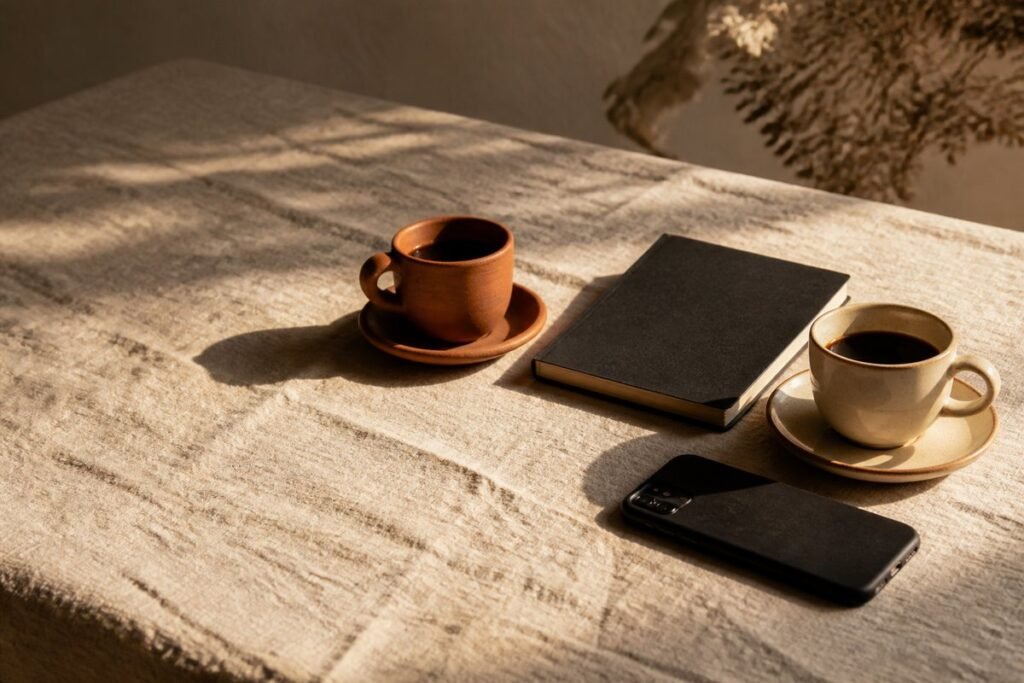
In Spain, you don’t grab a coffee. You take a coffee. You sit down. You breathe. You watch people. Maybe you read the paper. Maybe you just exist for twenty minutes without looking at your phone.
The cafetería (kah-feh-teh-REE-ah, coffee shop) is the living room of Spanish society. Business deals happen there. Arguments get resolved there. Romances start there. And the coffee itself? Usually just a tiny cortado (kor-TAH-doh, espresso with a splash of milk) or a café con leche (kah-FEH kon LEH-cheh, coffee with milk).
What This Teaches You About Spanish
Spanish cafe culture explains why so many common Spanish phrases for beginners revolve around drinking and socialising. The language is built for connection. Ordering a coffee in Spain isn’t a transaction. It’s the start of a conversation.
Pro tip: Never order a “café para llevar” (takeaway coffee) unless you want the barista to look at you with genuine sadness. Sit down. Stay. This is how native speakers actually talk, over a tiny cup of coffee that takes thirty minutes to drink.
6. Living Tranquilo: The “No Rush” Philosophy
Tranquilo (tran-KEE-loh, calm, relaxed, take it easy). This single word might be the key to understanding Spanish culture entirely.
Spaniards use it constantly. Running late? Tranquilo. Stressed about a deadline? Tranquilo. Panicking about your Spanish pronunciation? Tranquilo, tranquilo.
It’s not laziness. It’s a fundamentally different relationship with time. In Spanish culture, being perpetually rushed is seen as a failure, not a badge of honour. The ability to stay calm, enjoy the moment, and trust that things will work out? That’s a skill.
How This Changes Your Spanish
Once you adopt the tranquilo mindset, your Spanish grammar mistakes stop feeling catastrophic. You relax. You try things. You mess up and laugh about it. That’s when real learning happens.
Use it today: Next time someone apologises for being late, reply with “Tranquilo, no pasa nada” (tran-KEE-loh, no PAH-sah NAH-dah). It means “Relax, nothing’s wrong.” Very Spanish. Very freeing.
7. Family and Friend Time: Your People Come First
In Spain, Sunday lunch with the family isn’t optional. It’s sacred.
Spanish culture puts relationships at the centre of everything. Not as a nice idea. As a non-negotiable daily practice. Friends call each other daily. Families eat together multiple times a week. People prioritise quedar (keh-DAR, to meet up, to get together) over almost everything else.
The word pandilla (pan-DEE-yah, friend group, crew) captures this perfectly. Your pandilla is your people. Your chosen tribe. And you see them constantly, not once a month for a scheduled catch-up.
Why This Matters for Your Spanish
Language lives in relationships. You’ll learn more Spanish in one Sunday lunch with a Spanish family than in ten textbook chapters. The spanish daily routine revolves around people, not productivity apps.
Try saying: “Quedo con mi pandilla esta tarde” (KEH-doh kon mee pan-DEE-yah EHS-tah TAR-deh). It means “I’m meeting up with my crew this afternoon.” Now you sound like a local.
8. Seasonal Festivals: Life Organised Around Celebration
Spain has a festival for everything. And we’re not talking about small community fairs. We’re talking about entire cities shutting down for days of celebration.
Las Fallas (lahs FAH-yahs) in Valencia. La Feria de Abril (lah FEH-ree-ah deh ah-BREEL) in Seville. San Fermín (san fer-MEEN) in Pamplona. La Tomatina (lah toh-mah-TEE-nah) in Buñol. Each region has its own traditions, and people plan their entire year around them.
This isn’t just about partying. Spanish festivals are deeply tied to community identity, religious traditions, and seasonal rhythms. They mark the passage of time in a way that work deadlines never could.
The Language of Celebration
- Fiestas (fee-EHS-tahs): Festivals, celebrations
- Verbena (ver-BEH-nah): A street party, typically with music and dancing
- Madrugada (mah-droo-GAH-dah): The early hours (festivals often run until madrugada)
If you want to understand why the Spanish language is so rich in words for social situations, look at the festivals. A culture that celebrates this much naturally develops a vocabulary to match.
Want to experience Spanish culture through entertainment first? Check out our guide to the best Spanish TV shows to learn Spanish in 2026. Many of them feature festival scenes that’ll make you want to book a flight immediately.
Practice Box: Build Your Spanish Lifestyle Vocabulary
Quick Challenge: Use These Spanish Lifestyle Phrases This Week
Stop here and practise this. Say each phrase out loud. Seriously. Right now.
| Me voy a echar una siesta | I’m going to take a nap |
| ¿Tomamos un cafecito? | Shall we have a little coffee? |
| ¿Damos un paseo? | Shall we go for a walk? |
| Tranquilo, no pasa nada | Relax, nothing’s wrong |
| Quedo con mi pandilla | I’m meeting up with my crew |
| No cenamos hasta las diez | We don’t eat dinner until ten |
| ¿Tomamos un cortado? | Shall we have an espresso? |
Challenge: Pick two of these phrases and use them in conversation this week. Text a Spanish-speaking friend. Post one on social media. Your Spanish is ready for this.
Conclusion: Start Living the Spanish Way Today
These eight spanish lifestyle habits share one thing in common. They all prioritise being human over being productive.
The siesta teaches you to rest. Sobremesa teaches you to linger. The paseo teaches you to move slowly. Late dining teaches you patience. Cafe culture teaches you presence. Tranquilo teaches you calm. Family time teaches you priorities. And festivals teach you to celebrate everything.
You don’t need to move to Spain to adopt these spanish lifestyle habits. Start small. Take a longer lunch break. Go for an evening walk without your phone. Sit with your coffee instead of gulping it on the go. Have dinner later and make it last.
According to the Spanish Ministry of Health’s 2023 wellness report, Spaniards’ life expectancy ranks among the highest in Europe, and researchers attribute a significant portion of this to social connectedness and lifestyle rhythms rather than diet alone (source: Ministerio de Sanidad, Spain, Annual Health Report 2023).
Your Spanish daily routine is about to change. And so is your Spanish. Because when you live the way Spanish speakers live, the language stops being something you study and starts being something you feel.
Now go use these words. Try this phrase today. You’ve got this.
¡Vamos, tranquilo! (Let’s go, take it easy!) See? You’re already halfway there.
Share
Topics

audazrevista
You may also like
Get the Inside Scoop