Granada Spanish Guide: The Final S Is Gone 91% of the Time
By Camila Rossi, Culture writer, Buenos Aires & Barcelona
Updated September 10, 2026 · Reviewed by the Audaz editorial team
Granada is the Spanish city where the language you studied gets edited hardest. In the PRESEEA-Granada recordings of university-educated locals, a word-final S was deleted 91.2% of the time, the highest elision rate the study could find anywhere on the Spanish mainland. The Arabic you came to see in the Alhambra is also in your mouth: 55 of the 224 everyday words on our Granada list came into Spanish from Arabic. And the free tapa is real. The city council’s own tourism site says a free tapa comes with each drink in most places. Here is what each of those three facts means for how you order, listen and read.
- Educated Granada deletes syllable-final S 70.5% of the time overall and 91.2% at the end of a word. Seville’s educated speakers delete it 43.3% of the time. Granada is the more radical city.
- The S that carries grammar goes first. Plural and verb-ending S vanished 94.7% of the time. The plural has moved into the vowel, and a perception test shows locals hear it reliably for one vowel out of five.
- 55 of 224 words a visitor uses in Granada are Arabic by origin, checked one by one against Wiktionary’s etymology categories. In the tapas bar alone it is 20 of 71.
- The Alhambra took 2,726,871 visitors in 2025 against an annual cap of 2,765,500. That is 98.6% of the ceiling. Your Nasrid Palaces time slot is printed on the ticket and it is not flexible.
Every guide to Granada says the same three things. The Alhambra is breathtaking. The tapas are free. The accent is thick.
All three are true. None of them helps you at the bar at nine in the evening, when the waiter says something that sounds like lo tinto de verano and you are trying to work out whether he means one drink or three.
So we measured Granada instead of describing it. We read the sociolinguistic study of how the city actually pronounces its S, sound by sound. We ran a list of the words you will use here through an etymology database to count the Arabic. And we pulled the Alhambra’s own visitor numbers. This is what came out.
What did the linguists actually count in Granada?
The accent data comes from PRESEEA, the same long-running project behind our Seville accent piece. Researchers record ordinary people in a Spanish-speaking city, transcribe the interviews, and count what happens to each sound. The Granada arm was coordinated by Juan Antonio Moya Corral and recorded between 2007 and 2009.
| Study | What it measured | Sample |
|---|---|---|
| Tejada Giráldez (2012) Normas 2, 185-217 |
What happens to syllable-final S among university-educated speakers in the city of Granada | 18 PRESEEA-Granada interviews (3 men and 3 women in each of 3 age groups), 3,027 individual S sounds coded by hand |
| Herrero de Haro (2019) Nueva Revista de Filología Hispanica LXVII(2), 411-446 |
How eastern Andalusian vowels change when a following S is lost, and whether locals can hear the difference | Speech of 60 eastern Andalusian speakers in Almería province analysed acoustically, plus a listening test with school students from El Ejido, Adra and Balerma |
One limit to state before any number. The Granada study covers the high-education group only. It is 18 people, chosen so that the city’s 237,929 residents in 2006 were represented by one speaker for every 4,406. It tells you how educated Granada speaks. Street Granada is at least as reduced, and probably more so.
Does Granada really drop the S more than Seville?
Yes, and by a wide margin. Across all 3,027 sounds, the S disappeared completely 70.5% of the time. It softened to a breathy H 24.5% of the time. A clean textbook S survived in 1.4% of cases.
| What happens to the S | How it sounds | Granada, educated speakers |
|---|---|---|
| Elision | Nothing. Las casas reaches your ear as la casa with different vowels. | 70.5% |
| Aspiration | A breath like the H in hat. Está becomes eh-tá. | 24.5% |
| Assimilation | The S melts into the next consonant and doubles it. | 1.9% |
| Breath plus assimilation | Both at once. | 1.7% |
| Full S kept | The sound you learned. | 1.4% |
Put that next to Seville and the two Andalusian capitals split. In the Seville high-education group, deletion ran at 43.3% and the breath at 49.6%. In Granada the order is reversed and the gap is enormous. Seville softens. Granada deletes.
The study lines Granada up against every comparable corpus its author could find. Only the Granada coast (74.1%), Jaén (74.9%), Santo Domingo (75%) and Santiago in the Dominican Republic (80%) delete more. At the other end, Lima keeps a full S 75.9% of the time. Educated Buenos Aires keeps it 46% of the time and deletes it 13%. The author’s conclusion is blunt: Granada has the most elisions of any population studied on the peninsula.
If you trained your ear on Madrid, or on a Latin American teacher, Granada is the biggest single adjustment Spain will ask of you. Not because the words are different. Because the sound that ends most of them is missing.
Where exactly does the S go?
Position decides almost everything. Inside a word, the S usually survives as a breath. At the end of a word it is almost always gone.
| Position | Breathy H | Gone | Full S | Cases counted |
|---|---|---|---|---|
| Inside a word hasta, este, gusta |
77.4% | 8.4% | 1.1% | 758 |
| End of a word gracias, dos, buenos |
6.9% | 91.2% | 1.5% | 2,269 |
Three out of four S sounds in the corpus sit at the end of a word. So the 91.2% row is the one you will live in. Seville’s equivalent figure for word-final deletion is 56.1%. Granada takes the same habit and pushes it almost to the limit.
What comes next matters too. The study split every word-final S by whether a vowel, a consonant or a pause followed it.
| What follows the S | Gone | Breathy H | Full S | Cases |
|---|---|---|---|---|
| A vowel los amigos, dos euros |
98.0% | 0.8% | 1.2% | 508 |
| A consonant los coches, más tapas |
88.5% | 10.4% | 0.4% | 1,342 |
| A pause …son las dos. |
91.4% | 3.1% | 5.5% | 419 |
Before a vowel is the shocking row. In Seville, an S before a vowel was deleted 51.1% of the time. In Granada it is 98%. Dos euros will sound like do euro. Los amigos will sound like lo amigo. There is nothing to listen for. Decide from the article and the vowel.
The consonant column is where your only audible clue lives. Before a consonant, and especially before a P, T or K, the breath appears about one time in ten. Más tapas may come out as mah tapa. That breath is the last surviving trace of the S in fast Granada speech, so it is worth learning to hear it.
Does the plural S survive because it carries meaning?
This is the assumption every learner makes, and in Granada it is exactly backwards.
The study coded every S by whether it did grammatical work. A grammatical S marks a plural (los estudios) or a verb person (vienes, bailamos). A non-grammatical S is just part of the word (más, nosotros, es, and every S inside a word like hasta).
| Kind of S | Gone | Breathy H | Full S | Cases |
|---|---|---|---|---|
| Grammatical (plural or verb ending) | 94.7% | 4.3% | 1.0% | 1,436 |
| Not grammatical (part of the word, including inside-word S) | 48.6% | 42.8% | 1.8% | 1,591 |
The S that tells you a noun is plural was deleted 94.7% of the time. The S that tells you nothing was deleted less than half the time. Part of that gap is position, because the grammatical S is always at the end of a word. But the author tests the idea that meaning protects a sound, the so-called functional hypothesis, and rejects it. Granada does not keep an S because it is useful.
So where did the plural go? Into the vowel. This is the feature that makes eastern Andalusian different from Seville, and it is the single most useful thing to know before you arrive.
How does Granada say the plural without an S?
By opening the vowel in front of where the S used to be. La casa and las casas are not the same string of sounds in Granada, even though both have lost their S. In the plural, the final vowels are pronounced more open, and often the earlier vowels in the word shift with them. Linguists call it abertura vocálica (vowel opening) or desdoblamiento (vowel splitting).
Herrero de Haro measured this acoustically in 60 eastern Andalusian speakers and found the effect is real and large enough to count as separate vowels. Where standard Spanish has five, he identifies fourteen in this variety, one for each vowel plus the versions shaped by a lost S, R or TH sound.
Then he tested whether locals could hear it. Students listened to isolated vowels and had to say which of four things followed each one: nothing, a lost S, a lost R or a lost TH. Pure guessing scores 25%.
| Vowel | Plain final vowel heard correctly | Vowel with a lost S heard correctly | Above chance? |
|---|---|---|---|
| E (madre vs madres) | 99.2% | 52.3% | Yes, strongly |
| O (amigo vs amigos) | 95.5% | 25.0% | No |
| A (casa vs casas) | 43.5% | 17.3% | No |
| I | 61.2% | 19.8% | No |
| U | 53.8% | 21.4% | No |
Read the middle column honestly. Out of context, the opened-vowel plural was reliably identified for one vowel out of five. Natives hear it best on E. On A, the vowel that ends most feminine plurals, listeners scored 17%, which is below guessing. The system exists, and it works in running speech where the article and the verb help. Alone, it is a whisper.
The test was a four-way choice with a lost R and a lost TH in the mix, which is harder than the two-way singular-or-plural decision you face in a bar. And the listeners were in Almería province, not the city of Granada, though both sit inside the eastern Andalusian vowel zone. Treat the percentages as a ceiling on how much the vowel alone can tell you, not as a verdict on Granada speech.
The practical rule is the same one we gave for Seville, only stronger. Stop waiting for a plural S. Listen to the article. La and las differ in the vowel and in length, and a Granada speaker opens the A of las. Train on pairs: el libro against los libros, hearing the first word only.
How much of the Spanish you use in Granada is actually Arabic?
About a quarter, and in the old town nearly half. We wrote down 224 everyday words a visitor meets in Granada across four situations, before checking any of them. Then we ran the list against Wiktionary’s etymology category for Spanish terms derived from Arabic, which held 922 entries when we pulled it. 55 of the 224 words are Arabic by origin. That is 24.6%.
| Situation | Words checked | Arabic by origin | The ones you will actually say |
|---|---|---|---|
| The tapas bar | 71 | 20 (28.2%) | jarra, taza, café, azúcar, aceite, aceituna, alcachofa, albóndiga, berenjena, arroz |
| The Alhambra and the Albaicín | 46 | 21 (45.7%) | alcázar, alcazaba, alberca, aljibe, azulejo, mezquita, barrio, carmen, azotea, almohada |
| The market | 59 | 8 (13.6%) | alcaparra, albahaca, arroba, fardo, quintal, pato, atún, almeja |
| Getting around and sleeping | 50 | 6 (12.0%) | taquilla, aduana, alquiler, tarifa, alcalde, almacén |
Look at what is in the bar column. Aceite (oil), aceituna (olive), azúcar (sugar), arroz (rice), limón (lemon), naranja (orange), zanahoria (carrot), berenjena (aubergine), albóndiga (meatball), alcachofa (artichoke), jarra (jug), taza (cup). Even café arrived through Arabic. Strip those from a Granada menu and you cannot order breakfast.
Look at what is not there. Transport, money and the hotel are almost entirely Latin. Only 6 of 50 words in that group came from Arabic, and they are telling ones: alquiler (rent), tarifa (rate), aduana (customs), alcalde (mayor), almacén (warehouse) and taquilla (ticket office). Arabic gave Spanish its administration and its kitchen. Latin kept the verbs.
The Arabic in Granada is not only on the walls of the Alhambra. It is in the word for the oil on your bread, the sugar in your coffee and the rent on the flat you are staying in. You have been speaking it since your first lesson.
Is every word starting with al- Arabic?
Nearly, and the exceptions are worth knowing so you do not over-apply the rule. Our list had 21 words beginning with al-. Wiktionary traces 19 of them to Arabic, where al- is the definite article that got welded onto the noun. The two that are not are almendra (almond), which comes from Latin, and alameda (a poplar-lined walk), which is Spanish built on álamo. The rule is a strong hint, about nine times in ten on this list. It is not a law.
| On a Granada sign | Meaning | Arabic root, as glossed on the source page |
|---|---|---|
| Alhambra | The palace city on the hill | Arabic, from al-hamra, the red one |
| Granada | The city itself | Arabic, from Gharnata, originally a suburb absorbed into the city. Unrelated to granada the pomegranate, which is folk etymology |
| Albaicín | The old Moorish quarter on the hill facing the Alhambra | Not in the etymology category, so we do not count it, whatever the guidebooks say. |
| Alcaicería | The old silk market, now a lane of shops by the cathedral | Arabic, from al-qaysariyya |
| Zacatín | The street of the rag and clothes sellers | Not in the category. We leave it uncounted. |
| Carmen | A Granada villa with a walled garden, not a woman’s name here | Arabic, from karm, a vineyard |
| Aljibe | Cistern. Several in the Albaicín are open to visit | Arabic, from al-jubb |
| Alberca | Pool. The one in the Court of the Myrtles is the famous one | Arabic, from al-birka |
How to read these numbers. We chose the 224 words, so a different list gives a different share. The judge was a single source, Wiktionary’s category tree, which is crowd-edited and incomplete. A word missing from the category is counted as not Arabic even where scholars might disagree. The scripts and the full category dump are archived, so the count can be rerun.
How does the free tapa actually work?
It is not a legend and it is not a promotion. The city council’s tourism site states it plainly: in most places, a free tapa is served with each drink, and most bars include a tapa with your drink.
The same page describes three models, and knowing which one you are standing in saves an awkward conversation.
The council also lists where the habit lives: the centre, the Albaicín, and the working neighbourhoods of Zaidín and La Chana. Its exact words are that locals do not limit themselves to tourist areas. Neither should you.
| You say | It means | Why it matters in Granada |
|---|---|---|
| Una caña, por favor | A small draught beer, please | The drink that triggers the tapa. Ask for a tinto de verano (red wine with lemon soda) or a copa de vino (glass of wine) if beer is not your thing. The tapa comes either way. |
| ¿Qué tapa hay? | What tapa is there? | The question for a sequence bar. Expect an answer with the S sounds missing: hay migah y tortilla. |
| ¿Se puede elegir? | Can we choose? | Tells you instantly which of the three models you are in. |
| Otra ronda | Another round | In a sequence bar, this is how you reach the better tapas. They improve as you go. |
| La cuenta, por favor | The bill, please | You pay for the drinks only. If a tapa shows up on the bill, you ordered a ración (a full plate) by mistake. |
Before the crawl, read our beginner’s guide to surviving a Spanish tapas crawl for the etiquette that applies everywhere, and the fifteen food words you are probably saying wrong. Granada will delete the S from most of them anyway, but the vowels still have to be right.
What does the Alhambra visit demand of you?
Planning, and a ticket bought well ahead. The numbers explain why.
Two things follow. First, 2025 ran just 38,629 visitors under the cap across the whole year, which is about four days’ worth. Tickets for the dates you want will be gone before you are ready. Second, summer is not the peak. The Patronato says demand concentrates in spring and autumn, especially April, May, September and October, and summer occupancy in 2024 still ran at 95.5%.
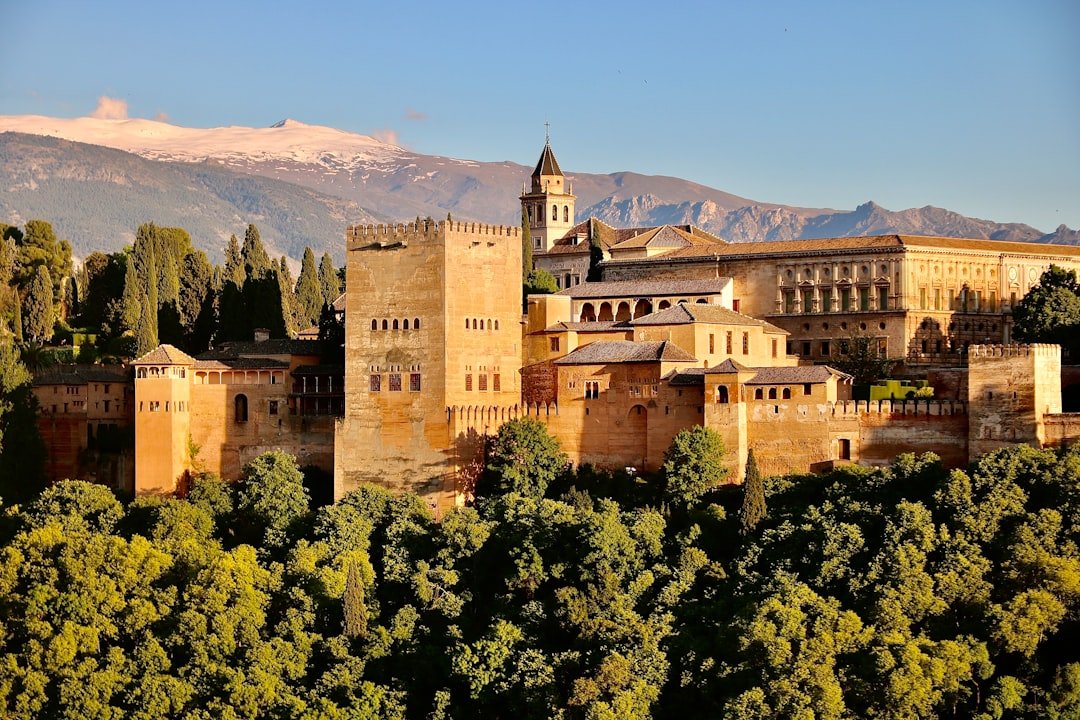
The rule that catches visitors is the time slot. The whole complex opens from 8.30 to 18.00 in winter and 8.30 to 20.00 in summer, but the Nasrid Palaces (Palacios Nazaríes) have a specific entry time printed on your ticket, and you must enter within it. Arrive late and the most famous rooms in Spain are closed to you, ticket or no ticket.
| On the ticket or the sign | What it means | Where the word came from |
|---|---|---|
| Palacios Nazaríes | The Nasrid Palaces, the timed part of the visit | Named for the Nasrid dynasty that built them |
| Alcazaba | The fortress at the western tip | Arabic, from al-qasaba |
| Generalife | The summer palace and gardens | Not in the etymology category we used, so we leave it uncounted |
| Taquilla | Ticket office | Arabic. Built on taca, from Arabic taqa, itself from Persian |
| Horario de acceso | Entry time. The one that matters. | Latin |
| Aljibe | Cistern. The Albaicín has several you can visit. | Arabic, from al-jubb |
For the wider region, our complete guide to Andalusia covers the route from Seville through Córdoba to Granada. The Córdoba piece is the natural companion to this one, since the two cities share the Arabic layer and almost nothing else. And Málaga, an hour and a half down the road, speaks a western Andalusian Spanish that softens where Granada deletes.
What can these numbers not tell you?
How do you prepare your ear for Granada in a week?
This is the fourth city we have measured rather than described, after Buenos Aires, Mexico City and Seville. For the map of where each accent sits, start with our region-by-region guide to how Spanish sounds across Spain.
So what is the honest description of Granada for a learner?
It is the city where the S you learned is gone nine times in ten, where the grammar has migrated into the vowels and even locals only half hear it, and where the words for the things you will eat, drink and photograph are Arabic more often than anywhere else you will visit in Spain.
It is also a city that hands you a free plate of food for the price of a small beer, and a palace that sells 98.6% of its annual capacity. Book the palace. Let the bar feed you. And listen to the vowels.
Frequently asked questions
Is the Granada accent hard to understand for learners?+
Harder than Seville, and much harder than Madrid, for one measurable reason. Educated Granada speakers delete a word-final S 91.2% of the time, against 56.1% in Seville. Before a vowel the figure is 98%. The words are the same; the endings are missing. Listen to articles and vowels rather than noun endings.
Do people in Granada speak with seseo or ceceo?+
The Granada S study does not cover that question, so we do not answer it here. What the eastern Andalusian research does show is that the city sits inside the vowel-opening zone, where a lost S changes the vowel before it. That feature, not seseo, is what separates Granada from Seville.
Are tapas really free in Granada?+
Yes, in most places. The Granada city council’s tourism site says a free tapa is served with each drink in most bars, and describes three models: a daily sequence you do not choose, a fixed list you choose from, and a house tapa that never changes. You pay for the drinks only.
How far ahead should I book the Alhambra?+
As far as you can. In 2025 the monument took 2,726,871 visitors against an annual ceiling of 2,765,500, which is 98.6% of capacity. Demand peaks in April, May, September and October. Your Nasrid Palaces entry time is printed on the ticket and must be respected.
How many Spanish words come from Arabic?+
For the whole language, estimates vary and we do not repeat a figure we cannot source. For the 224 everyday words on our Granada list, 55 are Arabic by origin according to Wiktionary’s etymology categories, which is 24.6%. The share is highest in the kitchen and the market.
Where does the accent data come from?+
Two peer-reviewed studies. Tejada Giráldez (2012) coded 3,027 syllable-final S sounds from 18 university-educated PRESEEA-Granada speakers. Herrero de Haro (2019) analysed 60 eastern Andalusian speakers acoustically and ran a perception test with school students. Both are linked in the sources below.
Sources
- Tejada Giráldez, M. de la S. (2012). Los factores lingüísticos de la /-s/ implosiva en el nivel de estudios altos de Granada. Normas. Revista de Estudios Lingüísticos Hispánicos, 2, 185-217. Read the study.
- Herrero de Haro, A. (2019). Catorce vocales del andaluz oriental: producción y percepción de /i/, /e/, /a/, /o/ y /u/ en posición final y ante /-s/, /-r/ y /-θ/ subyacentes en Almería. Nueva Revista de Filología Hispánica, LXVII(2), 411-446. Read the study.
- Ayuntamiento de Granada, Turismo. Tapas in Granada. Official page.
- Junta de Andalucía, cultural venue visitor figures for 2025, reported by Ahora Granada, 14 January 2026. Report.
- Patronato de la Alhambra y Generalife, summer 2025 figures and the 2,765,500 annual limit, reported by Motril Digital, September 2025. Report.
- Patronato de la Alhambra y Generalife. Prepara tu visita: momento de la visita. Official page.
- Wiktionary, category Spanish terms derived from Arabic and its subcategories, pulled 10 September 2026. Category page.
In a hurry? The headline numbers are in our web story version of this piece, ten cards, about a minute.
The vowels are easier to hear when you have already seen the words on a page. That is what reading gives you before a trip that a phrasebook does not. Our free Spanish Reading Starter Pack picks a first real book for your level and hands you the plan to finish it. Get the Starter Pack at Audaz Revista.
Camila Rossi
Culture writer, Buenos Aires & Barcelona
Camila Rossi is a writer based between Buenos Aires and Barcelona who covers the everyday culture of the Spanish-speaking world: its rituals, its food, and its unwritten social codes. She grew up sharing mate at her grandmother’s table, and writes about the customs that guidebooks tend to skip.
Share
Topics

audazrevista
You may also like


Get the Inside Scoop