Updated November 2, 2026 · Reviewed by the Audaz editorial team
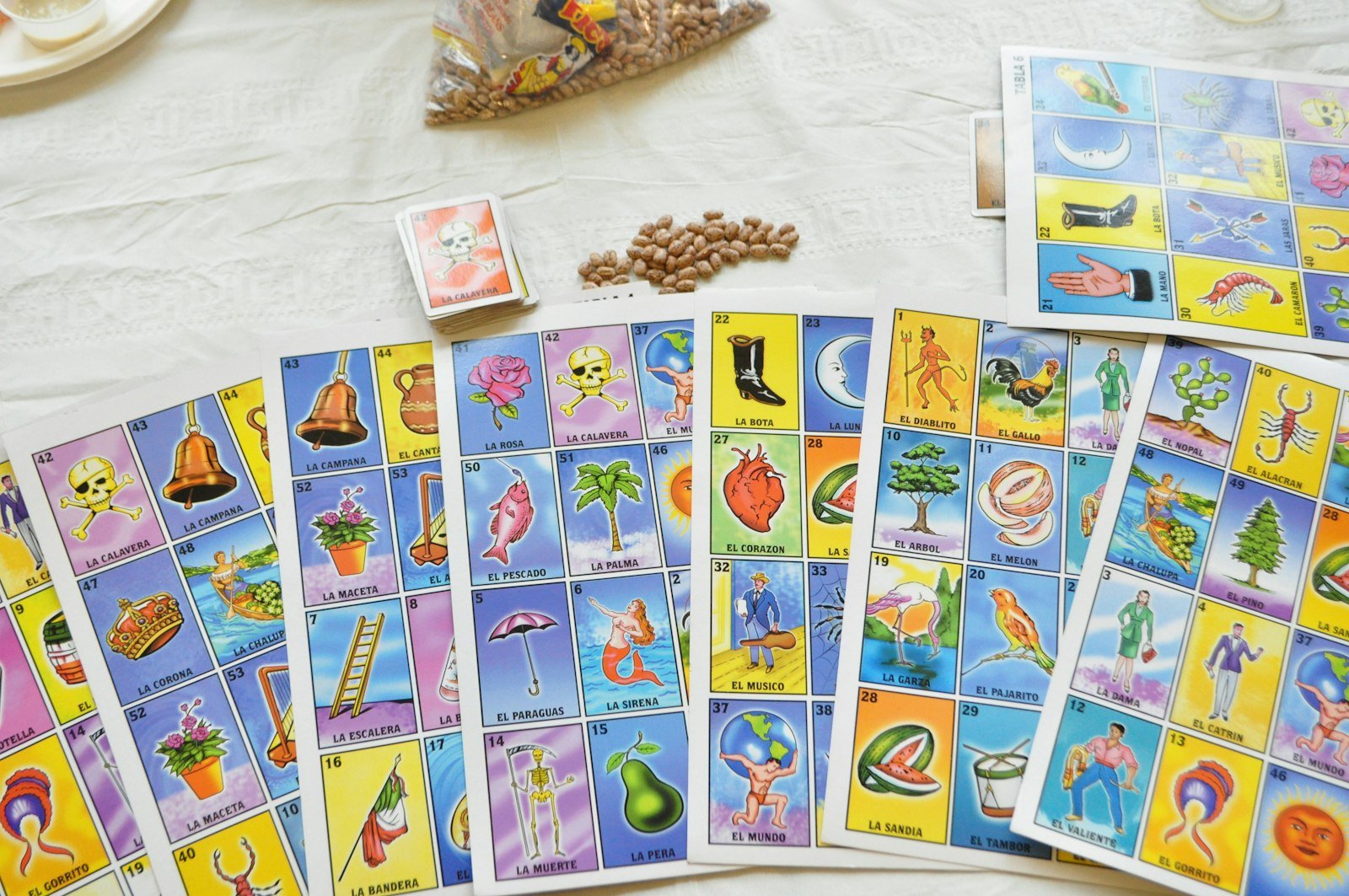
What is Lotería? Lotería is a Mexican game of chance, a lot like bingo. Instead of numbered balls, a caller draws from a deck of 54 picture cards, such as el gallo, the rooster, and la luna, the moon. Players mark each picture on their board, often with beans. The first to fill the board shouts ¡Lotería! Every card is a Spanish noun with its article, so the deck doubles as a 54-word vocabulary set.
- The game came from Italy, reached New Spain in 1769, and took its famous cards from Don Clemente Jacques in 1887.
- Of the 54 cards, 31 take el, 22 take la and 1 takes las.
- The caller’s verses hide old Spanish proverbs and some clever puns.
Most games only teach you how to win, but Lotería teaches you words as well. Each card shows a picture, its name and its article, so you hear la rana and see a frog at the same time. Below you’ll find all 54 cards in English, the words of the game itself, and the verses callers sing. We also point out the proverbs and puns tucked inside them.
In this guide (9)
- How do you play Lotería?
- Where did Lotería come from?
- What are the 54 Lotería cards in English?
- What can the 54 cards teach you about el and la?
- What does the caller sing for each card?
- Which Lotería verses work like Spanish proverbs?
- What are the puns hidden in the Lotería verses?
- How can you use Lotería to learn Spanish?
- Questions
How do you play Lotería?
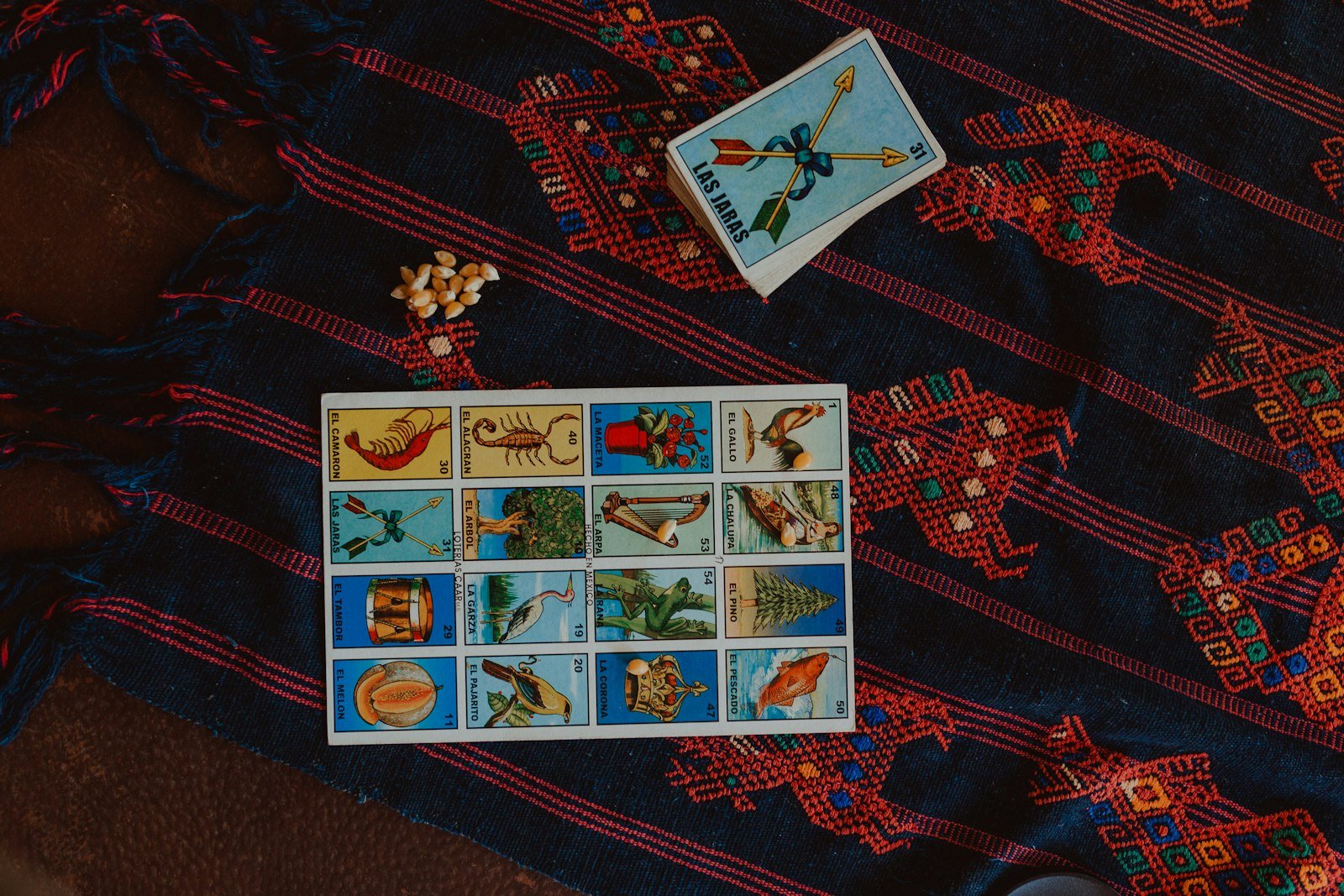
Each player gets a tabla, a board with 16 pictures in a 4 by 4 grid. Every board has a different mix of pictures. The caller, called el gritón or el cantor, shuffles the deck. Then they draw one card at a time and call out its name.
If you have that picture on your board, you mark it. In Mexico people use pennies, bottle caps or pinto beans. The first player to mark the agreed pattern wins. That might be the full board, a row, a column, a diagonal or the 4 corners. You can also win with a pozo, a small square of pictures next to each other.
The winner shouts ¡Lotería! or ¡Buenas! Sometimes the game keeps going so others can win too. Then you’ll hear ¡No las quiten!, don’t take them off, or ¡Sigue!, keep going.
| Spanish | What it means in the game |
|---|---|
| la tabla | the board, a grid of 16 pictures, 4 by 4 |
| la carta | one of the 54 cards in the deck |
| el gritón or el cantor | the caller, the person who sings out each card |
| ¡Corre! | off we go, the call that starts the game |
| los frijoles | the beans players use to mark their board |
| ¡Lotería! or ¡Buenas! | what the winner shouts |
| la vaquita | the pot of money everyone chips in at a fair |
| de a frijolito | playing just for beans, with nothing real at stake |
| el pozo | a small square of pictures, a way to win |
Playing just for fun. At fairs people often play for money. When nothing is at stake, Mexicans say they play de a frijolito, for a little bean. The beans on the board are the only prize.
Where did Lotería come from?
Lotería feels deeply Mexican, but it began in Italy in the 15th century. One early form was called lotto. In it, 5 numbers were drawn from 90, and each number went with a picture. The game spread to Spain and then crossed to New Spain, as colonial Mexico was called, in 1769.
At first it was a pastime for the rich. Over time it moved into fairs and town festivals, and everyone played. The earliest boards were made by hand. Artists painted them on tin or paper, and each set looked different.
The cards most people know today came from Clemente Jacques, a French businessman in Mexico. He started printing the game in 1887. His company also canned food, and his Lotería sets went out to Mexican soldiers with their rations and supplies. His images became so well known that they now stand for Lotería itself.
One deck, many versions. The 54 cards below are the standard set. Some decks swap el venado for el caballo, the horse, and add la guitarra and la manzana for 56 cards. Another popular deck, la Lotería del Comal, is all kitchen things, like el comal, the griddle, and el molcajete, the stone mortar.
Source: From the facts in this guide.
What are the 54 Lotería cards in English?
Here is the full traditional deck, in its usual order. The list comes from Wikipedia’s page on Lotería, and the numbers are the ones printed on the cards. Most players ignore the numbers, though, and call each card by its name.
| No. | Card | English |
|---|---|---|
| 1 | El gallo | the rooster |
| 2 | El diablito | the little devil |
| 3 | La dama | the lady |
| 4 | El catrín | the dandy |
| 5 | El paraguas | the umbrella |
| 6 | La sirena | the mermaid |
| 7 | La escalera | the ladder |
| 8 | La botella | the bottle |
| 9 | El barril | the barrel |
| 10 | El árbol | the tree |
| 11 | El melón | the melon |
| 12 | El valiente | the brave man |
| 13 | El gorrito | the little bonnet |
| 14 | La muerte | death |
| 15 | La pera | the pear |
| 16 | La bandera | the flag |
| 17 | El bandolón | the mandolin |
| 18 | El violoncello | the cello |
| 19 | La garza | the heron |
| 20 | El pájaro | the bird |
| 21 | La mano | the hand |
| 22 | La bota | the boot |
| 23 | La luna | the moon |
| 24 | El cotorro | the parrot |
| 25 | El borracho | the drunkard |
| 26 | El negrito | the little black man |
| 27 | El corazón | the heart |
| 28 | La sandía | the watermelon |
| 29 | El tambor | the drum |
| 30 | El camarón | the shrimp |
| 31 | Las jaras | the arrows |
| 32 | El músico | the musician |
| 33 | La araña | the spider |
| 34 | El soldado | the soldier |
| 35 | La estrella | the star |
| 36 | El cazo | the saucepan |
| 37 | El mundo | the world |
| 38 | El Apache | the Apache |
| 39 | El nopal | the prickly pear cactus |
| 40 | El alacrán | the scorpion |
| 41 | La rosa | the rose |
| 42 | La calavera | the skull |
| 43 | La campana | the bell |
| 44 | El cantarito | the little water pitcher |
| 45 | El venado | the deer |
| 46 | El Sol | the sun |
| 47 | La corona | the crown |
| 48 | La chalupa | the canoe |
| 49 | El pino | the pine tree |
| 50 | El pescado | the fish |
| 51 | La palma | the palm tree |
| 52 | La maceta | the flowerpot |
| 53 | El arpa | the harp |
| 54 | La rana | the frog |
A few cards show people in ways many players now find dated, such as El negrito and El Apache. When Google built a playable Lotería for its Doodle on 9 December 2019, it added new cards. Two of them were El ajolote, the axolotl, and El buscador, the search engine.
What can the 54 cards teach you about el and la?
We counted the articles on all 54 cards. 31 take el, 22 take la and 1, las jaras, is plural. So the deck gives you a steady mix of both genders, with the picture right there to help it stick.
It also holds a few traps worth knowing. El arpa, the harp, is a feminine word. It takes el only because it starts with a stressed a sound. La mano, the hand, ends in o but is feminine. El corazón, el camarón and el alacrán all end in -ón or -án and are masculine.
Some cards add a small ending to the word. So el diablito is a little devil, el gorrito a little bonnet and el cantarito a little jug. That -ito ending makes a word smaller or more loving. It’s the most common ending of its kind in Spanish, so the cards are a good place to meet it.
Say the article every time. When you call or mark a card, say la rana, never just rana. After a few games, the right article starts to come on its own.
What does the caller sing for each card?
A good caller doesn’t just read the name. They sing a short verse, a saying or a joke about the picture. The verse hints at the picture, and a caller is loved or not for their wit. At a church fair the jokes stay gentle. Among adults, the same caller can get a lot cheekier.
Wikipedia’s card list pairs each card with a verse callers often use. A few of them are short and very plain. For el paraguas, the umbrella, the caller sings Para el sol y para el agua, for the sun and for the rain. For la luna, it’s El farol de los enamorados, the street lamp of lovers. For el sol, it’s La cobija de los pobres, the blanket of the poor.
Others work like little tongue twisters for learners. For la chalupa, the canoe, you’ll hear Rema que rema Lupita, sentada en su chalupita. Lupita rows and rows, sitting in her little canoe. It’s a nice way to practise the sounds of Spanish out loud.
Which Lotería verses work like Spanish proverbs?
This is where Lotería turns into a lesson in everyday Spanish. Some verses borrow from refranes, the short proverbs Spanish speakers use. Camarón que se duerme, se lo lleva la corriente is a classic refrán. The fish verse echoes another one, Por la boca muere el pez. Others simply work like proverbs, with a bit of life advice in one line.
| Card | The verse | What it means |
|---|---|---|
| El árbol | El que a buen árbol se arrima, buena sombra le cobija. | Stay close to a good tree and you get good shade, just as good friends look after you. |
| El camarón | Camarón que se duerme, se lo lleva la corriente. | The shrimp that falls asleep is swept away by the current, so stay alert or you lose out. |
| El cantarito | Tanto va el cántaro al agua, que se quiebra y te moja las enaguas. | The jug goes to the water so often that it breaks and soaks your petticoat. Push your luck and it runs out. |
| La pera | El que espera, desespera. | The one who waits despairs, because waiting wears you down. |
| El pescado | El que por la boca muere, aunque mudo fuere. | It dies by its mouth, even if it can’t speak. A fish is caught by the hook it bites. |
| La maceta | El que nace pa’maceta, no sale del corredor. | Born to be a flowerpot, you never leave the hallway, and some people never change. |
If you like sayings like these, our list of Spanish idioms by country shows which ones travel and which stay at home.
What are the puns hidden in the Lotería verses?
Some verses only work if you hear them. They play on 2 words that sound alike, a favourite trick in Mexican Spanish. Read them out loud and the joke appears.
| Card | The verse | The pun |
|---|---|---|
| La pera | El que espera, desespera. | espera, waits, sounds like es pera, is a pear |
| El cazo | El caso que te hago es poco. | caso, attention, sounds like cazo, saucepan |
| El venado | Saltando va buscando, pero no ve nada. | ve nada, sees nothing, sounds like venado, deer |
| El mundo | Este mundo es una bola, y nosotros un bolón. | bola is a ball, and also a crowd |
The venado verse is the best one to start with. The deer jumps around looking for something, pero no ve nada, but sees nothing. Say ve nada fast and you’ll hear the deer. Puns like these sit close to riddles, and our Spanish riddles for children work the same way.
How can you use Lotería to learn Spanish?
Lotería is easy to find in Mexico. Markets, stationery shops and supermarkets sell it, and there are apps too. Once you have a deck, here are a few ways to turn it into practice.
- Be the caller, because calling the cards makes you say every word out loud, with its article.
- Start with the plain names, then swap in the traditional verses as clues once you know the deck.
- Write your own verse in Spanish.
- Sort the deck into piles for animals, food, music and people, and say each word as you place it.
- Play on a video call.
Many words on the cards turn up again in daily life. El nopal, the prickly pear cactus, sits at the centre of Mexico’s flag, under the eagle. If you’d like more of the food words, see our guide to Spanish food words by country. For the bigger picture of fairs, saints’ days and family games, read our guide to Mexican traditions.
Try it tonight. Pick 10 cards and call them out in Spanish, with el or la, while someone points to the picture. When you reach the last card, swap roles.
Words from this guide
| Spanish | English |
|---|---|
| el gallo | the rooster |
| la luna | the moon |
| la rana | the frog |
| la tabla | the board, a grid of 16 pictures |
| el gritón | the caller |
| los frijoles | the beans players use to mark their board |
| la vaquita | the pot of money everyone chips in at a fair |
| el pozo | a small square of pictures, a way to win |
| ¡Sigue! | keep going |
| los refranes | the short proverbs Spanish speakers use |
Frequently asked questions
What does lotería mean in English?
Lotería means lottery. In Mexico the word also names this picture game, which works a lot like bingo.
How many cards are in a Lotería deck?
The traditional deck has 54 cards, each with its own picture. Some decks add cards and reach 56.
What do you say when you win Lotería?
You shout ¡Lotería! Some players shout ¡Buenas! instead.
What do you use to mark a Lotería board?
In Mexico people often use pinto beans, pennies or bottle caps, though any small object works.
Who made the Lotería cards?
The game came from Italy, but the best-known cards come from Clemente Jacques, who began printing them in Mexico in 1887.
In a hurry? We also made a short web story version of this piece.
Games like this live in real places. Our next issue, Ciudades que hablan, takes you to 18 cities across the Spanish-speaking world. Each one gets a single story, told in Spanish by someone who lives there. Join the waitlist and we’ll tell you when it opens.


Your Spanishcould use some.
In Spanish, reading tends to fall apart at the first word you don’t know. Audaz Revista is a Spanish magazine written by experts, where you tap that word and keep going. Edition 1 is out now.
Pay once, and it opens the moment you pay. See what's in Edition 1
Try it. Tap any word.
.
We love meeting up with friends to go out for tapas.
From "5 Spanish customs you should know", Edition 1.
Pay once, and it opens the moment you pay. See what's in Edition 1