7 Latin American Traditions and the Words That Carry Them
By Camila Rossi, Culture writer, Buenos Aires & Barcelona
Updated September 18, 2026 · Reviewed by the Audaz editorial team
Which Latin American traditions still carry their original names? Seven living traditions go by words that Spanish took from indigenous languages such as Nahuatl, Quechua, Taíno and Guaraní: tianguis, temazcal, barbacoa, pachamanca, minga, mate and tereré. We checked them in the Real Academia Española dictionary, in Mexico’s own dictionary and in Wiktionary. Then we looked for them in a list of the 50,000 commonest word forms in Spanish film and TV subtitles. Five of the seven are not on it. The traditions survived. Most of their words live in only one region.
- Wiktionary lists 895 Spanish terms from six indigenous languages of the Americas. It lists 922 from Arabic alone.
- Five of our seven words are missing from the 50,000 commonest subtitle word forms.
- Mexico’s dictionary has no drink sense for mate. It lists only matte and checkmate.
- Barbacoa began as a Taíno frame of sticks. In Mexico it now means meat cooked in a pit.
- One word on the list has a vulgar double. Read the minga warning before you use it.
Every Hispanic Heritage Month brings the same kind of list. Ten traditions, a photo each, a line about colour and joy.
We wanted to know something more useful for a learner. When a tradition outlived the conquest, did its name come with it? And if it did, will you ever hear that name outside the place it comes from?
So we picked seven living traditions whose names Spanish took from an indigenous language. Then we checked every word against real dictionaries and a real frequency list. The answers were not what we expected.
How many indigenous words did Spanish keep?
Hundreds. On 17 September 2026 we pulled Wiktionary’s category lists of Spanish terms derived from six languages of the Americas. Wiktionary is a volunteer dictionary, so treat these as floor counts. The lists include place names such as Cuba and México.
| Source language | Where it was spoken | Spanish terms listed |
|---|---|---|
| Nahuatl (incl. Classical Nahuatl) | Central Mexico | 407 |
| Quechua | The Andes | 243 |
| Mapudungun | Chile and Argentina | 116 |
| Taíno | The Caribbean islands | 100 |
| Yucatec Maya | The Yucatán peninsula | 24 |
| Aymara | Bolivia and Peru | 21 |
Take out the words that appear in more than one list and you get 895 distinct terms. When we pulled the Arabic list for our Granada guide on 10 September, it held 922. So Arabic alone has left more words in Spanish, by this count, than these six American languages together.
Guaraní should be on that table. Wiktionary’s Guaraní category came back empty when we pulled it, so we have no number to give. We would rather leave the row out than guess it.
Which of these words will you actually hear?
Very few. We used the 2018 OpenSubtitles frequency list for Spanish, which ranks the 50,000 commonest word forms in film and TV subtitles. Those 50,000 forms add up to 413,264,052 running words. That is a good picture of how Spanish sounds on screen.
We checked every hit in the top 10,000 by hand. Then we set aside place names such as México and Cuba, and every spelling whose common use is a different word. Seven clear cases were left. All of them come from the Nahuatl and Taíno lists.
Two near misses are worth naming. Tequila ranks 8,524, but Wiktionary files it as the name of a town, so it went out with the place names. Taco ranks 9,442, and in Spain the same word also means a plug or a swear word. We could not tell those uses apart, so we left it out.
| Word | Meaning | Source (Wiktionary) | Subtitle rank |
|---|---|---|---|
| chocolate | chocolate. | Nahuatl. | 2,154 |
| maíz | maize, corn. | Taíno. | 4,715 |
| tabaco | tobacco. | Taíno. | 5,877 |
| tomate | tomato. | Nahuatl. | 6,660 |
| barbacoa | barbecue. | Taíno. | 8,461 |
| huracán | hurricane. | Taíno. | 8,697 |
| maní | peanut. | Taíno. | 9,508 |
The Quechua list looks busier, and it is a trap. Llama ranks 415, but most of those are the verb form llama, as in ¿quién llama? (who is calling?). Papa ranks 1,594 and shares its spelling with the word for dad and the Pope. Causa ranks 1,097, but that spelling is also the everyday word for cause. The Peruvian potato dish called causa is lost inside it.
A frequency list counts spellings. It cannot tell a llama from a phone call. The Quechua list has 13 hits in the top 10,000, and we kept none of them. Coca and cancha came closest, but we could not separate their Quechua sense from their other uses. The Mapudungun and Maya lists fall into the same trap with loco and chico.
Of our seven tradition words, only barbacoa is on the list with its meaning intact. Mate ranks 3,148, but that spelling is also a form of matar, to kill. The other five are missing from all 50,000.
That is the real lesson. These words are not rare because the traditions are fading. They are rare because each one belongs to a place. You learn them there, or you learn them from a story set there.
What is a tianguis, and why is it the same in the plural?
A tianguis is a Mexican street market that pops up on a set day. The Real Academia Española marks it Méx., gives its meaning as mercado (market) and traces it to the Nahuatl tianquiztli. Wiktionary spells the Classical Nahuatl source tiyānquiztli and glosses it as street market or marketplace.
Mexico’s own dictionary, the Diccionario del español de México (DEM) from El Colegio de México, is more precise. It describes a group of temporary stalls, set up in a fixed place on a fixed day of the week, for selling or swapping all sorts of goods. Its own example is Comí en el tianguis (I ate at the tianguis).
Here is the grammar point most lists miss. The DEM marks tianguis as s m sing y pl. It is a masculine noun with one form for both numbers. So you say el tianguis for one and los tianguis for several. Never tianguises.
If you go, you will need the food words too. Our guide to Mexican menu words covers what you will see on the stalls.
What does temazcal literally mean?
It means a bathing house. Wiktionary traces temazcal to the Classical Nahuatl temāzcalli, sweat lodge or sweat bath. That word joins tēma, to pour or bathe by pouring, with calli, house.
The DEM describes the temazcal as a traditional Mesoamerican steam bath. It is usually an adobe room shaped like an oven. Stones are heated in a fire inside, then sprinkled again and again with water and fragrant herbs.
The DEM also accepts the spelling temascal, with an s. You will see both on signs. One honest gap: we could not find an archived copy of the RAE entry, so this section relies on the Mexican dictionary alone.
How did barbacoa travel from a Caribbean frame to a Mexican pit?
This is the best story on the list, because the meaning moved while the word stayed put.
Wiktionary says Spanish borrowed barbacoa from Taíno, where it meant a framework of sticks. It was a raised wooden structure that people used to sleep on or to cure meat. The RAE is more careful. It says the word comes quizá (perhaps) from Taíno.
The DEM spells out the Mexican method. The pit is heated until it works like an oven. The meat goes on maguey leaves and is covered with more leaves and earth until it is cooked.
So a Spaniard who says barbacoa means a garden grill. A Mexican usually means a slow-cooked Sunday meat. Same word, different lunch.
Where does the word pachamanca come from?
The sources disagree, and that is worth knowing.
The RAE marks pachamanca as used in Ecuador and Peru. It defines it as meat seasoned with ají (chilli pepper) and roasted between hot stones, or in a hole in the ground covered with hot stones. The archived RAE entry gives no origin at all.
Infobae gives the popular explanation. It says the name is Quechua, with pacha meaning earth and manca meaning pot. Wiktionary’s English entry says something different. It traces the word to Aymara pacha, earth, and manq’a, food.
Both agree on the earth. They split on whether the rest is the pot or the meal. We could not settle it, so we will not pretend to.
The tradition itself has official standing. Infobae reports that the pachamanca was recognised as Cultural Heritage of the Nation in Peru in 2003. It also reports a Día de la Pachamanca on the first Sunday of February, set by Ministerial Resolution 0577-2015-MINAGRI.
What is a minga, and what should you never confuse it with?
A minga is shared work. The RAE traces it to the Quechua mink’a. Its first sense, used in Argentina, Chile, Colombia, Ecuador, Paraguay and Peru, is a gathering of friends and neighbours to do a job together for free. Its second sense, in Ecuador and Peru, is collective unpaid farm work for the good of the community.
The RAE also has a second, unrelated entry for minga. It is marked malsonante (vulgar) and means penis. Wiktionary dates that word to 1627, calls its origin unclear and labels it as Spain’s. Context usually makes the meaning clear. Still, use it only in a sentence that is plainly about shared work, and mainly in the countries the RAE lists.
Wiktionary records a third minga as well. In the slang of the Río de la Plata, ¡minga! means no way. Wiktionary traces that one to Lombard, a language of northern Italy.
This is a good example of why you learn a word inside its sentence. A bare word can carry three histories.
Does mate mean the drink in Mexico?
Not according to Mexico’s own dictionary. It does not record the drink at all.
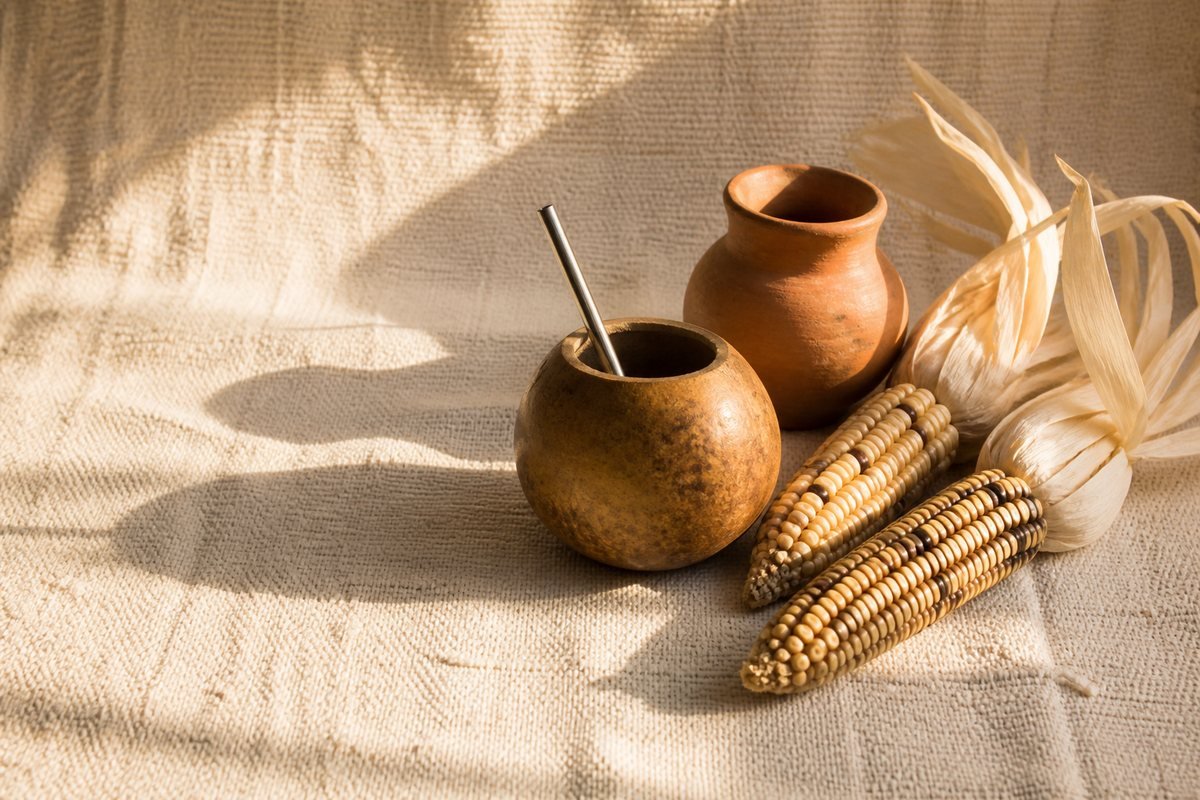
The RAE has four separate entries spelled mate. One comes from French and means matte, without shine. One is checkmate, from Arabic. One comes from matar. And one comes from the Quechua mati, which the RAE glosses as calabacita (little gourd). That last entry gives the infusion as its first sense, and the gourd you drink it from as another.
Now open the DEM entry for mate. It gives the matte colour and the chess move. It adds a popular phrase, darle mate a algo o a alguien. That means to finish something off completely, or to kill someone. Its own example is Vamos a darle mate al pastel (let’s finish off the cake). There is no drink anywhere on the page.
In Argentina the drink is law. Ley 26.871, passed on 3 July 2013, declares mate the national infusion. Its second article defines it as an infusion of yerba mate, placed in a container, wetted with hot water and drunk through a bombilla (metal straw).
The Argentine government traces the habit to the Guaraní peoples. It says they used the leaves as a drink, an object of worship and a currency. It also notes that 30 November is the Día Nacional del Mate, under Ley 27.117.
So the drink is Guaraní, and the word for it is Quechua. That is one tradition, carried by a word from a different people.
Is tereré just cold mate?
Close, but the herbs matter. The RAE marks tereré for Argentina, Paraguay and Uruguay. It defines it as a drink made with yerba mate and cold water, mixed in some places with medicinal herbs. Wiktionary says Spanish borrowed the word from Guaraní.
UNESCO inscribed Paraguay’s tereré on its Representative List of the Intangible Cultural Heritage of Humanity in 2020. Its description is precise. Cold water is mixed with Pohã Ñana, herbs crushed in a mortar. It is then served in a glass already filled with yerba mate and drunk through a bombilla.
One detail is worth reading twice. UNESCO says the practice has been handed down in Paraguayan families since roughly the sixteenth century. That is the century Spain colonised the region. So the family custom UNESCO describes is as old as the colony itself. It still goes by a Guaraní name.
Why do these words matter for your Spanish?
Because they tell people where you learned.
A course teaches you mercado. A market in Puebla teaches you tianguis. Both are correct. Only one tells a Mexican that you have been there, or read someone who has.
The frequency list makes the same point from the other side. If five of these seven words sit outside the 50,000 commonest forms, no app built on frequency will ever serve them to you. You meet them in places, and in books. A novel set in the Andes will hand you minga in context, with the right meaning attached. Our list of the best Latin American novels is a good place to start.
For more words that carry a place inside them, try our Oaxaca food vocabulary, the country identity words we checked for Heritage Month, or the story of Día de los Muertos and its words. For the wider picture, see our guide to Hispanic traditions across Latin America.
How did we check all this?
Four steps, all repeatable.
One limit to keep in mind. Subtitles lean towards drama and dialogue, and much of that is translated from English. A frequency list built from Mexican or Peruvian speech alone would rank some of these words higher. The list shows what reaches Spanish as a whole. It does not show what a single town says every day.
What should you do with these seven words?
Learn each one with its place and its sentence. El tianguis de los domingos. Una minga en la comunidad. Un tereré con Pohã Ñana.
Then check the regional label before you use it somewhere else. The dictionary already tells you where each word is at home. That one habit will keep you out of most trouble.
Frequently asked questions
What are some Latin American traditions that kept their indigenous names?+
Seven good examples are the tianguis street market and the temazcal steam bath in Mexico, barbacoa pit cooking, the pachamanca earth oven in Peru, the minga work party in the Andes, and mate and tereré in the Río de la Plata region and Paraguay. Their names come from Nahuatl, Taíno, Quechua or Guaraní, and the pachamanca has disputed Quechua and Aymara roots.
How many Spanish words come from indigenous languages?+
Wiktionary listed 895 distinct Spanish terms from Nahuatl, Quechua, Mapudungun, Taíno, Yucatec Maya and Aymara when we pulled its categories on 17 September 2026. Nahuatl was the largest source with 407. The count includes place names and is a floor, since Wiktionary is volunteer-built. For comparison, its Arabic list held 922 on 10 September.
Is tianguis singular or plural?+
Both. Mexico’s Diccionario del español de México marks tianguis as a masculine noun with the same form in singular and plural. Say el tianguis for one market and los tianguis for several.
Does mate mean the drink everywhere?+
No. In Argentina, Paraguay, Uruguay and nearby countries it does, and the RAE traces that sense to the Quechua mati, little gourd. Mexico’s own dictionary lists mate only as a matte colour, a checkmate, and the phrase darle mate, to finish something off. There is no drink sense in that entry.
What is the difference between mate and tereré?+
Mate is drunk with hot water. Argentina’s Ley 26.871 defines it that way. Tereré uses cold water, and in Paraguay it is mixed with Pohã Ñana, herbs crushed in a mortar. UNESCO inscribed the Paraguayan practice as intangible heritage in 2020.
Is minga a rude word?+
It can be. The RAE has two entries. The Quechua one means a gathering of neighbours for shared unpaid work. A separate entry, marked vulgar, is slang for penis. In Río de la Plata slang, ¡minga! also means no way. Use it only where the sentence is plainly about shared work, and mainly in the Andean and southern countries the RAE lists.
Words like these stick when a story hands them to you. Our Spanish Reading Starter Pack gives you the first real books worth finishing at your level, each with an honest rating, plus the method for reaching the last page. It is free. Get the Starter Pack.
Camila Rossi
Culture writer, Buenos Aires & Barcelona
Camila Rossi is a writer based between Buenos Aires and Barcelona who covers the everyday culture of the Spanish-speaking world: its rituals, its food, and its unwritten social codes. She grew up sharing mate at her grandmother’s table, and writes about the customs that guidebooks tend to skip.
Share
Topics

audazrevista
You may also like


Get the Inside Scoop