Spanish Reading Practice: 6 Short Texts, A2 to B2
By the Audaz Revista editorial team
Updated October 19, 2026 · Reviewed by the Audaz editorial team
What is good Spanish reading practice? Short, whole texts about real everyday life, at a level just above yours, with the hard words explained. Below are 6 short texts written by the Audaz team, from a Spanish breakfast to a Mexican street market. They run from A2 to B2, and each one has a glossary and 2 questions.
- 6 original Spanish texts, 2 each at A2, B1 and B2, sorted from easiest to hardest.
- Together they come to 623 Spanish words, with 43 words you can tap to see their meaning.
- Each text shows a real custom from Spain, Mexico or Argentina, and every custom is checked against a source.
- Every text ends with 2 questions, and the answers sit right below them.
Most reading practice for learners is about nothing in particular. Someone buys a ticket, someone asks the way. We wanted texts that also teach you how life works in the Spanish-speaking world. So each one here is built around a small custom that people really keep, and the words that come with it.
This page is interactive. Tap any red word in a Spanish text to see what it means and the sentence it comes from.
How did we write and level these texts?
We wrote all 6 texts ourselves for this page. The people in them are made up, but the customs are real. We checked each one against a dictionary or a published source before we used it. Word meanings follow the dictionary of the Real Academia Española, the RAE.
The levels are our own judgement on the CEFR scale, which runs from A1 (beginner) to C2. We looked at the tenses, the length of the sentences and how common the words are. Then we counted. The table shows what changes as the level goes up.
| Text | Where | Level | Spanish words | Sentences | Words per sentence | Tap-to-define words |
|---|---|---|---|---|---|---|
| El desayuno | Spain | A2 | 78 | 9 | 8.7 | 6 |
| El tianguis | Mexico | A2 | 95 | 11 | 8.6 | 6 |
| La sobremesa | Spain | B1 | 107 | 9 | 11.9 | 6 |
| En el colectivo | Argentina | B1 | 98 | 9 | 10.9 | 8 |
| Las mañanitas | Mexico | B2 | 114 | 8 | 14.2 | 8 |
| Las Fallas | Spain | B2 | 131 | 11 | 11.9 | 9 |
Sentence length is the clearest change. At A2 our sentences average 8.7 words. At B2 they average 12.9. That’s the jump you feel when a text suddenly seems hard, even when you know most of the words.
1. El desayuno (A2, Spain)
Level A2. 78 words. This first text uses the present tense only, and most sentences are short. It follows one woman through a normal working morning in Spain.
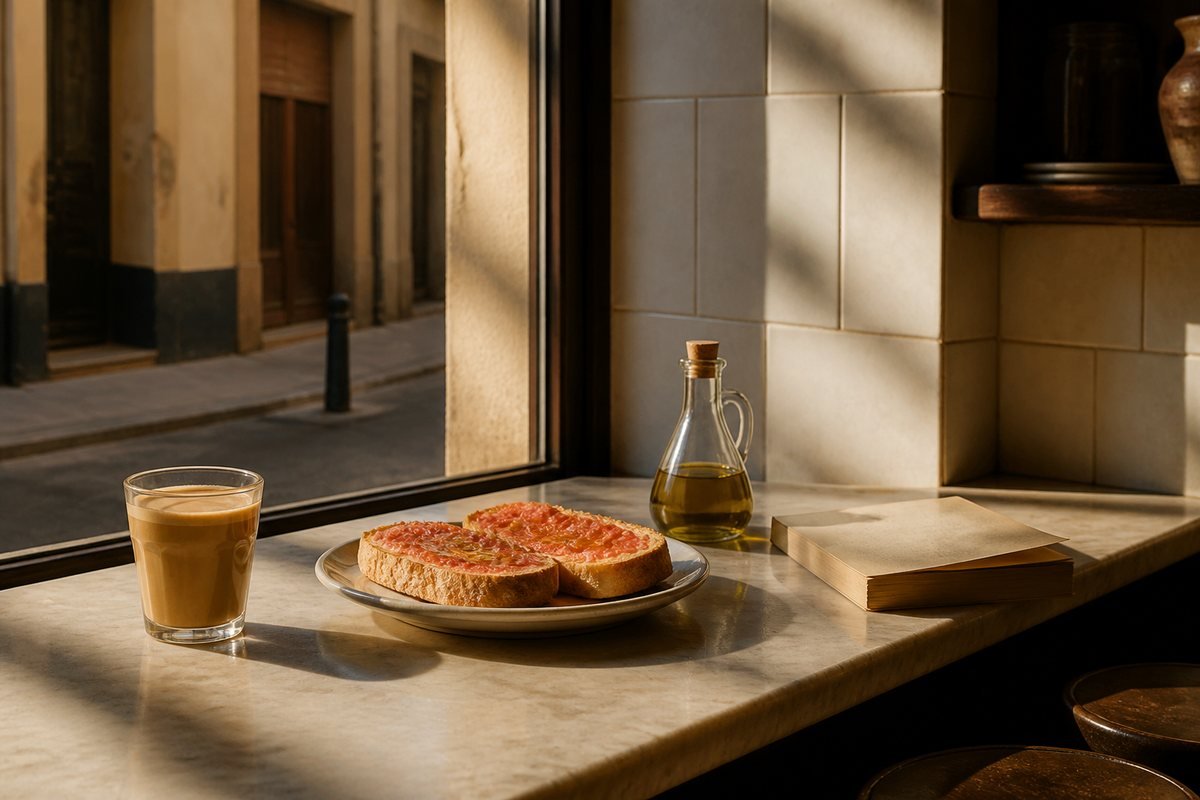
Son las ocho de la mañana. Marta entra en el bar de su calle. Pide un café con leche y una tostada con tomate. El camarero trae el pan caliente. Marta pone el tomate, el aceite de oliva y un poco de sal. Es un desayuno pequeño, pero le gusta mucho.
A las once, Marta tiene hambre otra vez. Sale de la oficina con dos compañeros y toman algo rápido. En España, la comida grande llega más tarde.
| Spanish | English |
|---|---|
| Pide | to ask for, to order |
| café con leche | coffee with milk, in about equal parts |
| tostada | a slice of toasted bread |
| aceite de oliva | olive oil |
| tiene hambre | to be hungry (literally, to have hunger) |
| compañeros | colleague, workmate |
The custom behind it: Breakfast in Spain is often light. Toast with oil and tomato is a common choice, and so is coffee with milk. Because lunch comes late, many people stop for a snack in the middle of the morning. Our guide to what people in Spain eat for breakfast goes further.
Learn from it: Tener hambre means to be hungry, but word for word it says to have hunger. Spanish uses tener the same way in tener frío (to be cold) and tener sueño (to be sleepy).
- ¿Qué pide Marta para desayunar? Answer: Un café con leche y una tostada con tomate.
- ¿Qué hace Marta a las once? Answer: Sale con dos compañeros y toma algo rápido.
2. El tianguis (A2, Mexico)
Level A2. 95 words. The second text is also in the present tense. It adds a short dialogue, so you see how a question and an answer look on the page.
Hoy es domingo y hay tianguis en el barrio de don Luis. El tianguis es un mercado al aire libre. No está en la calle todos los días: llega un día a la semana.
Don Luis compra fruta y verdura. Siempre va al mismo puesto. La vendedora lo saluda con una sonrisa, porque don Luis es su marchante. «¿Lo de siempre?», le pregunta ella. «Sí, lo de siempre», contesta él.
Luego camina despacio entre los puestos. Hay ropa, juguetes y música. Por la tarde, los vendedores recogen todo, y la calle está vacía otra vez.
| Spanish | English |
|---|---|
| tianguis | a street market (Mexico) |
| al aire libre | open-air, outdoors |
| puesto | a market stall |
| marchante | a regular customer |
| Lo de siempre | the usual |
| recogen | to pack up, to put away |
The custom behind it: A tianguis is an open-air market that sets up on certain days, often once a week, in a neighbourhood street. The word comes from Nahuatl, the language of the Aztec Empire. The tradition is much older than the Spanish language in Mexico. Wikipedia’s tianguis article covers its long history.
Learn from it: The RAE dictionary lists marchante in Mexico and several other countries as a regular customer, someone who keeps going back to the same shop. Its general meaning is a trader, especially one who deals in art.
- ¿Cuándo hay tianguis en el barrio de don Luis? Answer: Un día a la semana. Hoy es domingo.
- ¿Por qué la vendedora conoce a don Luis? Answer: Porque él es su marchante: siempre compra en su puesto.
3. La sobremesa (B1, Spain)
Level B1. 107 words. Now the past tenses arrive. Watch the two kinds: comimos and sirvió tell you what happened, while discutían and nos reíamos set the scene.
El domingo pasado comimos en casa de mis abuelos. Llegamos a las dos y cuarto, y la comida empezó a las dos y media. Mi abuela preparó tres platos, porque en España la comida es la más grande del día.
Cuando terminamos el postre, nadie se levantó de la mesa. Mi abuelo sirvió café y empezó a contar historias de cuando era joven. Mis tíos discutían de fútbol, y mi prima y yo nos reíamos sin parar.
Así pasamos casi dos horas. En mi familia, la sobremesa es tan importante como la comida. Cuando por fin nos fuimos, mi abuela nos dio comida para toda la semana.
| Spanish | English |
|---|---|
| la comida | lunch, the main meal of the day |
| postre | dessert |
| se levantó | to get up |
| discutían | to argue, to debate |
| nos reíamos | to laugh |
| sobremesa | the time spent at the table after a meal |
The custom behind it: In Spain, lunch is the big meal of the day. It usually starts between 2:00 and 2:30 in the afternoon, and it is often followed by sobremesa, the talk at the table after eating. Coffee often comes out at this point. Read our piece on sobremesa for the full custom.
Learn from it: Comida has two meanings. It means food in general, and in Spain it also names lunch itself. The last sentence of the text uses it both ways.
- ¿Qué pasó cuando terminaron el postre? Answer: Nadie se levantó de la mesa. El abuelo sirvió café y contó historias.
- ¿Cuánto tiempo duró la sobremesa? Answer: Casi dos horas.
Halfway through? Try reading the first 3 texts out loud. If you stumble, read the sentence again more slowly, then once at normal speed.
4. En el colectivo (B1, Argentina)
Level B1. 98 words. This text stays in the present, but the sentences get longer, and you meet one line of Argentine Spanish.
Sofía vive en Buenos Aires y va a la facultad en colectivo. Cada mañana espera en la parada. En el cartel ve el número de la línea y las calles principales del recorrido.
Cuando llega el colectivo, Sofía sube y paga adentro con su tarjeta SUBE. Hoy hay mucha gente, así que viaja de pie. Una señora le pregunta: «¿Vos bajás en la próxima?». «No, bajo más adelante», contesta Sofía.
Un poco antes de su parada, Sofía toca el timbre que está cerca de la puerta. El colectivo frena, ella baja y llega a clase justo a tiempo.
| Spanish | English |
|---|---|
| colectivo | a bus (Argentina and other countries) |
| parada | a bus stop |
| línea | the bus route and its number |
| recorrido | the route |
| de pie | standing up |
| bajás | to get off |
| timbre | the bell or buzzer |
| frena | to brake |
The custom behind it: The RAE dictionary gives colectivo as the word for a bus in Argentina, Bolivia, Ecuador, Paraguay and Peru. In Buenos Aires, each stop has a sign with the line number and the main streets on its route. You pay once you’re on board, with a SUBE card or a contactless card. To get off, you press the bell near the door before your stop.
Learn from it: ¿Vos bajás? is the vos form, used in Argentina where Spain would say ¿tú bajas? The stress moves to the end, so it sounds like ba-JÁS. Our guide to vos in Argentine Spanish explains the pattern.
- ¿Cómo paga Sofía el colectivo? Answer: Paga adentro, con su tarjeta SUBE.
- ¿Qué hace Sofía antes de su parada? Answer: Toca el timbre que está cerca de la puerta.
5. Las mañanitas (B2, Mexico)
Level B2. 114 words. Here the grammar gets harder. You’ll find the past perfect, three kinds of subjunctive and one sentence that starts with aunque (although).
Era el cumpleaños de mi madre, y mi padre nos había despertado antes de que saliera el sol. «Si queremos que sea una sorpresa, tenemos que estar listos antes de que ella se despierte», nos dijo en voz baja.
Nos pusimos en fila frente a la puerta de su cuarto. Mi hermano sostenía el pastel, y yo, las flores. Cuando mi padre dio la señal, empezamos a cantar Las mañanitas. En la parte que dice «despierta, mi bien, despierta», mi padre cambió «mi bien» por el nombre de mi madre.
Ella abrió la puerta medio dormida y se echó a reír. Aunque desafinábamos un poco, nos abrazó como si hubiéramos cantado en un teatro.
| Spanish | English |
|---|---|
| había despertado | to wake someone up (here: had woken us) |
| antes de que saliera el sol | before the sun came up |
| en voz baja | quietly, in a low voice |
| en fila | in a line |
| dio la señal | to give the signal |
| se echó a reír | to burst out laughing |
| desafinábamos | to sing out of tune |
| como si hubiéramos cantado | as if we had sung |
The custom behind it: Las mañanitas is the traditional Mexican birthday song. It’s often sung early in the morning to wake the birthday person. When families sing it at home, they often swap the words mi bien (my dear) for the person’s name.
Learn from it: Look at antes de que saliera el sol. After antes de que, Spanish always needs the subjunctive. In the past, that becomes saliera. In the present, the father says antes de que ella se despierte.
- ¿Por qué se levantó la familia tan temprano? Answer: Porque querían cantarle a la madre antes de que se despertara.
- ¿Qué cambió el padre en la canción? Answer: Cambió «mi bien» por el nombre de la madre.
6. Las Fallas (B2, Spain)
Level B2. 131 words. The last text is the longest. It mixes the future, the present perfect and a passive-style se, and it explains a custom from start to finish.
Si alguna vez visitas Valencia en marzo, oirás la fiesta antes de verla. Del 1 al 19 de marzo hay una mascletà cada día, un espectáculo de petardos.
En las calles, cada barrio levanta su falla. Es un gran monumento de cartón y papel maché, lleno de figuras llamadas ninots. Muchas fallas se burlan de lo que más ha dado que hablar ese año.
La noche del 19 de marzo, hacia la medianoche, las queman todas. Esa noche se llama la Cremà. Solo se salva un ninot, el que el público ha elegido con su voto, y termina en un museo.
Puede parecer extraño quemar tanto trabajo en una sola noche. Sin embargo, de ahí viene el nombre: falla significa antorcha. Desde 2016, la UNESCO reconoce las Fallas como patrimonio cultural inmaterial de la humanidad.
| Spanish | English |
|---|---|
| oirás | to hear (here: you will hear) |
| petardos | firecracker |
| levanta | to put up, to build |
| cartón | cardboard |
| ninots | one of the figures in a falla |
| se burlan de | to make fun of |
| queman | to burn |
| se salva | to be saved, to escape |
| antorcha | torch |
The custom behind it: Las Fallas is a spring festival. Neighbourhood groups build huge figures of cardboard and papier-mâché, often poking fun at the news. They burn them around midnight on 19 March. One figure, chosen by public vote, is spared and goes to a museum. UNESCO added the festival to its intangible heritage list on 30 November 2016. See the Fallas entry on Wikipedia for the full calendar.
Learn from it: Lo que más ha dado que hablar means whatever got people talking most. Dar que hablar (to give people something to talk about) is a phrase you’ll hear about gossip, politics and football.
- ¿Qué es un ninot? Answer: Una de las figuras que forman parte de una falla.
- ¿Qué pasa la noche del 19 de marzo? Answer: Queman todas las fallas. Esa noche se llama la Cremà.
How should you use these texts?
Pick the text that feels a little hard, but not so hard that you stop. If you have to look up every other word, go back one level. Our piece on comprehensible input looks at how much reading and listening it takes to get fluent.
What should you read after these texts?
Once these texts feel easy, move on to whole books. Our guide to reading books in Spanish as a beginner shows how to keep going when a page gets hard. If the customs caught your eye, our calendar of festivals in Spain and Latin America has many more to read about.
Frequently asked questions
What is the best way to practise reading in Spanish?+
Read short, whole texts at a level just above yours. Read each one twice, once for the story and once with a glossary, then read it out loud the next day.
What level are these Spanish reading texts?+
They run from A2 to B2 on the CEFR scale. Texts 1 and 2 are A2, texts 3 and 4 are B1, and texts 5 and 6 are B2.
Who wrote these Spanish texts?+
The Audaz Revista editorial team wrote all 6 for this page. The people are made up, but every custom in them comes from a dictionary or a published source.
What does colectivo mean in Spanish?+
In Argentina, Bolivia, Ecuador, Paraguay and Peru, a colectivo is a bus. Spain says autobús.
What is a tianguis?+
A tianguis is an open-air street market in Mexico and Central America that sets up on certain days, often once a week. The word comes from Nahuatl.
In a hurry? We also made a short web story version of this piece.
The full magazine reads like this. Our next issue, Ciudades que hablan, takes you to 18 cities across the Spanish-speaking world. Each one gets a single story, told in Spanish by someone who lives there. Join the waitlist and we’ll tell you when it opens.
Audaz Revista
Audaz Revista is the reading guide for Spanish learners. We tell you what you can read in Spanish at your level, and help you finish it.
Share
Topics

audazrevista


Get the Inside Scoop