What’s Inside
- 1What Even Is a Tapas Crawl?
- 2Timing Is Everything
- 3Dress Smart, Not Fancy
- 4Order Like a Local
- 5What to Order at Your First Stop
- 6Pace Yourself (Seriously)
- 7The Napkin-on-the-Floor Rule
- 8Payment Customs That Confuse Everyone
- 9Regional Differences You Need to Know
- 10Common Mistakes (and How to Dodge Them)
- 11Your Essential Tapas Vocabulary Cheat Sheet
- 12Tapas Crawl Readiness Score
Picture this. You’re standing in a narrow street in Seville. The air smells like fried fish and garlic. There are about forty people crammed into a bar the size of your living room. Everyone’s shouting, laughing, and waving down the bartender. Plates are flying. Wine is flowing. And you have absolutely no idea what to order.
Welcome to your first Spanish tapas crawl. It’s chaotic, loud, delicious, and one of the most unforgettable experiences you’ll ever have. But without a game plan? You’ll end up hungry, confused, and standing awkwardly in the corner.
Forget what your textbook told you about polite restaurant dining. A tapas crawl is a completely different animal. Let’s break down exactly how to survive it, thrive in it, and walk away feeling like a local. Your Spanish is about to level up.
1. What Even Is a Tapas Crawl?
A tapas crawl, or ir de tapas (eer day TAH-pahs, going for tapas), is the Spanish tradition of hopping between bars and eating small plates at each one. You don’t sit down for a big meal. You move. You graze. You socialise.
The idea is simple: visit three to five bars in a single evening. At each stop, you order one or two small dishes and a drink. Then you move on. No reservations needed. No fixed menu. Just pure, spontaneous food adventure.
Think of it as a core social custom in Spain, not just a meal. Spaniards don’t really do tapas crawls as tourists. They do them as life. It’s how friends catch up, how families celebrate, and how strangers become friends over a plate of patatas bravas.
2. Timing Is Everything
Here’s the real talk. If you show up at a tapas bar at 6 PM, you’ll be eating alone. Spaniards eat late. Really late.
For a proper tapas crawl, aim for these windows:
- Lunch tapas: 1:30 PM to 3:30 PM
- Evening tapas: 8:30 PM to 11:00 PM (yes, eleven at night)
The sweet spot for an evening crawl is around 9 PM. That’s when bars fill up, the energy peaks, and the kitchen is firing on all cylinders. Say ¿Está abierto? (ehs-TAH ah-bee-AIR-toh, is it open?) if you’re unsure. But honestly, just follow the noise.
This is one of those Spanish habits that shapes daily life. Late meals aren’t laziness. They’re a rhythm built around family, conversation, and savouring the moment.
3. Dress Smart, Not Fancy
Nobody wears a suit to a tapas bar. But nobody wears flip-flops either.
The dress code is informal pero arreglado (in-for-MAL PEH-roh ah-reh-GLAH-doh, informal but put together). Think clean jeans, a nice top, comfortable shoes you can walk in. You’re going to be on your feet for hours, squeezing between people, and possibly standing at a bar counter.
Leave the fancy heels at the hotel. Spanish streets are cobblestone nightmares. Trainers are fine, especially outside Madrid and Barcelona. The goal is to look like you belong, not like you’re trying too hard.
4. Order Like a Local
This is where the magic happens. Ordering at a tapas bar is nothing like ordering at a restaurant. There’s no host. No waiter coming to your table. You walk up, you get the bartender’s attention, and you order.
Start with this phrase: ¡Ponme una de eso! (PON-may OO-nah day EH-so, give me one of that!). Point at whatever looks good on someone else’s plate. This is completely normal and encouraged.
If there’s a chalkboard menu, even better. But many tapas bars don’t have written menus at all. Ask: ¿Qué hay de tapa? (KAY eye day TAH-pah, what’s the tapa today?). In cities like Granada and parts of Andalusia, you’ll get a free tapa with every drink. That’s not a myth. That’s beautiful reality.
Want to sound like you’ve done this before? Check out these seven Spanish food terms that make you sound native at any restaurant.
5. What to Order at Your First Stop
Don’t go big at bar number one. You’ve got three to five stops ahead of you. Start light.
Safe first orders that every tapas bar does well:
- Aceitunas (ah-say-too-EE-nahs, olives) – the classic warm-up
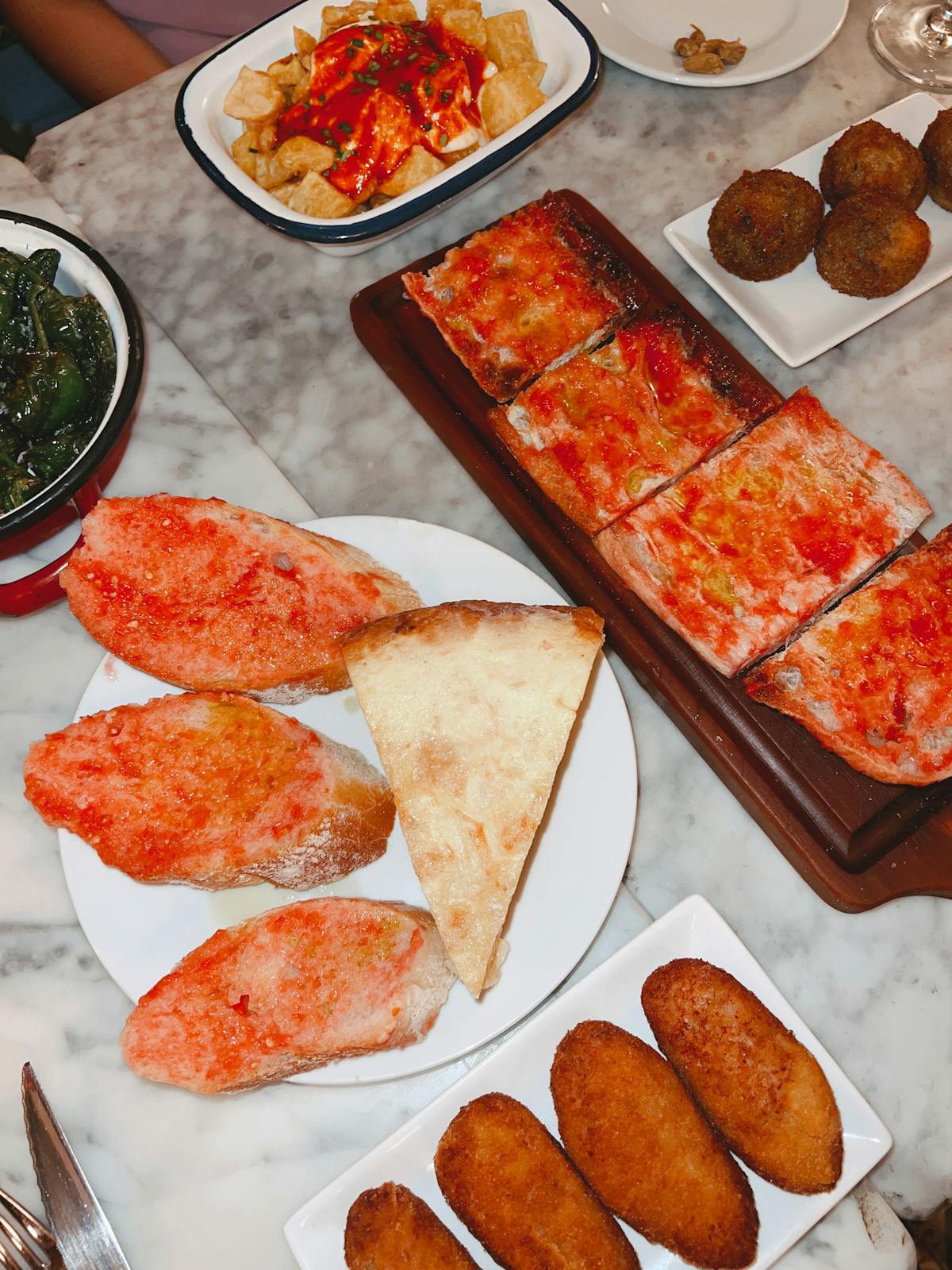
- Patatas bravas (pah-TAH-tahs BRAH-vahs, crispy potatoes with spicy sauce) – the universal crowd-pleaser
- Jamón ibérico (hah-MON ee-BEH-ree-ko, Iberian cured ham) – if you want to treat yourself early
- Pan con tomate (pahn kon toh-MAH-tay, bread with tomato) – simple, perfect, and everywhere in Catalonia
Pair it with a caña (KAH-nyah, a small draught beer) or a glass of tinto de verano (TEEN-toh day veh-RAH-noh, red wine with lemon soda). Both are cheap, refreshing, and exactly what locals drink.
6. Pace Yourself (Seriously)
The number one mistake tourists make? Ordering too much at the first bar. Then they’re full by bar two and miserable by bar three.
Here’s your pacing strategy:
- Bar 1: One tapa + one drink. Light stuff. Olives, bread, croquettes.
- Bar 2: One to two tapas + one drink. Get adventurous. Try the seafood.
- Bar 3: One to two tapas + one drink. This is your peak. Order the house speciality.
- Bar 4: One tapa + one drink. Wind down. Something simple.
- Bar 5 (optional): Dessert or a final drink. Maybe some churros con chocolate (CHOO-rohs kon choh-koh-LAH-tay, fried dough with chocolate).
Between bars, walk slowly. Digest. Enjoy the street life. A good tapas crawl isn’t a race. It’s a marathon of flavour. According to Spain Tourism’s official gastronomy guide, the art of tapeo (bar-hopping) is considered an essential part of Spanish intangible cultural heritage.
7. The Napkin-on-the-Floor Rule
This one shocks visitors every time. In traditional tapas bars, especially in southern Spain, you throw your napkins on the floor. Yes, the floor.
It’s not rude. It’s tradition. The logic? A busy floor means a popular bar. Locals actually use the napkin pile as a quality indicator. If the floor around the bar is covered in crumpled napkins, that’s a good sign. Walk in.
Don’t do this at fancy restaurants or modern gastrobars, obviously. But at old-school tapas joints? Toss that napkin with confidence. Say ¡Qué bueno! (kay BWEH-no, how good!) while you do it.
8. Payment Customs That Confuse Everyone
Forget splitting the bill item by item. In Spain, the group pays together. One person covers the round at one bar. Someone else gets the next bar. It’s called invitar (in-bee-TAR, to treat someone).
When it’s your turn, say: Esta ronda la pago yo (EHS-tah ROHN-dah lah PAH-go yoh, I’m paying for this round). You’ll earn instant respect.
Other payment tips:
- Cash is still king at many traditional tapas bars, especially smaller ones. Carry coins and small notes.
- Tipping is optional. Locals round up or leave small change. One to two euros total is generous for tapas.
- Ask for the bill: ¿La cuenta, por favor? (lah KWEN-tah por fah-VOR, the bill, please?). Don’t wait for it. They won’t bring it until you ask.
Understanding these customs is part of learning how Spanish lifestyle habits differ from what you’re used to.
9. Regional Differences You Need to Know
Spain is not one country when it comes to tapas. It’s twenty different food cultures wearing a trench coat.
Andalusia (Seville, Granada, Málaga): Free tapas with every drink. This is the heartland. Expect generous portions and lots of fried fish.
Basque Country (San Sebastián, Bilbao): They don’t call them tapas here. They’re pintxos (PEEN-chohs, small bites on toothpicks). You grab what you want from the bar counter, eat it, and keep the toothpick. They count your toothpicks to calculate the bill. Genius.
Catalonia (Barcelona): Tapas culture is strong but more modern. Expect creative twists on classics. Pan con tomate is sacred here.
Madrid: Classic tapas scene with a huge variety. Try a bocadillo de calamares (boh-kah-DEE-yoh day kah-lah-MAH-rehs, calamari sandwich). It’s the city’s unofficial street food.
Galicia (Santiago de Compostela): Seafood heaven. Pulpo a la gallega (POOL-poh ah lah gah-YEH-gah, Galician-style octopus) is the star. The wine is Albariño, and it’s spectacular.
According to Matador Network’s guide to tapas culture, Spain has over 150 distinct regional tapas traditions, each shaped by local ingredients and centuries of culinary history.
10. Common Mistakes (and How to Dodge Them)
Avoid these and you’ll blend right in:
- Sitting down when you should stand. At busy tapas bars, standing at the bar or high tables is standard. Sitting at a table often costs more and signals you want full table service.
- Ordering a full meal at one bar. You’re crawling, not camping. One to two dishes per stop.
- Eating too early. Arriving before 8:30 PM for evening tapas marks you as a tourist instantly.
- Being shy about pointing. See something delicious on someone else’s plate? Point and order. Nobody minds.
- Skipping the house speciality. Every bar has one dish they’re famous for. Ask ¿Cuál es la especialidad? (kwahl ehs lah ehs-peh-see-ah-lee-DAHD, what’s the speciality?).
- Forgetting to say thank you. A simple ¡Gracias, estaba buenísimo! (GRAH-see-ahs ehs-TAH-bah bweh-NEE-see-moh, thanks, it was amazing!) goes a long way.
11. Your Essential Tapas Vocabulary Cheat Sheet
You don’t need to be fluent. You need these phrases. Try saying them out loud right now. Seriously, do it.
Ordering:
- ¡Ponme una caña! (PON-may OO-nah KAH-nyah) – “Get me a small beer!”
- ¿Qué me recomiendas? (KAY may reh-koh-mee-EN-dahs) – “What do you recommend?”
- Una ración para compartir (OO-nah rah-see-OHN PAH-rah kom-par-TEER) – “A sharing plate”
- ¿Tienen algo sin gluten? (tee-EH-nen AHL-go seen GLOO-ten) – “Do you have anything gluten-free?”
Reacting:
- ¡Está riquísimo! (ehs-TAH ree-KEE-see-moh) – “This is so delicious!”
- ¡Qué rico! (KAY REE-koh) – “How tasty!”
- ¡Otra más! (OH-trah mahs) – “Another one!”
Paying and leaving:
- ¿Cuánto es? (KWAN-toh ehs) – “How much is it?”
- ¿Aceptan tarjeta? (ah-SEHP-tahn tar-HEH-tah) – “Do you accept card?”
- ¡Hasta la próxima! (AHS-tah lah PROHK-see-mah) – “Until next time!”
Want more phrases like these? Here are fifteen expressions that make your Spanish sound native in any situation.
12. Tapas Crawl Readiness Score
How ready are you? Check off each item below. Be honest with yourself.
Your Tapas Crawl Readiness Checklist
Timing & Planning (3 points)
- ☐ I know to start my evening crawl at 8:30 PM or later (+1)
- ☐ I’ve mapped out 3 to 5 bars within walking distance (+1)
- ☐ I’m wearing comfortable walking shoes (+1)
Ordering Skills (4 points)
- ☐ I can say ¡Ponme una caña! without hesitation (+1)
- ☐ I know to order only 1 to 2 tapas per bar (+1)
- ☐ I can ask ¿Qué hay de tapa? for the daily special (+1)
- ☐ I know the difference between a tapa, ración, and media ración (+1)
Cultural Awareness (3 points)
- ☐ I know napkins go on the floor at traditional bars (+1)
- ☐ I’m prepared to stand, not sit (+1)
- ☐ I have cash and small change ready (+1)
Your Score:
- 8 to 10: You’re basically Spanish already. Get out there.
- 5 to 7: You’re ready. A few awkward moments, but you’ll survive beautifully.
- 2 to 4: Re-read tips 4, 5, and 8. Then try again.
- 0 to 1: Start from the top. We believe in you.
You’re Ready. Go Eat.
A Spanish tapas crawl isn’t just about the food. It’s about standing shoulder to shoulder with strangers, pointing at mysterious dishes, attempting new words, laughing when you get them wrong, and discovering that the best meals happen when you stop planning and start exploring.
You don’t need perfect Spanish. You need the confidence to walk into a crowded bar, smile at the bartender, and say ¡Ponme una de eso! The rest takes care of itself.
Now you’re ready to explore. Go use these phrases and have an incredible experience. Try this phrase today. You’ve got this.