Barcelona’s Little Sister Is the Real Deal
Pack your bags. Tarragona is where the real Spain happens.
An hour south of Barcelona by train, Tarragona sits quietly on the Mediterranean coast with 2,000 years of history, UNESCO World Heritage Roman ruins, a fishing quarter that serves the best seafood in Catalonia, and almost zero tourist crowds. It’s everything Barcelona used to be before the world showed up.
And for Spanish learners? It’s gold. Tarragona has far fewer English speakers than Barcelona. The locals are genuinely excited when foreigners try to speak Spanish (or Catalan). The pace is slow enough that conversations actually happen. You won’t be rushed through an interaction here. People have time for you.
This is your complete language-first guide to a city that deserves ten times the attention it gets.
What’s Inside
- 1The Roman Ruins: 2,000 Years of History at Your Feet
- 2The Cathedral and the Old Town
- 3Rambla Nova vs La Rambla: A Better Stroll
- 4El Serrallo: The Fishing Quarter
- 5Castells: The Human Tower Tradition
- 6Why Tarragona Beats Barcelona for Spanish Practice
- 7Day Trips: Siurana and Priorat Wine Country
- 8Practical Info: Getting There, Budget, Best Time to Visit
- 9Essential Tarragona Vocabulary
- 10Your Tarragona Game Plan
The Roman Ruins: 2,000 Years of History at Your Feet
Tarragona was once Tarraco, the capital of Roman Hispania and one of the most important cities in the Roman Empire. Julius Caesar himself walked these streets. And the ruins are spectacular.
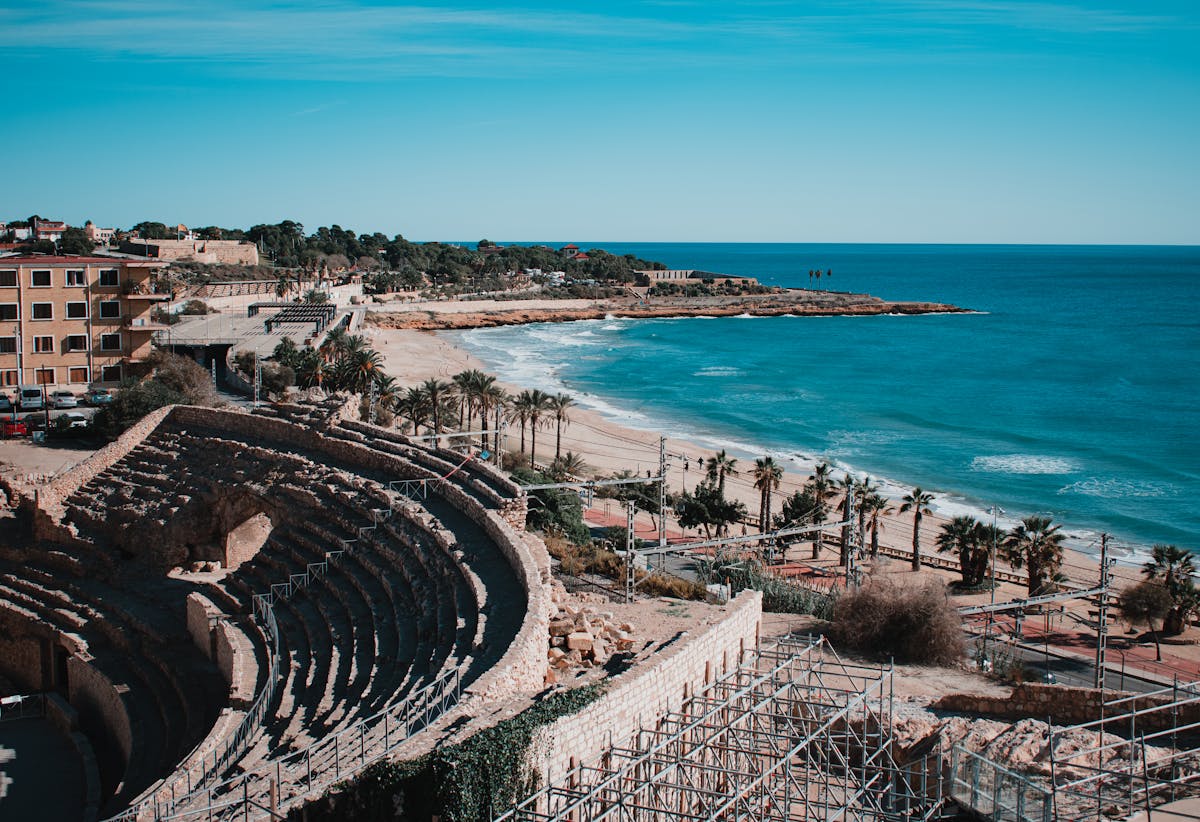
Start at the Anfiteatro Romano (an-fee-teh-AH-troh roh-MAH-noh, Roman Amphitheatre). This 2nd-century arena sits right on the Mediterranean coast, carved into the hillside with the sea as its backdrop. Gladiators fought here. Early Christians were martyred here. And now you can walk through it for about €4. It’s the most photogenic Roman amphitheatre in Spain, and there’s usually nobody there. Try visiting Barcelona’s Roman ruins and you’ll be elbow-to-elbow with tour groups. Here? You might have it to yourself.
Next, the Circ Romà (THEERK roh-MAH, Roman Circus). This was a chariot-racing track, one of the best-preserved in the western Mediterranean. Parts of it run underneath the old town, and you can walk through the underground vaults where chariots once thundered past. The audio guide is in Spanish, which makes it a brilliant listening exercise. It’s about 30 minutes long and uses clear, descriptive language.
Then there’s the Pont del Diable (pont del dee-AH-bleh, Devil’s Bridge), a jaw-dropping Roman aqueduct about 4km north of the city centre. It’s 27 metres tall, perfectly preserved, and you can walk across the top of it. Legend says the devil built it in one night. The real story is that Roman engineers built it in the 1st century AD, which is equally impressive.
Pro Tip
Get the “Tarragona Card” for about €15. It gives you access to all the Roman sites plus the Cathedral. More importantly, the ticket office interactions are great Spanish practice. Ask: “¿Qué incluye la tarjeta?” (kay een-KLOO-yay lah tar-HEH-tah, What does the card include?) and let the explanation flow.
The Cathedral and the Old Town
The Catedral de Tarragona sits at the highest point of the old town, on the site of a Roman temple and later a Moorish mosque. It’s a fascinating mix of Romanesque and Gothic architecture, with a stunning cloister that feels like stepping into a medieval painting.
But the cathedral isn’t the only reason to explore the old town (known locally as the Part Alta, part AL-tah, literally “high part”). The narrow medieval streets are filled with small shops, cafes, and plazas where locals gather. Unlike Barcelona’s Gothic Quarter, which has been thoroughly commercialised, Tarragona’s old town still feels like a place where people actually live.
Wander through Plaça de la Font (PLAH-sah day lah font, Fountain Square), the social hub of the old town. Grab a seat at one of the terrazas (teh-RAH-thahs, outdoor terraces) and watch life happen. This square sits on top of the old Roman circus, which means you’re literally having coffee on top of 2,000-year-old ruins. How’s that for perspective?
For conversation practice, the small shops in the Part Alta are ideal. They’re run by locals, not chains, and the owners are chatty. Try Carrer Major and Carrer de la Merceria for boutiques, antique shops, and artisan food stores. Walk in, browse, and ask about what you see. “¿Esto es de la zona?” (ES-toh es day lah THOH-nah, Is this from the local area?) is a great opener that shows genuine interest.
Rambla Nova vs La Rambla: A Better Stroll
Every Spanish city has its rambla (RAHM-blah, tree-lined promenade). Barcelona’s La Rambla is world-famous, absolutely packed with tourists, and honestly not very enjoyable anymore. Tarragona’s Rambla Nova is what La Rambla used to be before it became a human traffic jam.
Rambla Nova runs from the centre of town straight to the Balcó del Mediterrani (bal-KOH del meh-dee-teh-RAH-nee, the Mediterranean Balcony), a viewpoint at the end with stunning views over the sea and the Roman amphitheatre below. The tradition here is to “tocar ferro” (toh-KAR FEH-rroh, touch the iron railing) for good luck. You’ll see locals and visitors alike reaching out to touch the railing as they take in the view.
Along the Rambla Nova, you’ll find some of Tarragona’s best cafes and restaurants. This is where the evening paseo (pah-SAY-oh, stroll) happens. Families walk up and down, stopping for helado (eh-LAH-doh, ice cream) or a caña (KAH-nyah, small draft beer). It’s one of those beautiful Spanish traditions where the point isn’t to get anywhere. The point is to be seen, to greet neighbours, to slow down.
If this kind of slow, authentic Spanish culture is what you’re after, you’ll love our piece on daily life and social customs in Spain.
El Serrallo: The Fishing Quarter
El Serrallo (el seh-RRAH-yoh) is Tarragona’s working fishing port, and it’s one of the most authentic food experiences in all of Catalonia. This isn’t a tourist attraction. It’s a real port where real fishermen bring in the catch every afternoon.
The lonja (LON-hah, fish market/auction) happens every weekday afternoon around 4:30pm. You can watch the fresh catch being auctioned off in rapid-fire Spanish. It’s fast, chaotic, and thrilling. Don’t worry if you can’t follow the auctioneer. Nobody can. But it’s an incredible spectacle and a window into a way of life that’s been happening here for centuries.
After the auction, walk to one of the restaurants lining the port. These are family-run places that serve whatever came off the boats that day. The speciality is arrossejat (ah-rroh-seh-ZHAT, a Catalan rice dish cooked in fish broth, served with alioli). It’s Tarragona’s signature dish, and it’s extraordinary.
Here’s how to order like a local at a Serrallo restaurant:
- “¿Qué hay fresco hoy?” (kay eye FRES-koh oy, What’s fresh today?) – Shows you know the fish comes in daily
- “¿Me recomiendas el arrossejat?” (may reh-koh-mee-EN-dahs el ah-rroh-seh-ZHAT, Do you recommend the arrossejat?) – Shows you know the local speciality
- “Para compartir” (PAH-rah kom-par-TEER, To share) – Seafood platters here are enormous and designed for sharing
The prices are remarkably fair. A full seafood meal with wine costs €20 to €30 per person. In Barcelona’s equivalent waterfront restaurants, you’d pay twice that for half the quality.
Castells: The Human Tower Tradition
If you visit Tarragona during the right season, you’ll witness one of Spain’s most extraordinary cultural traditions: castells (kahs-TELS, human towers). This is a Catalan tradition dating back to the 18th century, and Tarragona is its spiritual heartland.
Castells are exactly what they sound like. Groups of people (called colles, KOH-yes, teams) climb on each other’s shoulders to build human towers that can reach eight, nine, even ten levels high. A small child, the enxaneta (en-shah-NEH-tah), climbs to the very top to signal completion. It’s breathtaking, nerve-wracking, and deeply emotional to watch.
Every two years, Tarragona hosts the Concurs de Castells (kon-KOORS day kahs-TELS, Human Tower Competition) at the Tarraco Arena. It’s like the Olympics of human towers. Teams from across Catalonia compete to build the highest, most complex structures. The atmosphere is electric.
Even outside the competition, you can see castells at local fiestas (fee-ES-tahs, festivals) throughout the year, especially during the Festes de Santa Tecla in September, Tarragona’s biggest festival. The Plaça de la Font fills with people, the traditional gralla (GRAH-yah, Catalan folk instrument) music starts, and the towers begin to rise.
Watching castells is free. Understanding the vocabulary makes it ten times more exciting:
- Pinya (PEEN-yah): The base of people holding up the tower
- Tronc (tronk): The main trunk of the tower
- Pom de dalt (pom day dalt): The crown, the top three levels
- ¡Força! (FOR-sah): The shout of encouragement from the crowd, meaning “strength!”
Why Tarragona Beats Barcelona for Spanish Practice
Let’s get specific about why Tarragona is better for language learning than its famous neighbour up the coast.
Less English, more patience. In Barcelona’s tourist zones, staff switch to English automatically. In Tarragona, Spanish (or Catalan) is the default. When you speak Spanish, people respond in Spanish. They don’t assume you’re struggling and “rescue” you with English. They give you space to communicate.
Catalan-Spanish bilingualism is an asset, not a problem. Like Barcelona, Tarragona is bilingual. But because there are fewer tourists here, you’re more likely to have genuine conversations about the bilingual reality. Locals will explain the differences between Catalan and Spanish expressions, teach you local words, and appreciate your curiosity. It’s a cultural bonus, not a barrier.
The size is perfect. Tarragona has about 130,000 people. Big enough to have everything you need (restaurants, cafes, cultural events, public transport). Small enough that you’ll start recognising faces within a few days. That familiarity breeds conversation. The bartender remembers you. The market vendor asks how you are. These micro-interactions are where real language learning happens.
It’s cheaper. A cheaper city means you can stay longer. And time is the single biggest factor in language acquisition. If Barcelona eats your budget in two weeks, Tarragona gives you a month. That extra time is worth more than any language course.
Day Trips: Siurana and Priorat Wine Country
Once you’ve explored Tarragona itself, two spectacular day trips are waiting.
Siurana (see-oo-RAH-nah) is a tiny clifftop village about an hour’s drive inland. Perched on the edge of a dramatic limestone gorge, it’s one of the most beautiful villages in Catalonia. The last Moorish stronghold in Catalonia fell here in 1153, and the views from the clifftop are staggering.
Siurana has a population of about 30 people. There’s one restaurant, one church, and the kind of silence that makes your ears ring. It’s also a world-class rock climbing destination, so you’ll meet climbers from everywhere. The combination of tiny-village authenticity and international climbing culture creates a unique social atmosphere.
For language practice, the drive itself is valuable. Stop at small villages along the way. Order coffee at bars where you might be the only non-local. These are the interactions where your Spanish gets tested and strengthened.
Priorat (pree-oh-RAHT) wine country surrounds Siurana, and it produces some of Spain’s most celebrated wines. The region is steep, terraced, and hauntingly beautiful. Small bodegas (boh-DEH-gahs, wineries) dot the landscape, and many offer tastings.
Wine tastings are fantastic for Spanish practice. The vocabulary is specific but learnable, and winemakers love explaining their craft. Try these phrases:
- “¿Hacéis visitas a la bodega?” (ah-THAY-ees bee-SEE-tahs ah lah boh-DEH-gah, Do you offer winery visits?)
- “¿Qué tipo de uva es?” (kay TEE-poh day OO-bah es, What type of grape is it?)
- “Tiene mucho cuerpo” (tee-EH-nay MOO-choh KWER-poh, It has a lot of body) – instant sommelier credentials
The two main Priorat grapes are garnacha (gar-NAH-chah, grenache) and cariñena (kah-ree-NYEN-yah, carignan). Drop those names and you’ll earn immediate respect.
Practical Info: Getting There, Budget, Best Time to Visit
Getting there from Barcelona: The train is the easiest option. Renfe runs regular services from Barcelona Sants or Passeig de Gràcia to Tarragona station. The journey takes about 1 hour on the regional train (€8 to €12) or 35 minutes on the AVE high-speed train (€15 to €25). Trains run roughly every 30 minutes during the day.
You can also take the bus (ALSA operates the route, about 1.5 hours, €10 to €14) or drive (1 hour via the AP-7 motorway, tolls apply).
Budget for a day trip:
- Train return: €16 to €30
- Tarragona Card (all Roman sites + Cathedral): €15
- Lunch at El Serrallo: €20 to €30
- Coffee and snacks: €5 to €8
- Total: approximately €56 to €83 for a full day
Budget for a multi-day stay:
- Budget hotel or hostel: €40 to €70 per night
- Mid-range hotel: €80 to €130 per night
- Airbnb in the old town: €60 to €100 per night
- Daily food and drink: €25 to €45
Best time to visit:
- April to June: Perfect weather (18 to 25 degrees), fewer tourists, everything is open. Best overall choice.
- September: The Festes de Santa Tecla (third week of September) is Tarragona’s biggest festival. Castells, concerts, parades, fireworks. Incredible atmosphere but book accommodation early.
- October: Concurs de Castells happens in even-numbered years (2026, 2028). If you can time your visit, do it.
- July to August: Hot (30+ degrees) and busier, but still manageable compared to Barcelona. Great for beach time.
- November to March: Quieter and cooler, but many sites stay open and the Serrallo restaurants are excellent year-round.
Essential Tarragona Vocabulary
| Spanish / Catalan | Pronunciation | Meaning |
|---|---|---|
| anfiteatro | an-fee-teh-AH-troh | Amphitheatre |
| muralla | moo-RAH-yah | City wall (Tarragona’s are Roman-era) |
| castells | kahs-TELS | Human towers (Catalan tradition) |
| lonja | LON-hah | Fish market/auction |
| bodega | boh-DEH-gah | Winery or wine cellar |
| arrossejat | ah-rroh-seh-ZHAT | Catalan rice dish cooked in fish broth (Tarragona’s signature dish) |
| garnacha | gar-NAH-chah | Grenache grape (Priorat’s star variety) |
| paseo | pah-SAY-oh | Evening stroll (a daily Spanish tradition) |
| fiesta | fee-ES-tah | Festival or celebration |
| terraza | teh-RAH-thah | Outdoor terrace seating |
Practice Time: Navigate Tarragona in Spanish
You’ve just arrived in Tarragona by train. Test yourself with these real situations:
1. Ask someone at the station how to get to the old town.
2. Buy a Tarragona Card at the amphitheatre ticket office.
3. Order the arrossejat at a Serrallo restaurant.
4. Ask at a Priorat winery about a tasting.
Answers:
1. “Perdona, ¿cómo llego al casco antiguo desde aquí?” (Excuse me, how do I get to the old town from here?)
2. “Hola, quería comprar la tarjeta de Tarragona. ¿Qué incluye?” (Hi, I’d like to buy the Tarragona card. What does it include?)
3. “¿Me recomiendas el arrossejat? ¿Es para compartir?” (Do you recommend the arrossejat? Is it for sharing?)
4. “Buenas tardes, ¿hacéis visitas a la bodega? Me gustaría hacer una cata.” (Good afternoon, do you offer winery visits? I’d like to do a tasting.)
Pro Tip
If you’re coming from Barcelona and want to make the most of your language immersion, stay overnight. Day-trippers miss the evening paseo, the Serrallo dinner scene, and the morning cafe ritual. Two nights in Tarragona will give you three times the Spanish practice of a rushed day trip.
Your Tarragona Game Plan
Tarragona is the anti-Barcelona experience. It has the Roman history Barcelona doesn’t. The seafood Barcelona charges twice as much for. The quiet streets Barcelona lost years ago. And the authentic Spanish-speaking environment that Barcelona’s tourist zones simply can’t provide anymore.
Here’s your ideal three-day itinerary. Day one: Roman ruins (amphitheatre, circus, aqueduct), cathedral, and the Part Alta old town. Day two: morning coffee on Rambla Nova, Serrallo fishing quarter for lunch, evening paseo and tapas. Day three: day trip to Siurana and Priorat wine country.
If you only have one day, prioritise the amphitheatre, a wander through the old town, and a long seafood lunch at El Serrallo. That’s the Tarragona essential experience in a nutshell.
This city doesn’t shout for attention. It doesn’t need to. Two thousand years of history, world-class food, a living tradition of human towers, and a community that still has time for a conversation. That’s Tarragona. And your Spanish is about to level up because of it.
If you’re exploring more of Catalonia, check out our guide to experiencing Barcelona like a local. And for those planning a bigger Spanish adventure, our guide to Seville’s Feria de Abril is the perfect complement to your Catalonia trip.
Share

audazrevista
You may also like


Get the Inside Scoop