Christmas in Latin America runs on one word, aguinaldo. Meet Colombia’s novena, Puerto Rico’s parrandas and the Nochebuena table, country by country.
What is Christmas like in Latin America? The big night is Nochebuena, 24 December, when families share a long dinner and many go to a midnight mass. The run-up changes by country. Colombia prays the novena de aguinaldos from 16 to 24 December. Puerto Rico goes out on parrandas, surprise carols at a friend’s door late at night. Venezuela makes hallacas, its Christmas tamales.
- The word aguinaldo means something different in almost every country: a prayer, a song, a dawn mass, a bag of sweets or a bonus.
- Colombia’s novena was written in the 18th century by a friar born in Quito, and a nun added its songs.
- Puerto Rico’s season is one of the longest in the world. It runs from late November to late January.
In this guide (8)
Say the word aguinaldo in Bogotá, San Juan and Caracas in December, and it calls up 3 different things. In Colombia it’s a book of prayers, and in Puerto Rico it’s a song. In Venezuela it’s an early morning mass.
That one word is the best way into Christmas across the Spanish-speaking world. This guide follows it country by country. You’ll see what people do on each night, what they eat on Nochebuena, and the Spanish words that go with it all. Mexico’s own nine nights, the posadas, have a full guide of their own.
What does aguinaldo mean in Spanish?
At its simplest, an aguinaldo is a Christmas present. Spanish Wikipedia defines it as a Christmas gift, or a gift given to anyone on any occasion. The word comes from an older form, aguilando. That may come from the Latin phrase hoc in anno, which means “in this year”.
From there, each country took the word somewhere new. We read the culture pages for each one and lined up what aguinaldo means there. The table is the short version.
| Where | What an aguinaldo is | Example |
|---|---|---|
| Colombia | The 9 days of prayer before Christmas, and the games played in them | la novena de aguinaldos |
| Puerto Rico | A style of Christmas song, sung at parrandas | There are 60 styles of it |
| Venezuela | The early masses held from 16 to 24 December | las misas de aguinaldo |
| Mexico | A bag of sweets and fruit handed out at the posadas and on Nochebuena | Children wait for it |
| Puerto Rico | A tip or gift on Nochebuena for the people who serve you | The postman and the rubbish collectors |
In many countries you’ll also hear it used for the extra pay workers get in December. Spanish Wikipedia notes that the RAE dictionary doesn’t record that meaning, though it’s used in some Latin American countries.
When does Christmas start in Latin America?
It starts earlier than you might think, and Colombia’s season begins on the night of 7 December, the Día de las velitas, or Day of the Little Candles. People set candles and paper lanterns on windowsills, balconies and pavements. They do it for the Immaculate Conception, which Pope Pius IX declared a dogma in 1854.
In Uruguay the tree goes up on 8 December. In Paraguay families build their nativity scene after the same date, the feast of the Virgin of Caacupé. Puerto Rico starts in the last week of November and keeps going until late January. That makes its Christmas one of the longest anywhere.
Puerto Rico’s Christmas runs for 2 months
Most countries mark a few key nights between 7 December and 6 January.
- Late Nov to late JanPuerto Rico’s season, one of the longest anywhere.
- 7 DecDía de las velitas in Colombia. Candles in every window.
- 8 DecTrees go up in Uruguay, nativity scenes in Paraguay.
- 16 to 24 DecThe novena in Colombia, and the early masses in Venezuela.
- 24 DecNochebuena: the family dinner, then the Misa de Gallo.
- 28 DecDía de los Santos Inocentes, a day for pranks.
- 6 JanThree Kings Day, when the gift giving ends in most countries.
- After 6 JanPuerto Rico keeps going with the Octavitas, 8 more days.
Dates as given in this guide.
What is the novena de aguinaldos in Colombia?
The novena de aguinaldos is 9 nights of prayer, from 16 to 24 December. Each night remembers the months before Jesus was born, and the last one ends at the manger. It’s also prayed in Ecuador and in parts of Venezuela.
In Colombia it’s as much a party as a prayer. Families gather at home. Offices hold one for their staff, and neighbours meet in parks and churches. People take turns reading each part aloud, then everyone sings villancicos, Christmas carols. Afterwards come buñuelos, natilla and arroz con leche.
Each night follows the same order. There’s a prayer for every day, then the reading for that day, called the consideración. Prayers to Mary and Joseph follow. Then come the gozos, sung verses, and a last prayer to the baby Jesus.
Who wrote the novena?
A Franciscan friar called Fernando de Jesús Larrea wrote it. He was born in Quito in 1700 and ordained in 1725, then preached in Ecuador and Colombia. He wrote it for Clemencia Caycedo, who founded the Colegio de La Enseñanza, a girls’ school in Bogotá.
When it first appeared in print is less clear. El Tiempo says the first 10 copies were printed in 1743 in Santa Fe, today’s Bogotá. Colombia’s public broadcaster, Radio Nacional, says the date of the gift is unknown. It puts the first printed edition in Lima in 1788. So the dates are worth holding loosely.
The songs came later, from a nun called Mother María Ignacia. She entered La Enseñanza in 1886, then revised the text and added the gozos. She was born Bertilda Samper Acosta in 1856 and died in 1910. Her version was approved by the Archbishop of Bogotá in 1910, and it’s still the best known.
What are the juegos de aguinaldos?
During the same 9 days, Colombians play the aguinaldos, little games between friends. The players first make a promise sealed with their little fingers. It sets the prize for the winner and the forfeit for the loser. These are some of the classics.
| Game | What it means |
|---|---|
| Hablar y no contestar | Talk but don’t answer |
| Pajita en boca | A straw in your mouth |
| Tres pies | Three feet |
| Beso robado | A stolen kiss |
| Sí y no | Yes or no |
What is a parranda in Puerto Rico?
A parranda is a group of friends who turn up at your house late at night, singing. The word means a party or a spree. The singers are parranderos, and the whole group is a trulla. When they wake you up without warning, it’s called an asalto navideño, which literally means a Christmas assault.
How a parranda goes, from porch to dawn
- After 10 pmThe group creeps up to the porch.
- The signalThe leader gives it, and the music starts.
- Lights onThe family wakes and lets everyone in.
- Food and drinkFor an hour or two.
- Next houseThe family joins the trulla.
- DawnIt ends with asopao de pollo.
The plan goes something like this. The group arrives after 10 at night and creeps up to the porch. When the leader gives a signal, the music starts. The family wakes up, switches on the lights and lets everyone in for food and drink. After an hour or two, the family joins the group and they all move on to the next house.
By the last stop the trulla can be large, so it often ends at a house ready to feed them all. The traditional last dish is asopao de pollo, a Puerto Rican chicken soup. The party usually breaks up around dawn.
The songs are aguinaldos, and they’re mostly about the season rather than the church. The main instrument is the cuatro, Puerto Rico’s national instrument, with güiro and maracas behind it. One count puts the island’s styles at over 60 kinds of aguinaldo and over 140 kinds of seis, a related song form.
The custom is an old one, and El Nuevo Día points to a book from 1849, El Gíbaro by Manuel A. Alonso. Its chapter called “Aguinaldos” describes a group of singers arriving at a house at night. The family invites them up to a table that held “manjar blanco, almojábanas, buñuelos de muchas clases”. So the parranda was already a settled habit by then.
What do people eat on Nochebuena in Latin America?
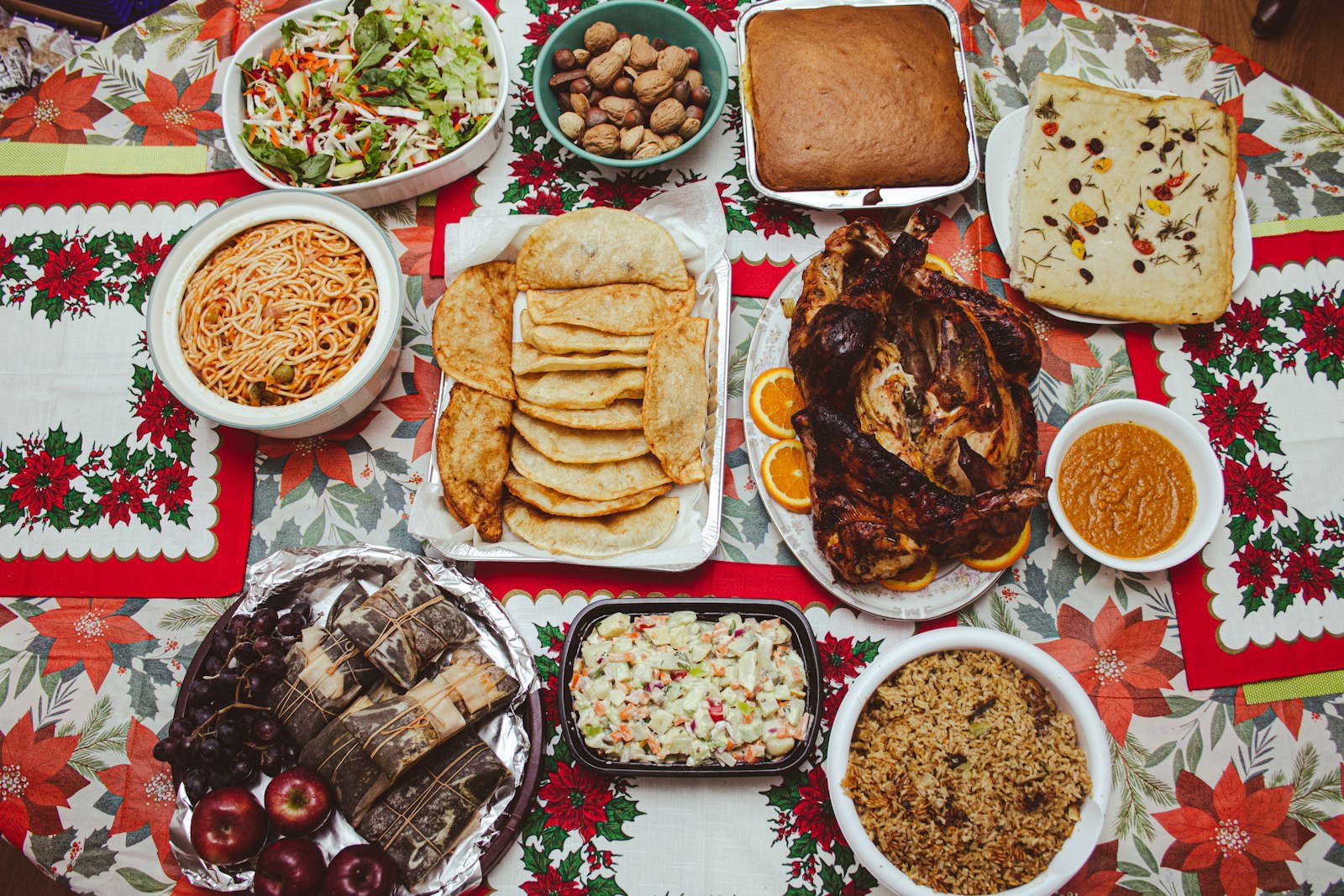
Nochebuena is the evening of 24 December, and the dinner is the heart of it. Every country fills the table differently. Most of these come from Spanish Wikipedia’s country notes on Nochebuena.
| Country | On the table | What it is |
|---|---|---|
| Venezuela | hallacas, pan de jamón, ponche crema | Tamales in plantain leaves, a ham bread, and an eggnog liqueur |
| Puerto Rico | lechón asado, arroz con gandules, pasteles, coquito | Roast pork, rice with pigeon peas, and a coconut and rum drink |
| Colombia | natilla, buñuelos | A corn starch pudding sweetened with panela, and fried balls of cheese and corn dough |
| Dominican Republic | puerco en puya, moro de guandules con coco | Pork roasted on a spit, and rice with pigeon peas and coconut |
| Argentina | vitel toné, matambre, pionono | Meats, salads and sweets, then a toast with cider or champagne at midnight |
| Chile | pan de Pascua, cola de mono | A spiced fruit cake, and a coffee and milk drink with spirits |
| Paraguay | sopa paraguaya, chipa guasu | Chicken, then 2 corn dishes. Chipa guasu is a baked corn cake |
| Guatemala | tamales | Eaten at midnight on 24 and 31 December |
Source: Spanish Wikipedia, Nochebuena country notes.
For more on the wider kitchen, see our guide to Latin American dishes, country by country.
Why are hallacas such a big deal in Venezuela?
The hallaca is Venezuela’s Christmas dish. The dough is corn, coloured with onoto, which is annatto. It’s filled with a stew of beef, pork and chicken. Olives, raisins and capers often go in too. Then each one is wrapped in plantain leaves, tied with string and boiled.
It’s an old dish. An Italian Jesuit missionary, Felipe Salvador Gilij, described something like it around 1749. A woman in a court case of 1756 said she sold hallacas from her home. Yet it wasn’t always a Christmas food. Until well into the 19th century, people ate it mostly at weekends.
The pan de jamón beside it is much younger. The food writer Miro Popić credits a baker, Lucas Manuel Ramella, who is said to have made it in December 1905. The classic filling is ham, raisins and green olives. The soundtrack is the gaita zuliana, a folk style from Zulia state that is now Venezuela’s Christmas music.
What do Puerto Ricans eat and drink at Christmas?
Roast pork leads the table, and lechón asado is eaten with arroz con gandules at Christmas, and official figures show pork eating rises by 20% in December. Pasteles are a little like tamales. Coquito is a cold drink of coconut cream, white rum, milk, cinnamon and vanilla. It even has its own day, the Día Nacional del Coquito on 21 December.
What is a chocolatada in Peru?
In Peru, December brings the chocolatada navideña. Groups and public bodies hand out hot chocolate, often with panetón, to children and families in poverty. Gifts often come too. Spanish Wikipedia traces written records of it to the 1930s. Spanish Wikipedia also calls Peru the biggest panetón eater on the continent.
What happens at midnight on Nochebuena?
Many Catholic families go to the Misa de Gallo, the Rooster’s Mass, held at midnight. In Puerto Rico, children sometimes dress as shepherds or as figures from the nativity scene. In Venezuela, the baby Jesus is placed in the pesebre, the nativity scene, at midnight. Then the children open presents brought by el Niño Jesús, or by Santa Claus in some homes.

That’s different from Spain, where the Three Kings bring the gifts for many families. Our guide to Christmas in Spain covers that night. If you want the words to send with a card, try Feliz Navidad and 15 other ways to say Merry Christmas.
Which Christmas words should a Spanish learner know?
These 10 words will carry you through a Latin American December. Each one appears above, so you’ve already met them in context.
| Spanish | English |
|---|---|
| laNochebuena | Christmas Eve, 24 December |
| laMisa de Gallo | the midnight mass |
| elpesebre | the nativity scene in Colombia and Venezuela |
| elvillancico | a Christmas carol |
| elaguinaldo | a Christmas gift, and much more, by country |
| lanovena | 9 days of prayer |
| laparranda | a night of carols, house to house |
| latrulla | the group that goes on a parranda |
| lahallaca | Venezuela’s Christmas tamal |
| lasvelitas | little candles |
For more customs with their words, read 7 Latin American traditions and the words that carry them.
Frequently asked questions
How is Christmas celebrated in Latin America?
The main night is Nochebuena, 24 December, with a family dinner and often a midnight mass. Colombia prays the novena from 16 December, Puerto Rico holds parrandas, and Venezuela makes hallacas.
What is the novena de aguinaldos?
It’s 9 nights of prayer and carols from 16 to 24 December, mostly in Colombia, and also in Ecuador and parts of Venezuela. A friar born in Quito wrote it, and a nun added its songs.
What is a parranda in Puerto Rico?
It’s a group of friends who arrive at a house late at night, singing Christmas songs. The family lets them in for food, then joins them on the way to the next house.
What does aguinaldo mean?
It means a Christmas gift. It also names the novena in Colombia, a song style in Puerto Rico, the early masses in Venezuela and a bag of sweets in Mexico.
What do Venezuelans eat at Christmas?
Hallacas, which are corn tamales filled with a meat stew and wrapped in plantain leaves. Pan de jamón, roast pork or turkey, and ponche crema share the table.