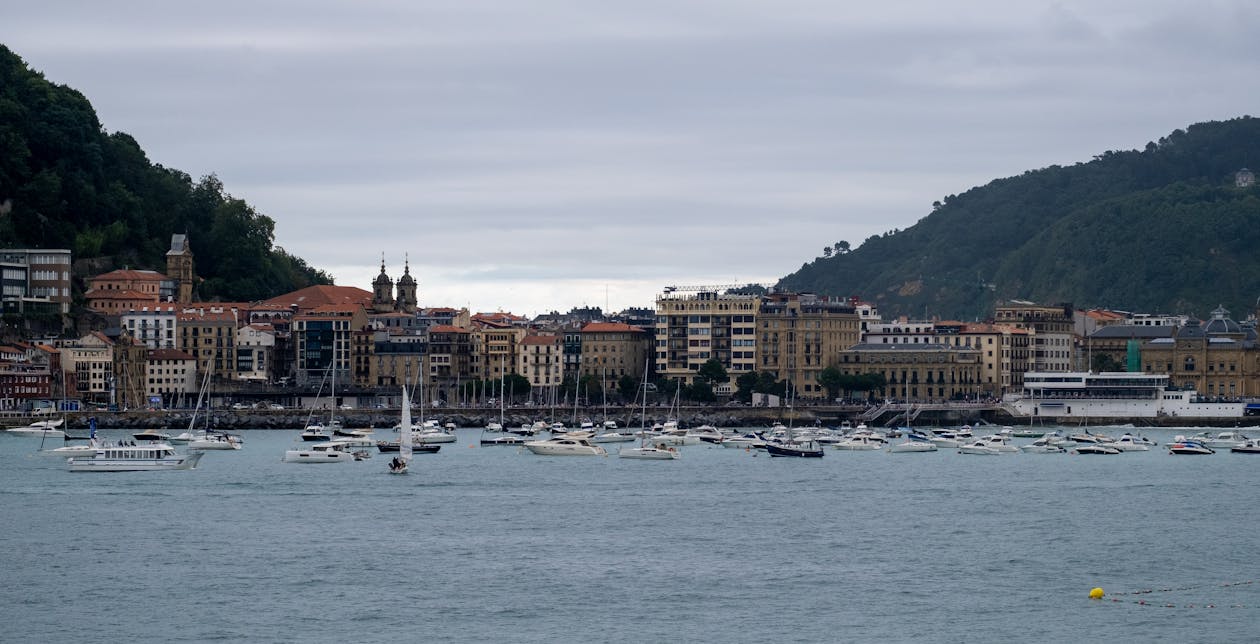
The smell of sizzling garlic. The clink of txakoli (chah-koh-LEE) glasses. A bar counter piled high with tiny, architectural masterpieces made of bread, fish, and peppers. Welcome to Donostia-San Sebastián (doh-NOHS-tee-ah san seh-bahs-tee-AHN), the city where eating isn’t just a meal. It’s a way of life.
We’ve covered San Sebastian’s hidden gems before. This guide goes in a different direction: straight into the food. Because if there’s one city in Spain where your stomach will teach your brain more Spanish than any textbook, it’s this one.
Pack your bags. And wear stretchy trousers.
Why San Sebastian Is Spain’s Food Capital
Here’s the real talk. San Sebastian (population: roughly 190,000) has more Michelin stars per square metre than anywhere else on Earth, according to the Michelin Guide. The city holds 16 Michelin stars across its restaurants, including three-star legends like Arzak and Martín Berasategui.
But the real food magic isn’t in the fancy restaurants. It’s in the pintxo (PEEN-choh) bars of the Parte Vieja (PAR-teh vee-EH-hah, Old Town), where locals go hopping from bar to bar every evening, eating one or two bites at each stop. It’s democratic, communal, and gloriously messy.
And here’s the twist that makes it even more interesting for Spanish learners: you’re in the Basque Country. That means you’ll encounter two languages, euskera (ehs-KOO-keh-rah, the Basque language) and Spanish, sometimes in the same sentence.
Pintxos 101: Everything Your Guidebook Gets Wrong
First, the Name
They’re pintxos (PEEN-chohs), not tapas (TAH-pahs). Using the word “tapas” in San Sebastian is like calling champagne “fizzy wine” in Reims. Technically not wrong. Socially, very wrong.
The word comes from pinchar (peen-CHAR), meaning “to pierce.” Traditional pintxos are held together with a toothpick speared through the top. You count the toothpicks at the end to calculate your bill.
The Pintxo Bar Crawl: How It Works
A txikiteo (chee-kee-TEH-oh) is the Basque word for a bar crawl. Here’s how to do it properly.
- Choose your bar. Walk into the Parte Vieja and follow the crowds. If a bar is packed with locals, it’s good.
- Scan the counter. Pintxos are displayed on the bar. Some are cold (on the counter already), others are hot (ordered from the kitchen).
- Order a drink. Say “Un zurito” (oon thoo-REE-toh), a small beer unique to the Basque Country, or “Un txakoli” (oon chah-koh-LEE), the local sparkling white wine.
- Grab what you want. For cold pintxos, take a plate and help yourself. For hot ones, ask: “¿Qué pintxo caliente me recomiendas?” (keh PEEN-choh kah-lee-EN-teh meh reh-koh-mee-EN-dahs), meaning “Which hot pintxo do you recommend?”
- Eat one or two, then move on. The goal is variety. You don’t sit down and order five pintxos at the same place. You eat, pay, and walk to the next bar.
- Pay at the end. Tell the bartender what you had. They trust you. Say “He tomado dos pintxos y un zurito” (eh toh-MAH-doh dohs PEEN-chohs ee oon thoo-REE-toh), meaning “I had two pintxos and a small beer.”
For general restaurant ordering confidence, check our guide on ordering food in Spanish.
The Pintxos You Must Try
Every bar has its speciality. Here are the iconic ones you’ll find across the city.
Cold Pintxos (Counter Classics)
- Gilda (HEEL-dah): An olive, a pickled pepper (guindilla, geen-DEE-yah), and an anchovy on a toothpick. Named after Rita Hayworth’s character in the 1946 film because it was “salty, spicy, and a little bit green.” It’s the original pintxo and still the most popular.
- Anchoa del Cantábrico (ahn-CHOH-ah del kahn-TAH-bree-koh): Cantabrian anchovies. These aren’t the salty, overpowering anchovies you might know. They’re buttery, delicate, and served on bread with a drizzle of olive oil. Possibly the best anchovy you’ll ever eat.
- Txaka (CHAH-kah): Crab salad (usually surimi) on bread. Simple and everywhere. The name is Basque.
Hot Pintxos (Kitchen Specials)
- Croquetas de jamón (kroh-KEH-tahs deh hah-MOHN): Ham croquettes with a crispy outside and molten, creamy inside. Every bar makes them. Some bars make them transcendently.
- Txipirones en su tinta (chee-pee-ROH-nehs en soo TEEN-tah): Baby squid cooked in their own ink. Sounds intimidating. Tastes incredible. The ink creates a rich, savoury sauce that stains everything it touches.
- Foie con compota de manzana (fwah kohn kohm-POH-tah deh mahn-THAH-nah): Foie gras with apple compote. A modern pintxo that shows how far the cuisine has evolved from its simple origins.
Basque Words You’ll See Everywhere
This is where things get interesting for language learners. The Basque Country is bilingual, and you’ll see euskera on signs, menus, and in conversation. Basque is one of Europe’s oldest languages, with no known relationship to any other language family. The Basque Language Academy (Euskaltzaindia) estimates that roughly 34% of the Basque Country’s population speaks it.
Food-Related Basque Words
- Jatetxea (hah-TETCH-eh-ah): Restaurant. You’ll see this on signs everywhere.
- Sagardotegia (sah-gar-doh-TEH-gee-ah): Cider house. A major part of Basque food culture.
- Txuleta (choo-LEH-tah): A massive bone-in beef chop, grilled over coals. The Basque version of a ribeye. Often shared between two people and priced by weight.
- Esne (EHS-neh): Milk. You’ll see this on cartons and in cafés.
- Ardoa (ar-DOH-ah): Wine. Often on wine lists alongside the Spanish vino.
Practical Bilingual Tips
Don’t panic about euskera. Everyone in San Sebastian speaks Spanish fluently. But showing awareness of Basque is a sign of respect that locals genuinely appreciate.
Try: “Eskerrik asko” (ehs-KEH-reek AHS-koh), meaning “Thank you” in Basque. Use it after a meal. Watch the server’s face light up.
Or: “Kaixo” (KAI-shoh), meaning “Hello” in Basque. A simple greeting that shows you understand where you are.
The Cider House Experience
From January to April, the sidrerías (see-dreh-REE-ahs, cider houses) outside the city come alive. This isn’t just drinking cider. It’s a full cultural experience.
How It Works
You pay a fixed price (usually around 35-45 euros per person) for an all-you-can-drink cider experience paired with a set menu. The traditional meal is always the same.
- Tortilla de bacalao (tor-TEE-yah deh bah-kah-LAH-oh): Salt cod omelette.
- Txuleta (choo-LEH-tah): The massive grilled beef chop.
- Queso de Idiazábal con membrillo (KEH-soh deh ee-dee-ah-THAH-bal kohn mem-BREE-yoh): Smoked sheep’s cheese with quince paste.
- Nueces (noo-EH-thehs): Walnuts. To finish.
The Txotx Ritual
When someone shouts “Txotx!” (CHOHCH), everyone rushes to the massive barrels lining the walls. You hold your glass under the stream of cider that shoots from the barrel and catch it from a distance. The cider splashes, aerates, and foams as it hits your glass. You drink it in one or two gulps, then get back in line.
It’s chaotic, joyful, and completely unforgettable.
Beyond the Old Town: Restaurants Worth the Splurge
If you want to experience the fine dining side of San Sebastian, here’s the vocabulary you’ll need.
Reservation Phrases
- “Quisiera reservar una mesa para dos personas” (kee-see-EH-rah reh-ser-VAR OO-nah MEH-sah PAH-rah dohs per-SOH-nahs): “I’d like to reserve a table for two.”
- “¿Tienen menú degustación?” (tee-EH-nen meh-NOO deh-goos-tah-thee-OHN): “Do you have a tasting menu?” Most fine dining restaurants offer one.
- “¿Tienen opciones para celíacos/vegetarianos?” (tee-EH-nen op-thee-OH-nehs PAH-rah theh-LEE-ah-kohs / beh-heh-tah-ree-AH-nohs): “Do you have options for celiacs/vegetarians?”
At the Table
- “¿Qué nos recomienda el chef?” (keh nohs reh-koh-mee-EN-dah el chef): “What does the chef recommend?” Shows you trust the kitchen.
- “Maridaje” (mah-ree-DAH-heh): Wine pairing. Most tasting menus offer this.
- “La cuenta, por favor” (lah KWEN-tah, por fah-VOR): “The bill, please.” Never rush this. In Spain, you ask for the bill. It never comes automatically.
A Day of Eating in San Sebastian: Your Itinerary
Here’s how to eat your way through the city like a local.
- 9:00 AM: Coffee and a croissant at any café on Boulevard. Say “Un café con leche y un cruasán” (oon kah-FEH kohn LEH-cheh ee oon kroo-ah-SAHN). For more on ordering coffee in Spanish like a local, check our guide.
- 11:00 AM: Walk to La Bretxa market. Wander the fish stalls. Ask vendors “¿Qué está fresco hoy?” (keh ehs-TAH FREHS-koh oy), meaning “What’s fresh today?”
- 1:30 PM: Start your txikiteo in the Parte Vieja. Hit three or four bars. One or two pintxos each, plus a zurito or txakoli.
- 4:00 PM: Walk along La Concha (lah KOHN-chah) beach to digest. This crescent-shaped bay is consistently ranked among Europe’s most beautiful urban beaches.
- 8:30 PM: Second round of pintxos. New bars this time. Try the hot pintxos now, as the kitchens are in full swing.
- 10:30 PM: If you still have room, a gin-tonic (heen-TOH-neek, that’s how they say it) at a cocktail bar in Gros (grohs), the modern neighbourhood across the river.
Practical Tips for San Sebastian
Getting There
San Sebastian has its own airport (Aeropuerto de San Sebastián), but flights are limited. Most visitors fly into Bilbao (one hour by bus) or Biarritz in France (45 minutes). The ALSA bus from Bilbao airport runs hourly and costs about 18 euros.
When to Visit
- Best time: May to October for warm weather and outdoor eating. September for the San Sebastián International Film Festival (Zinemaldia, thee-neh-MAHL-dee-ah).
- January to April: Cider house season. Worth visiting just for the txotx experience, even if it rains every day (which it will).
- Avoid: The first two weeks of August, when the city is absolutely packed for Semana Grande (seh-MAH-nah GRAHN-deh, Big Week) festivities.
Budget Tips
Pintxos typically cost 2-4 euros each. A zurito is about 1.50 euros. You can eat incredibly well for 20-25 euros per person per txikiteo round. Fine dining tasting menus start around 150 euros, but that’s for a once-in-a-lifetime experience.
For more Spanish travel wisdom, check out our guides on exploring Barcelona like a local and understanding daily Spanish habits.
The Bottom Line
San Sebastian is the kind of city that ruins every other food experience for you. Once you’ve stood at a counter in the Parte Vieja, pointing at pintxos and ordering txakoli poured from a height, you’ll understand why Basques are so fiercely proud of their food culture.
Your Spanish is about to level up. And your taste buds? They’re about to have the best week of their lives.
Now you’re ready to explore. Go use these phrases and have an incredible experience.
]]>Share

audazrevista
You may also like
Get the Inside Scoop