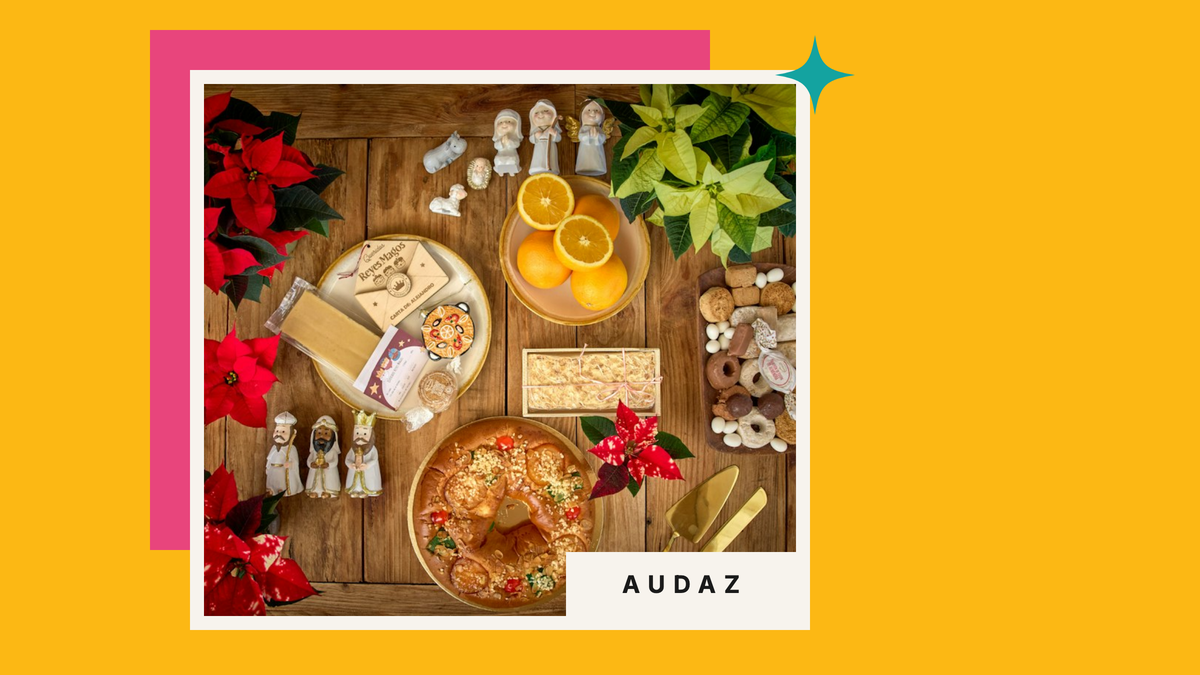
Three Kings Day: Rosca de Reyes, Shoes and Grass
By the Audaz Revista editorial team
Updated November 20, 2026 · Reviewed by the Audaz editorial team
What is Three Kings Day? Three Kings Day, el Día de Reyes, is 6 January. In much of the Spanish-speaking world, the Kings bring children their presents on the night before. Children leave out their shoes, and in Puerto Rico a shoebox of grass for the Kings’ animals. Mexico then cuts the rosca de Reyes, and whoever finds the baby inside hosts a tamales party on 2 February.
- The night that matters is 5 January, la víspera de Reyes.
- Children in 5 countries leave grass for the Kings’ animals, from Puerto Rico to Uruguay.
- In Mexico, finding the baby in the rosca means you owe everyone tamales on 2 February.
Christmas in the Spanish-speaking world doesn’t end on 25 December. It ends on 6 January, with the Three Kings. For many children it’s the best night of the year.
Every country keeps the night its own way. One leaves water for camels. Another cuts fresh grass for horses. A third bakes a doll into the bread and turns it into a party in February.
This guide follows that night from country to country, with the Spanish you’ll hear in each home. If you want Spain’s version in full, with the parade and the sweet coal, read our guide to Christmas in Spain.
In this guide (9)+
- What does Día de Reyes mean?
- What do children do on the night of 5 January?
- Why do Puerto Rican children leave grass in a shoebox?
- Where is the Three Kings museum?
- What is the rosca de Reyes?
- What happens if you find the baby in the rosca?
- How do Peru and Chile mark 6 January?
- What Spanish words go with Three Kings Day?
- Questions
What does Día de Reyes mean?
Día de Reyes means Kings’ Day. The full name is el Día de los Reyes Magos, the day of the Magi kings. The church name is la Epifanía, Epiphany.
Epiphany comes from the Greek epipháneia, which means appearance. It comes from a verb meaning to appear. The idea is that on this day the baby Jesus was shown to the world.
The Kings have names in Spanish: Melchor, Gaspar y Baltasar. The earliest records of those 3 names go back to the 5th century. They bring gold, frankincense and myrrh, oro, incienso y mirra.
What do children do on the night of 5 January?
The night before is the one children wait for. It’s called la víspera de Reyes or la Noche de Reyes. Children leave their shoes out so the Kings know where to put the presents.
In Spain, shoes go by the tree, the door or a window. Many families leave sweets or fruit for the Kings, and water or food for the camels. In the morning, the plates are empty and the presents are there.
In Mexico, children often leave a shoe by the door where the Kings will come in. Not every part of Mexico does this. Some children send their letter into the sky instead, tied to a helium balloon, un globo. The note says why they were good and what they’d like.
Why do Puerto Rican children leave grass in a shoebox?
This is the custom people outside the Caribbean rarely know. On the night of 5 January, children in Puerto Rico run out to the yard to pick grass. They put it in a shoebox, una caja de zapatos, by the bed or under the Christmas tree.
The grass is food for the Kings’ animals on their long trip. In the morning it’s gone, and presents are in its place. One Puerto Rican telling adds a kiss on the forehead from each King before they leave.
There’s a twist, too. In Puerto Rico the Kings usually ride horses, not camels. Local artisans carve them on horseback, and that’s how families picture them.
One custom, 3 words for grass. Puerto Rican news stories about this night use grama, yerba and pasto, sometimes in the same article. All 3 mean grass. Hearing all 3 is a small lesson in how Spanish varies, even on one island.
The custom is cared for in public too. In December 2025, the Instituto de Cultura Puertorriqueña gave out free boxes for the grass at Supermercados Amigo stores. The outside of the box shows the Kings on horseback.
Puerto Rico isn’t alone. Children in the Dominican Republic, Paraguay, Argentina and Uruguay also cut fresh grass on the eve of Reyes. They leave it in a shoebox, often with water, for the camels.
Where is the Three Kings museum?
It’s in Juana Díaz, a town on the south coast of Puerto Rico. The town calls itself la Ciudad de los Reyes y los Poetas, the city of kings and poets.
Its Casa Museo de los Santos Reyes is said to be the first museum in the world given over entirely to the Three Kings. It also holds a collection of music for the celebration.
What is the rosca de Reyes?
La rosca de Reyes is a ring of sweet bread, decorated with dried and candied fruit. One Spanish description says it’s shaped like a tyre, en forma de neumático. In Mexico, families cut it on 6 January and drink hot chocolate with it. Argentina and Uruguay eat a rosca de Reyes too.
Inside are one or more tiny dolls of the baby Jesus, muñequitos. They were once made of porcelain or ceramic. Today they’re usually heat-proof plastic.
The hidden doll has a meaning. It recalls the story of the baby Jesus being hidden to keep him safe from King Herod.
Spain has its own version, el roscón de Reyes. The ending -ón makes a word bigger, so a roscón is a big ring. Spain hides a figure and a dried bean, el haba, and in many homes whoever finds the bean pays for the cake.
What happens if you find the baby in the rosca?
In Mexico, you’ve just agreed to host the next party. Whoever finds the doll brings tamales for everyone on 2 February. That day is el Día de la Candelaria, Candlemas.
The date isn’t random. The Candelaria falls 40 days after Christmas. It marks the day Mary and Joseph presented Jesus at the temple.
Many families dress their Niño Dios, the figure from the nativity scene, and take it to church to be blessed. After mass, they share tamales and atole, a warm corn drink, with family and friends.
So in Mexico the season runs from 12 December to 6 January, with one last party on 2 February. Our guide to Las Posadas covers the 9 nights before Christmas.
How do Peru and Chile mark 6 January?
Not every country gives presents on this day. In Peru, gifts on 6 January have mostly faded. Families and communities hold a Bajada de Reyes instead, a small gathering while they take down the nativity scene.
Lima has a link to the date as well. The story goes that Francisco Pizarro named it Ciudad de los Reyes, the City of the Kings, because of the Epiphany.
In Chile, 6 January is mostly seen as the end of Christmas. It’s the day people put away the tree. The big event is the Fiesta del Niño Dios de Sotaquí, a 4 day religious festival that draws thousands of people.
For the rest of the season in Latin America, from novenas to Nochebuena, see our guide to Christmas in Latin America.
What Spanish words go with Three Kings Day?
These are the words you’ll hear from the night of 5 January to the tamales in February.
| Spanish | What it means |
|---|---|
| los Reyes Magos | the Three Kings, or Magi: Melchor, Gaspar and Baltasar. |
| la víspera de Reyes | the eve of the Kings, the night of 5 January. |
| la Noche de Reyes | the Night of the Kings, the same night. |
| el zapato | the shoe that children leave by the door. |
| la grama | grass. Puerto Rican children pick it for the Kings’ animals. |
| la yerba | grass again, the spelling you’ll see in Puerto Rico. |
| el pasto | grass or pasture, the word much of Latin America uses. |
| la caja de zapatos | the shoebox the grass goes in. |
| los camellos | the camels. In Puerto Rico the Kings often ride horses, los caballos. |
| la rosca de Reyes | the ring-shaped Kings’ bread of Mexico and Latin America. |
| el muñequito | the little doll of the baby Jesus hidden in the rosca. |
| el Niño Dios | the Christ child, the figure families take to church on 2 February. |
| la Candelaria | Candlemas, 2 February, the day of tamales in Mexico. |
| el atole | a warm corn drink served with tamales. |
| la Epifanía | Epiphany, the church name for 6 January. |
| la Bajada de Reyes | Peru’s custom of taking down the nativity scene. |
For the Christmas greetings that come before it, read our guide to Feliz Navidad and other ways to say Merry Christmas.
Frequently asked questions
What is Three Kings Day?+
It’s 6 January, the day the Three Kings reach the baby Jesus in the Christian story. In Spanish it’s Día de Reyes. In much of the Spanish-speaking world, the Kings bring children their presents that night.
Why do children put grass in a shoebox?+
The grass is food for the Kings’ animals. Children in Puerto Rico, the Dominican Republic, Paraguay, Argentina and Uruguay leave it out on the night of 5 January. In the morning the grass is gone and presents are there instead.
What happens if you get the baby in the rosca de Reyes?+
In Mexico, you host the next party. You bring tamales and atole on 2 February, Día de la Candelaria.
What is the difference between rosca and roscón?+
Both are the ring-shaped Kings’ cake. Mexico and much of Latin America say rosca de Reyes. Spain says roscón de Reyes, and hides a dried bean inside as well as a figure.
Do Spanish-speaking children get presents at Christmas or on 6 January?+
Often both now. In Spain the Kings were the main gift bringers, though many children now get presents on both days. In Peru, gifts on 6 January have mostly faded.
Every country keeps 6 January its own way. Our next issue, Ciudades que hablan, takes you to 18 cities across the Spanish-speaking world. Each one gets a single story, told in Spanish by someone who lives there. Join the waitlist and we’ll tell you when it opens.
Audaz Revista
Audaz Revista is the reading guide for Spanish learners. We tell you what you can read in Spanish at your level, and help you finish it.
Share
Topics

audazrevista
Your Spanishcould use some.
In Spanish, reading tends to fall apart at the first word you don’t know. Audaz Revista is a Spanish magazine written by experts, where you tap that word and keep going. Edition 1 is out now.
Pay once, and it opens the moment you pay. See what's in Edition 1
Try it. Tap any word.
.
We love meeting up with friends to go out for tapas.
From "5 Spanish customs you should know", Edition 1.
encantar · verb
love (nos encanta = we love)
Works like gustar: nos encanta = we love it (literally: it delights us).
Pay once, and it opens the moment you pay. See what's in Edition 1
You may also like
Free read: a real Edition 1 article
Get one of the 13 short reads from Edition 1, free. Tap any word and its meaning pops up. We’ll email you the link.