Forget Your Textbook. Spanish Literature Is an Adventure.
Here’s something your Spanish teacher probably never mentioned. Spain’s literary heritage isn’t just dusty old books sitting on shelves. It’s a living, breathing force that shaped the language you’re learning right now. Every idiom you memorise, every phrase you practise, has roots in centuries of storytelling genius.
Your Spanish is about to level up. Because once you understand the literatura (lee-teh-rah-TOO-rah, literature) behind the language, you’ll start hearing echoes of it everywhere, in songs, in conversations, in the way Spaniards argue over coffee.
Ready? Let’s dive into eight things about Spanish literature in Spain that genuinely surprise people when they discover them.
1. Don Quixote Is the World’s First Modern Novel (And It’s Hilarious)
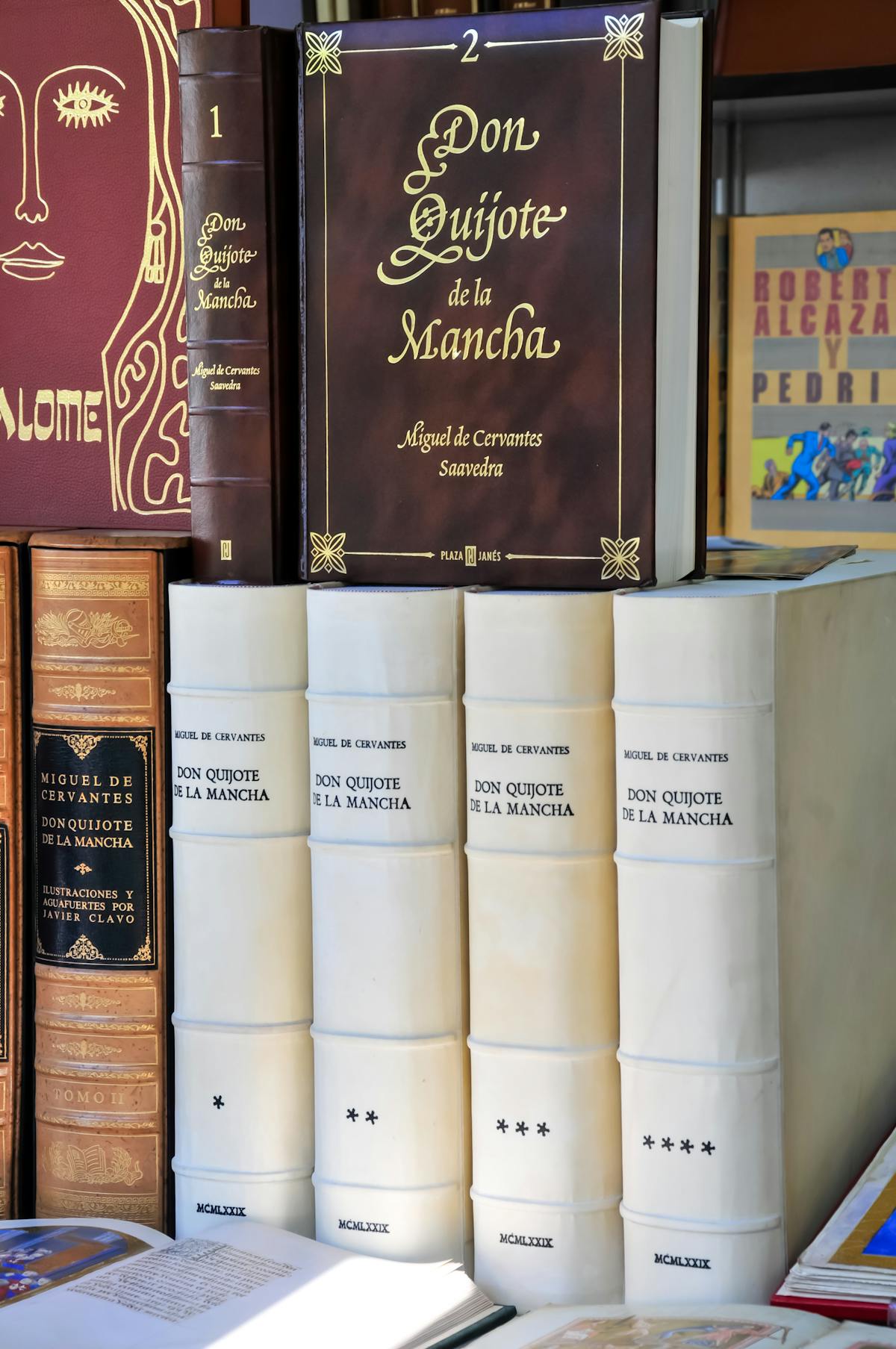
Most people know Miguel de Cervantes wrote Don Quijote de la Mancha (don key-HOH-tay deh lah MAN-cha). But here’s what surprises visitors: it was published in 1605, and it’s considered the very first modern novel ever written. Not just in Spanish. In any language.
The Real Academia Espanola and literary scholars worldwide credit Cervantes with inventing the novel as a literary form. Before him, long-form fiction didn’t use unreliable narrators, meta-commentary, or multi-layered character development. He did all of that over 400 years ago.
And it’s funny. Genuinely, laugh-out-loud funny. Don Quixote tilting at windmills isn’t just a metaphor. It’s a comedy scene that still lands today. The phrase luchar contra molinos de viento (loo-CHAR CON-trah moh-LEE-nos deh vee-EN-toh), meaning “to fight windmills,” is still used in everyday Spanish when someone is battling imaginary problems.
According to the Instituto Cervantes, Don Quixote has been translated into over 140 languages, making it the most translated work of fiction after the Bible. That’s not just literary history. That’s cultural dominance.
2. Spain Has Produced Five Nobel Laureates in Literature
This one catches people off guard. Spain punches well above its weight in Nobel Prizes for Literature. Five Spanish writers have taken home the award:
- Jose Echegaray (1904), a playwright who blended mathematics with drama
- Jacinto Benavente (1922), who reinvented Spanish theatre
- Juan Ramon Jimenez (1956), a poet whose work Platero y yo (plah-TEH-roh ee yoh, “Platero and I”) is still required reading in Spanish schools
- Vicente Aleixandre (1977), a surrealist poet of extraordinary imagination
- Camilo Jose Cela (1989), whose novel La familia de Pascual Duarte launched an entire literary movement
For language learners, Jimenez’s Platero y yo is pure gold. It’s written in simple, poetic prose about a man and his donkey. The vocabulary is accessible, the sentences are short, and the imagery is beautiful. If you’re at an intermediate level, this is your next read.
3. The Generacion del 27 Changed Everything
Walk into any bookshop in Spain and you’ll see their names everywhere. The Generacion del 27 (heh-neh-rah-see-ON del vayn-tee-see-EH-tay, Generation of ’27) was a group of poets and writers who came together in the late 1920s and absolutely transformed Spanish literature.
The group included Federico Garcia Lorca, Rafael Alberti, Pedro Salinas, Luis Cernuda, and others. They blended traditional Spanish forms like romances (roh-MAN-says, ballads) with avant-garde experimentation. The result was electric.
Here’s the real talk. What makes this group matter for language learners is that they wrote in a Spanish that bridges old and new. Their work uses classical vocabulary alongside modern expression. Reading them helps you understand both the Spain of yesterday and the Spain of today.
According to the Fundacion Federico Garcia Lorca, Lorca remains the most translated Spanish-language poet in history. His influence extends far beyond literature into music, theatre, and visual art.
4. Garcia Lorca’s Murder Made Him Immortal
Federico Garcia Lorca is Spain’s most famous literary figure after Cervantes. And his story is heartbreaking. He was murdered by Nationalist forces at the start of the Spanish Civil War in 1936. He was just thirty-eight years old.
But his death didn’t silence him. It amplified him. His plays, like Bodas de sangre (BOH-das deh SAN-gray, Blood Wedding) and La casa de Bernarda Alba (lah KAH-sah deh ber-NAR-dah AL-bah, The House of Bernarda Alba), are performed constantly in Spain and across the world.
Lorca wrote about passion, repression, rural life, and the clash between desire and social expectation. These themes still resonate in modern Spain. When Spaniards quote “Verde que te quiero verde” (VEHR-day keh teh kee-EH-roh VEHR-day, “Green, how I want you green”), everyone knows exactly where it comes from.
This is where the magic happens for language learners. Lorca’s poetry uses vivid, sensory language. Colours, textures, sounds. His vocabulary is surprisingly accessible, and his rhythms teach you the natural music of Spanish.
5. Spanish Idioms Come Straight from Literature
You know those idioms that make native speakers laugh when you use them correctly? Many of them were born in Spanish literature.
“Tirar la casa por la ventana” (tee-RAR lah KAH-sah por lah ven-TAH-nah) means “to throw the house out the window,” or to spare no expense. It originated from a literary tradition of describing lavish celebrations.
“Ponerle el cascabel al gato” (poh-NEHR-leh el kas-kah-BEL al GAH-toh) means “to bell the cat,” or to take on a dangerous task. This comes from a medieval fable that was popularised in Spanish literature.
And “estar en las nubes” (ehs-TAR en las NOO-behs), meaning “to be in the clouds” or daydreaming, has deep literary roots going back to Golden Age Spanish writing.
Learning these idioms through their literary origins doesn’t just help you memorise them. It gives you the cultural context that makes your Spanish sound genuinely natural. Try dropping one of these in conversation. Watch the reaction you get.
6. The Siglo de Oro Was Spain’s Literary Golden Age
Between roughly 1550 and 1700, Spain experienced its Siglo de Oro (SEE-gloh deh OH-roh, Golden Century). This period produced an astonishing concentration of literary genius that rivalled the Italian Renaissance.
Cervantes was the headline act. But he shared the stage with Lope de Vega, who wrote an estimated 1,500 plays (yes, really), and Francisco de Quevedo, whose satirical prose was so sharp it got him imprisoned.
Calderon de la Barca wrote La vida es sueno (lah VEE-dah ehs SWAY-nyoh, “Life Is a Dream”), a philosophical drama that asks whether reality is an illusion. It’s still performed in theatres across Spain every year.
For anyone interested in Spain’s cultural identity, the Siglo de Oro is essential context. It’s when Spain established itself as a literary superpower, and the language you’re learning today was shaped profoundly during this era.
7. Contemporary Spanish Authors Are Having a Moment
Spanish literature didn’t peak in the 1600s and go quiet. Right now, contemporary Spanish authors are winning international awards and selling millions of copies worldwide.
Carlos Ruiz Zafon’s La sombra del viento (lah SOM-brah del vee-EN-toh, “The Shadow of the Wind”) has sold over 15 million copies and is set in Barcelona’s mysterious Cemetery of Forgotten Books. It’s atmospheric, gripping, and written in accessible modern Spanish.
Arturo Perez-Reverte, a former war correspondent, writes historical thrillers that blend real Spanish history with page-turning fiction. His Captain Alatriste series brings seventeenth-century Madrid to life with historical accuracy and vivid street-level detail.
And Maria Duenas’s El tiempo entre costuras (el tee-EM-poh EN-tray kohs-TOO-rahs, “The Time In Between”) became one of Spain’s best-selling novels of the twenty-first century.
If you’re looking to improve your Spanish through reading, these contemporary authors use modern, natural language. They’re the perfect bridge between your textbook Spanish and real-world fluency.
8. Every Spanish City Has a Literary Soul
This is what genuinely surprises visitors when they arrive in Spain. Literature isn’t confined to libraries and classrooms. It’s woven into the streets.
Salamanca’s university, founded in 1218, is one of the oldest in Europe and was the intellectual home of writers like Fray Luis de Leon. Madrid’s Barrio de las Letras (Literary Quarter) is where Cervantes, Lope de Vega, and Quevedo actually lived and worked, sometimes feuding with each other on the same street.
Barcelona has its own literary tradition, blending Catalan and Castilian voices into something unique. Cadiz and southern Spain produced the passionate Andalusian literary voice that influenced Lorca and the cante jondo (KAN-tay HON-doh, deep song) tradition.
Pack your bags. When you visit these places, you’re walking through living literary history. The plaques on buildings aren’t just decorations. They’re markers of where the language you’re learning was forged.
Why This Matters for Your Spanish
Understanding Spanish literature isn’t just about being cultured (though that’s a nice bonus). It’s about understanding the DNA of the language itself.
When you know that quijotesco (key-hoh-TEHS-koh, quixotic) comes from Cervantes, or that Lorca’s poetry shaped how Spaniards express emotion, your comprehension deepens. You start to hear the literary echoes in everyday conversation and daily life.
The Spanish language carries its literary history in every sentence. And now you know where to look for it.
Now you understand this culture better. Use this knowledge to connect authentically. Start with one of the authors mentioned here. Read a page. Then another. Your Spanish, and your appreciation of Spain, will never be the same.
Share

audazrevista
Get the Inside Scoop